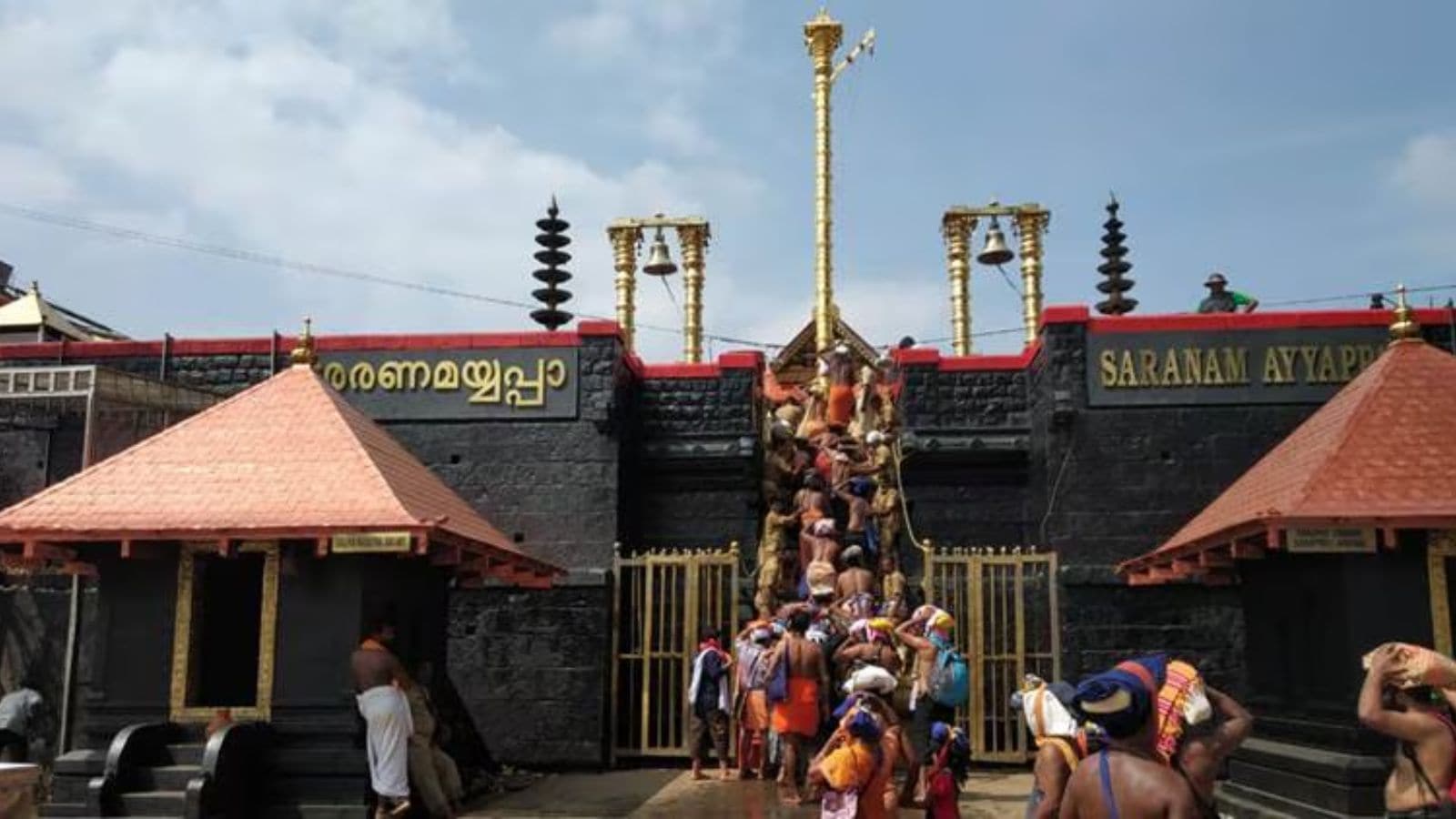
Sabarimala Reference Hearing in Supreme Court Today Live Updates: The Supreme Court will be hearing the Sabarimala case and will continue with the submission of parties.
The case concerns the discrimination against women in religious places, including the Sabarimala temple, and the scope of religious freedom under the Constitution.

Story continues below this ad
Previously, the apex court, on the seventh day of hearing, the Supreme Court said that Hindus must unite and unify, observing that temples cannot exclude others on denominational lines and that such exclusion would ultimately weaken the denomination itself.
Justice Nagarathna responded to senior advocate Dwivedi, who argued that a religious denomination is a closed and disciplined group protected under Article 26.
The apex court also said that, as far as social welfare and social reform are concerned, it is a very wide term. The apex court further added that the state is not a stranger and not an alien.
“The state represents the will of the people, and if the people want a certain social evil to be reformed, that power can be exercised,” the Chief Justice of India added.
Nine-judge bench: Chief Justice of India Surya Kant will preside over the bench, which will include Justices B V Nagarathna, M M Sundresh, Ahsanuddin Amanullah, Aravind Kumar, Augustine George Masih, Prasanna B Varale, R Mahadevan and Joymalya Bagchi.
Questions for consideration: There are seven questions for consideration before the court:
- What is the scope and ambit of the right to freedom of religion under Article 25 of the Constitution of India?
- What is the interplay between the rights of persons under Article 25 of the Constitution and the rights of religious denominations under Article 26?
- Whether the rights of a religious denomination under Article 26 of the Constitution are subject to other provisions of Part III of the Constitution, apart from public order, morality and health?
- What is the scope and extent of the word ‘morality’ under Articles 25 and 26 of the Constitution, and whether it is meant to include constitutional morality?
- What is the scope and extent of judicial review of a religious practice under Article 25 of the Constitution?
- What is the meaning of the expression “Sections of Hindus” occurring in Article 25 (2) (b) of the Constitution?
- Whether a person not belonging to a religious denomination or religious group can question a practice of that religious denomination or religious group by filing a PIL?