


Treasury Secretary Scott Bessent’s bond market interventions have generated a modest decline in yields along with a growing chorus of derision from those who think they won’t work over the long haul and could have dangerous repercussions.
Wall Street has been generally skeptical that Treasury has enough firepower to manage a fixed income market that saw some $4.7 trillion in debt issued in 2025 alone, a level that could be exceeded this year.
Bessent has proposed at least doubling the department’s buyback efforts for longer-dated debt issues. Treasury also intervened in currency markets in late July to support the yen so the Bank of Japan didn’t have to sell Treasurys, which likely would have raised yields on U.S. debt.
The efforts have pushed longer-dated yields off recent peaks that were the highest since before the global financial crisis in 2008, but market experts see the moves as doomed to fail, particularly if the U.S. does not address a fiscal situation in which total debt just eclipsed $40 trillion and the budget deficit is well on its way to top $2 trillion for 2026.
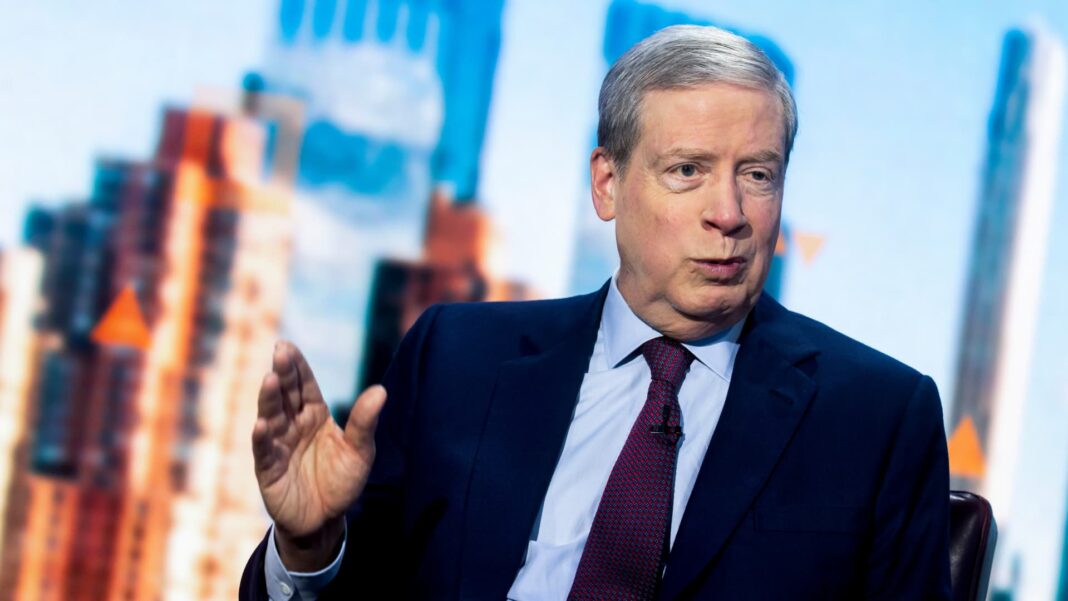
The latest critic to pile on: Stanley Druckenmiller, the prominent head of Duquesne Family Office and, perhaps more significantly, Bessent’s investing mentor. The two, along with George Soros, famously orchestrated the bet against the UK pound in the early 1990s.
Druckenmiller warned that without fiscal discipline, efforts to tamp down yields are dangerous both for markets — and the Treasury Department’s credibility.
“If the 30-year must trade at 5.5% to clear, that isn’t a crisis. It is an invoice,” he wrote in a Wall Street Journal op-ed piece. “Then do the only thing that durably lowers long-term yields: address the primary deficit.”
‘A subsidy to procrastination’
In the essay, titled “Let the Bond Market Speak,” Druckenmiller urged Bessent to abandon the buyback scheme announced Aug. 19 and allow the market the opportunity, free of the government’s hand, to set the proper price for government debt.
“Every basis point of artificial yield suppression is a subsidy to procrastination,” he wrote. “Once markets believe Treasury is defending a price, every rise in yields becomes a test of official resolve, and the operations must grow to survive the tests.”
“Governments defending prices against fundamentals always lose. The only variable is how much they spend before conceding,” he added.
The Treasury Department didn’t immediately respond to a CNBC request for comment on Druckenmiller’s column.
Bessent’s initial plan was to double Treasury’s usual $2 billion buybacks of off-the-run — or previously issued — securities, a program begun two years ago under his predecessor, Janet Yellen.
In addition, Treasury sources this week told CNBC that the department also could use its $935 billion general account to fund fixed income purchases.
Still, there was skepticism that even going that route would be enough. The general account is essentially Treasury’s checkbook which it uses to fund government operations and has been utilized during the multiple debt ceiling impasses in Congress, and as such has limits.
The recent moves have been compared to tools the Federal Reserve has used in the past to provide liquidity to debt markets and to hold rates in check. One, called Operation Twist, entails selling shorter-term debt and buying longer-term securities. The other, called quantitative easing, is when the Fed simply uses its own resources to buy up fixed income.
The difference: Unlike Treasury, the Fed isn’t constrained by a finite cash balance and can create reserves to finance its purchases.
The Fed’s position
“If the U.S. government is serious about yield suppression, the Federal Reserve must be involved,” Ryan Swift, chief strategist at BCA, said in a client note. “Unless the Federal Reserve deploys its balance sheet, any efforts by the U.S. government to suppress bond yields will fail. In fact, they could even be counterproductive if investors start to sniff out that the administration is getting desperate.”
But Swift thinks Fed Chairman Kevin Warsh will be reluctant to get involved. During his short time heading the central bank, Warsh has stressed the importance of allowing the market to employ price discovery.
“Market participants are learning to play the ball, not the referee — and market prices will continue to respond in the direction and magnitude they see fit,” Warsh said after the July Fed meeting.
Like some others, Swift doesn’t see anything terribly alarming about the recent rise in yields, saying the 30-year long bond is near “fundamental fair value” based on the Fed’s benchmark rate and expectations for the central bank, along with inflation, unemployment and market volatility.
The 30-year bond is only trading slightly above its 50-year average around 5.16%. The benchmark 10-year note as of Tuesday morning actually traded exactly in line with its 4.64% historical average going back to the early 1960s.
“The bond market’s message is straightforward: fiscal or monetary policy should be tighter,” wrote Nohshad Shah, head of fixed income sales for Europe, the Middle East and Africa at Citadel Securities. “Preventing Treasuries from clearing at lower prices does not eliminate that pressure … it merely shifts it elsewhere.”
The Fed will get its say next when it meets Sept. 15-16, with markets pricing in about a 40% chance of a rate hike, according to CME Group calculations. Warsh will speak Friday at the Fed’s Jackson Hole, Wyoming, symposium and could address the Treasury issue then.
Krishna Guha, head of economics and central bank policy at Evercore ISI, said the chairman could try to avoid getting involved.
“It will not be easy for Warsh to comment on yields in a way that is reassuring to markets while at the same time avoiding contradicting Bessent’s unconventional actions, and Warsh might just decide to take a pass,” Guha wrote.