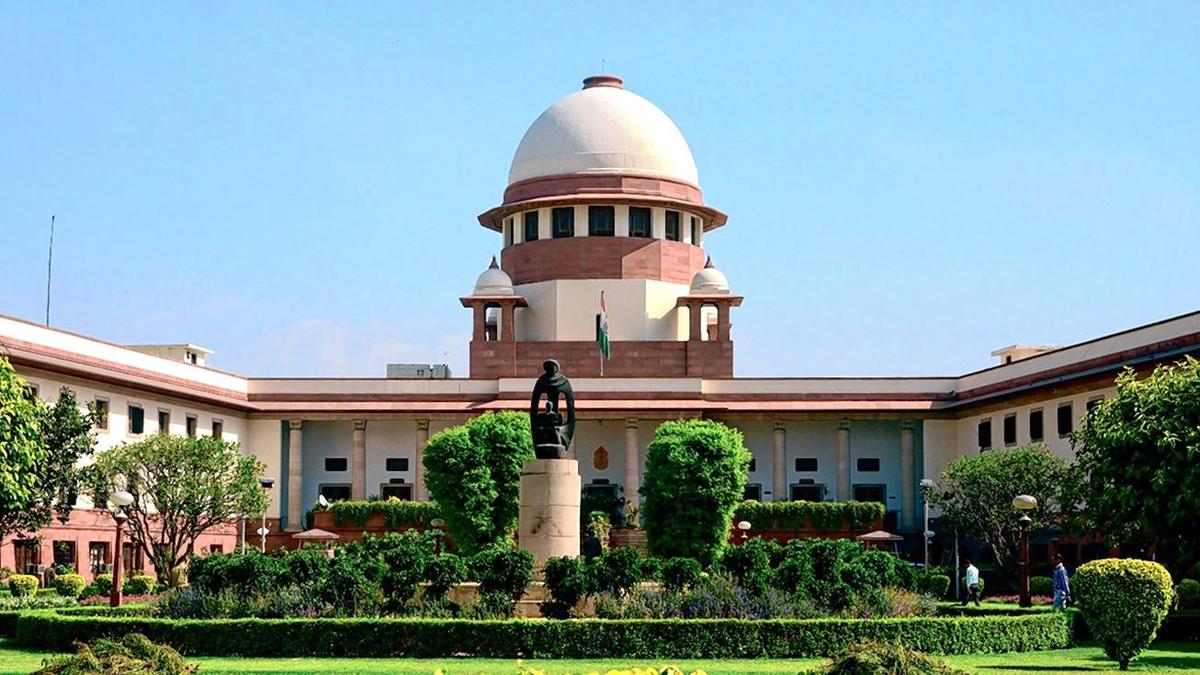
The Supreme Court on Tuesday (May 19, 2026) decided to examine a petition alleging that the State of Uttar Pradesh weaponised its police machinery to infiltrate and crush a legitimate labour agitation in Noida.
| Photo Credit: The Hindu
The Supreme Court on Tuesday (May 19, 2026) decided to examine a petition alleging that the State of Uttar Pradesh weaponised its police machinery to infiltrate and crush a legitimate labour agitation in Noida in order to shield corporate entities indulging in “rampant wage theft”.
A Bench headed by Justice B.V. Nagarathna issued notice to the Uttar Pradesh government, the State Police, and the Union government for their response on a petition filed by Shakambhari, whose 60-year-old activist husband, Satyam Verma, was arraigned in three different First Information Reports (FIRs), and slapped with the National Security Act (NSA) to frustrate his chances of getting bail.

“The State has weaponised its police machinery to arbitrarily crush a legitimate labour agitation in Noida, Uttar Pradesh, shielding corporate entities from liability for rampant wage theft, and maliciously criminalising the working class and civil society members through dragnet criminal proceedings,” advocates Shahrukh Alam and Paras Nath Singh submitted.
The petition said its cause in court was not just about the illegal arrest of Mr. Verma, but a “concerted deployment of arbitrary, dragnet and fabricated criminal proceedings to silence the labour class and its democratic allies”.
The previous hearing had witnessed the court remark that agitating workers should not be treated as “terrorists” by the State, and the government had a constitutional obligation to ensure a “living wage” to workers. Two protestors whisked away by the police were produced in court on May 19. Their families had moved the apex court seeking their whereabouts. The court directed their continuation in judicial custody.
Rather than fulfilling its role as a welfare state, the petition said the State had used its police officers to covertly become part of WhatsApp groups of the protestors.
The petition alleged there was “incontrovertible evidence” showing that “State police personnel acted as agent provocateurs to incite the very violence they are now prosecuting”. The entire prosecution was vitiated when the investigating agency itself acted as the “architect of the unrest”, the petition said. The court should have an enquiry headed by a retired or sitting judge into the role of the Uttar Pradesh Police, it said.
The plea said the protests, spanning April 10–13, were a spontaneous and peaceful demand by factory workers for a statutory minimum wage hike (sparked by a recent 21% increase in neighbouring Haryana), and an end to 12-hour shifts for a mere ₹11,000 per month.

“Extracting labour below the minimum wage constitutes forced labour under Article 23, as held by the Supreme Court. Instead of mediating the dispute effectively to bring real changes or prosecuting the employers for statutory violations, the State unleashed severe police brutality and criminalised the workers’ fundamental right to collective bargaining,” the petition, drawn by advocates Deeksha Dwivedi and Krithika D., said.
It said the State has also deliberately fragmented a single, continuous labour protest into 14 separate FIRs even though the allegations, geographical locations, and sequence of events across these FIRs were identical.
“This strategic multiplication subjects citizens to an endless cycle of arrests and remands,” the petition argued.
It said the FIRs should be probed by the Central Bureau of Investigation or a Special Investigation Team. The court listed the case next on July 21.
Published – May 19, 2026 07:12 pm IST