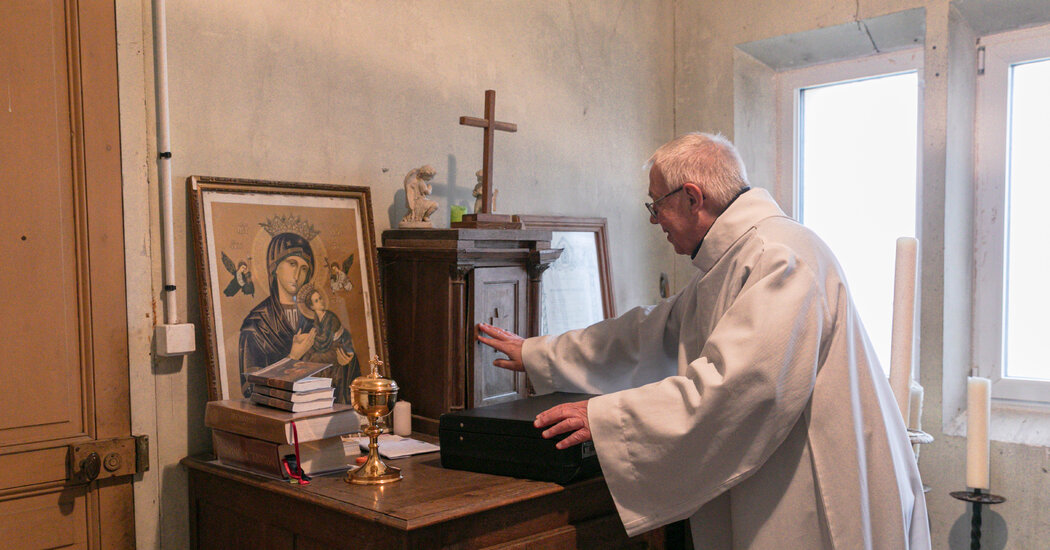
The villagers of Burelles transformed their church into a fortress several centuries ago, securing it with a defensive wall, a safe room and arrow slits to protect them from marauding troops.
All those defenses did nothing to stop a pair of thieves who ransacked the Roman Catholic church at some point before 7 p.m. one Sunday in late July.
They smashed the donation box, broke through the wooden sacristy door and grabbed communion plates, two vials used at baptisms and an ornate brass frame known as a monstrance, which is used to display bread during communion services.
That same day, the same thieves stole a chalice from the church in Vervins, the next village up the road in northern France. The next day, they struck the church in another nearby village, Marle, breaking open its tabernacle and stealing another elaborate chalice.
These were just three of the 29 churches across northern France that, a court ruled, were targeted last summer by Raphaël Hourdeaux, 35, and, in all but one case, his romantic partner, Tony Paupière, 30. The couple, who admitted to most of the accusations, hit up one church twice, five weeks apart.
Their extraordinary three-month spree heightened a wider sense of alarm in France that the country may be unable to protect its cultural heritage. It occurred during a rash of security lapses at museums, churches and galleries — in Paris, in other cities and in the remote countryside.
The most audacious heist came last October when another group of thieves breached the Louvre museum in daylight and made off with crown jewels worth more than $100 million.
In other cases last fall, thieves stole dishes worth $11 million from a museum in Limoges, the heart of French porcelain making. Then three men were found guilty of burgling some 40 churches in less than four months in the southwest of the country. And thieves broke into a small museum in southern France, stealing roughly 100 crosses.
In general, the thefts have provoked debates about sparse budgets and outdated security infrastructure. Burglaries at remote churches have also kicked at a wound in what the French call “deep France” — lonely parts of the countryside where villagers feel abandoned by society, the state and the times.
Just about every French village was built around a church. To this day, a village church represents history and identity, even as churchgoing rates have plummeted and many rarely open.
Burelles’ church, St. Martin, has become even more important to the village’s identity since the only inn shut down and the last cafe closed. Local volunteers tend to it, allowing the church to remain open longer than most, and the village hosts regular concerts there.
“The church is the heart of the village. It’s our pride,” said Damien Yverneau, the village mayor. “We have nothing left beyond that.”
He added, “People leave to do their studies and they don’t come back.”
To deter thefts from churches, the police increased patrols. Yet with some 800 churches in the surrounding region of Aisne, there is a limit to how much ground they can cover.
Most of these churches open sparingly, for funerals or baptisms. They typically hold regular Mass only a few times a year: A priest sometimes oversees as many as 50 churches.
That means days may have passed before some church burglaries were discovered, making it hard to figure out timing and track down witnesses, said Fanny Anor, the prefect of Aisne, who oversees the local police.
After a particularly busy Sunday in August, when four churches reported burglaries, a specialized investigative police unit took charge.
Using cellphone geolocation, they were able to track Mr. Hourdeaux and Mr. Paupière. The police began to surveil them.
The thieves’ method was often shockingly simple. After selecting a church to burgle, they typically looked online to check whether it was closed and then used a crow bar to break in, the prosecution said during the trial.
The couple planned weekend trips around the burglaries, in one case driving their 2008 Peugeot to a spa near a church they targeted, prosecutors said during the trial.
According to prosecutors, the duo sold some items to a local antique dealer, who was later convicted of handling stolen goods. Others they melted down and sold as metal to a buyer in Paris.
They kept many others.
Last October, 30 police officers mounted a raid on the couple’s home and found the men had used some stolen liturgical items as decorations and stashed others in cupboards and plastic bags.
Investigators sent photos of 46 recovered items to the mayors and priests who had reported the church thefts.
Because few churches kept detailed inventories, most could not prove that they were an item’s rightful owner, said Col. Stéphane Aurousseau, who oversaw the police investigation.
We attended the two men’s half-day trial in December, in a courthouse set inside a medieval palace in the nearby city of Laon.
A handful of mayors and priests drove in from across the region, hoping for answers. But the accused did not show up. Mr. Paupière sent a doctor’s note that said he was suffering from depression and suicidal thoughts.
“It shows total disrespect,” Mr. Yverneau, 56, the Burelles mayor, said of the men’s failure to appear. “You can do stupid things, but you have to take responsibility for them,” he said, adding: “It’s total cowardice.”
The two men sent a letter of apology, according to lawyers for both the defense and the victims, but some mayors and priests said they never saw it. During a brief telephone interview, Mr. Hourdeaux said media coverage of the case had ruined their lives and he doubted how valuable the items had been to the communities, since so few were able to identify them later. During a second telephone conversation, he threatened to sue for defamation if we published his name, which has been widely reported in France, or his earlier comments.
Caroline Biencourt, a representative for the local diocese, told the courtroom tearfully that the churches provided a rare place for reflection and beauty in areas far from museums. “Anyone can push open the door and be before a Rubens or a little statue that has received countless prayers,” she said. “These items belonged to everyone and we will never have them again.”
The two men were sentenced to three years’ prison, two suspended. They will begin serving their year’s detention in coming weeks at home with electronic monitoring, the chief prosecutor, Jean-Baptiste Miot, said in an email.
In September, a court is set to assess how much compensation should be awarded to the burgled communities.
Mr. Yverneau says Burelles is owed 7,700 euros, about $9,000, some of which he plans to spend on security cameras. But it tempers his hopes that neither he nor Jean-Michel Vignez, the head of the church volunteer association, could identify any of the village’s missing items among the 46 artifacts the police recovered.
“Will we ever be compensated for this?” Mr. Vignez asked. “It’s priceless. It’s entirely symbolic. I could go onto the internet and find that kind of item, but it will never be the one from Burelles.”
Some recovered items have been returned to churches that could prove their ownership. The police have given the rest to the local Catholic authorities, which will bless them and distribute them to the burgled churches in a “handover ceremony,” Ms. Biencourt said. The churches will not necessarily receive the items that they lost, but the hope is that the handover will offer some consolation.
In another nod to judicial karma, the court ruled to give the couple’s car to the police. Among other roles, it will be used to patrol villages like Burelles.
Ségolène Le Stradic contributed reporting from Paris.