
SC seeks Lok Sabha Speaker’s response on merger of Shiv Sena (UBT) MPs
Syllabus:
Preliminary Examination: Indian Polity and Governance-Constitution, Political System, Panchayati Raj, Public Policy, Rights Issues, etc.
Mains Examination: General Studies II: Parliament and State legislatures—structure, functioning, conduct of business, powers & privileges and issues arising out of these.
What’s the ongoing story: The Supreme Court Wednesday refused to order any interim stay on Lok Sabha Speaker Om Birla’s decision recognising the merger of six Shiv Sena (UBT) MPs with the Eknath Shinde-led Shiv Sena, but agreed to hear a challenge against the order after two weeks.
Key Points to Ponder:
• What was the issue exactly?
• What is the Shiv Sena case?
• What was the political setup in Maharashtra before the crisis?
• Why was there a political crisis in Maharashtra in 2022?
• What Supreme Court said exactly?
• What is the Anti-Defection Law?
• What is the ‘merger’ provision under the anti-defection law?
• What constitutes defection? Who is the deciding authority?
• What Supreme Court of India said in Kihoto Hollohan case (1993)?
• Is anti-defection law are subject to judicial review?
• Has the anti-defection law ensured the stability of governments?
• The 91st Amendment Act of 2003 made one change in the provisions of the Tenth Schedule. What was that?
• The disqualification of member on the ground of defection does not apply in the two exceptional cases. What is that ‘exception’?
Key Takeaways:
• A bench of Justices P S Narasimha and Alok Aradhe issued notice to Speaker Birla on the writ petition filed by Shiv Sena (UBT) leader Arvind Ganpat Sawant, challenging what he claimed was “ex facie unconstitutional, illegal, and perverse circular dated 18.07.2026…issued by the Joint Secretary, Lok Sabha Secretariat…” recognising the merger.
• Appearing for Sawant, Senior Advocate Devadutt Kamat pointed out that no disqualification petitions are pending before the Speaker, and as such, there was no occasion to pass the order approving the merger.
• Seeking an interim stay, Kamat contended that the merger order was signed by a joint secretary and not by the Speaker.
• Kamat said the matter “raises important questions of constitutional morality and propriety, goes to the heart of parliamentary democracy.” He contended that “the whole thing” was “orchestrated only for the purposes of Parliament session…”.
• In his petition, Sawant said the members of Parliament who merged with the rivals were given tickets by the Shiv Sena (UBT) and contested the Lok Sabha elections under the party’s name and symbol (the flaming torch). “The entire organisation, rank and file, and the leadership of the political party put immense effort and resources in campaigning for and securing their victory…from their respective constituencies,” he said.
• He added that the electorate in these constituencies reposed faith in Uddhav Thackeray’s ideology and leadership. “The Lok Sabha elections in 2024 were fought, inter alia, against the candidates sponsored by Shiv Sena, led by Eknath Shinde. The campaign, inter alia, revolved around the usurpation of the legacy of Balasaheb Thackeray by Eknath Shinde through illegal means and unconstitutionally orchestrated defections. The electorate of their constituencies, in electing…accepted and validated the campaign carried out by the SS (UBT) leadership and organisation”.
Do You Know:
• Two days before the Monsoon Session of Parliament began, Lok Sabha Speaker Om Birla on June 18 recognised the merger of six Sena (UBT) MPs with the Eknath Shinde-led Shiv Sena. The move has done more than just alter numbers in Parliament.
• By increasing the Shiv Sena’s strength in the Lok Sabha from seven to 13 MPs and reducing Sena (UBT)’s tally to three, the approval has strengthened Shinde’s position within the BJP-led NDA. This comes after the 2024 Maharashtra Assembly election established the BJP as the dominant partner in the ruling Mahayuti alliance in the state.
• The 91st Constitutional Amendment Act of 2003 did two things.
—First, it said that to avoid disqualification proceedings, at least two-thirds of the members of a party in a House had to switch over to another party, something that would be seen as a merger. If the numbers were below two-thirds of that party’s strength of the House, the shifting members would be liable to face disqualification proceedings.
—Second, the Act laid down that the total number of ministers in a government would not exceed 15% of the total strength of Lok Sabha or state Assembly, adding that the number would not be less than 12 in very small states.
• This Act strengthened the 10th Schedule as it stood after the 52nd Constitutional Amendment Act 1985 which inserted the above Schedule. However, the 10th Schedule in 1985 recognised a split of one-third of the members of a party in a House as legitimate. As this, too, was misused many times, the 91st Constitutional Amendment Act made switching over more difficult by deleting the one-third reference from the 10th Schedule, and mandating that two-thirds had to switch for a merger that would save them from disqualification proceedings.
• Article 102 (2) of the Constitution states ‘A person shall be disqualified for being a member of either House of Parliament if he is so disqualified under the Tenth Schedule.’ According to 191 (2), ‘A person shall be disqualified for being a member of the Legislative Assembly or Legislative Council of a State if he is so disqualified under the Tenth Schedule.’
Other Important Articles Covering the same topic:
📍Shiv Sena MPs merger: How Speaker Om Birla’s decision changes NDA politics
Previous year UPSC Prelims Question Covering similar theme:
1) Which one of the following Schedules of the Constitution of India contains provisions regarding anti-defection? (UPSC CSE, 2014)
(a) Second Schedule
(b) Fifth Schedule
(c) Eighth Schedule
(d) Tenth Schedule
Nation
With eye on China, Quad commits to strengthen ‘free & open Indo-Pacific’
Syllabus:
Preliminary Examination: Current events of national and international importance.
Mains Examination: General Studies II: Bilateral, regional and global groupings and agreements involving India and/or affecting India’s interests
What’s the ongoing story: With an eye on China’s assertive behaviour in the region, the foreign ministers of India, the United States, Australia, and Japan met in the Philippines on Wednesday, pledging to work together to keep the Indo‑Pacific region stable while stressing support for the Association of Southeast Asian Nations (ASEAN).
Key Points to Ponder:
• What is Quadrilateral Security Dialogue (QUAD)?
• Know the Principles and the motive behind the Quadrilateral Security Dialogue (QUAD)
• Who are member nations in Quadrilateral Security Dialogue (QUAD)?
• Who are observer nations in Quadrilateral Security Dialogue (QUAD)?
• Know the difference between observer and member countries
• What are U.S. interests in the Quad?
• What is Japan’s aims for the Quad?
• How is China’s relations with each of the Quad members?
• The QUAD in the Indo-Pacific region and its geopolitical implication-Know in detail
• How QUAD is Significant for India?
• What is ASEAN?
• What is India’s link with ASEAN?
• Map Work-ASEAN
• What is East Asia Summit?
Key Takeaways:
• The Quad (Quadrilateral Security Dialogue) foreign ministers’ meeting in Manila was attended by External Affairs Minister S Jaishankar, US Secretary of State Marco Rubio, Australian Foreign Minister Penny Wong, and Japanese Foreign Minister Toshimitsu Motegi.
• After the meeting, Jaishankar posted on X, “Glad to participate in the Quad Foreign Ministers Meeting in Manila. Reviewed the Indo-Pacific landscape and discussed recent developments. Followed up on the outcomes of the recent New Delhi meeting. Committed to a free and open Indo-Pacific with a recognition of ASEAN centrality.”
• Rubio said that the US, India, Australia, and Japan share a vision of a free and open Indo-Pacific “grounded in the rule of law, sovereignty, and territorial integrity”. “The Quad remains a priority, and we will meet again later this year,” he added.
• In its joint statement, the Quad foreign ministers reaffirmed their commitment to a free and open Indo Pacific and expressed strong support for ASEAN’s “unity and centrality”. “We are deeply invested in the region’s success and in cooperating with ASEAN and its member states,” it added.
Do You Know:
• Quadrilateral Security Dialogue (Quad) is the informal strategic dialogue between India, USA, Japan and Australia. The four nations share a common objective to ensure and support a “free, open and prosperous” Indo-Pacific region.
• Jaishankar is visiting Manila for the foreign minister-level meetings under the ASEAN framework, including the ASEAN-India, East Asia Summit, and ASEAN Regional Forum meetings.
• The Ministry of External Affairs said that the visit “underscores India’s deepening engagement with ASEAN under the Act East Policy and reaffirms our strong commitment to further strengthening the ASEAN-India Comprehensive Strategic Partnership. It is of particular significance that 2026 has been designated as the ASEAN-India Year of Maritime Cooperation”.
• ASEAN is central to India’s Act East policy, which focuses on the extended neighbourhood in the Asia-Pacific region. The policy was originally conceived as an economic initiative but has gained political, strategic and cultural dimensions including the establishment of institutional mechanisms for dialogue and cooperation.
India is part of the ASEAN Plus Six grouping, which includes China, Japan, South Korea, New Zealand and Australia as well.
• In 2010, a Free Trade Agreement was also signed and entered into force between India and ASEAN. While India was part of negotiations to join the Regional Comprehensive Economic Partnership (RCEP) in 2020, it ultimately decided not to do so. However, in the past eight years, trade has grown in terms of value, barring the pandemic years of 2020 and 2021.
Other Important Articles Covering the same topic:
📍Quad launches new maritime, critical mineral initiatives at Delhi Summit
Previous year UPSC Prelims Question Covering similar theme:
2) With reference to the ‘Trans-Pacific Partnership’, consider the following statements: (UPSC CSE, 2016)
1. It is an agreement among all the Pacific Rim countries except China and Russia.
2. It is a strategic alliance for the purpose of maritime security only.
Which of the statements given above is/are correct?
(a) 1 only
(b) 2 only
(c) Both 1 and 2
(d) Neither 1 nor 2
India using too many powerful antibiotics meant for specific infections: Study
Syllabus:
Preliminary Examination: Current events of national and international importance.
Mains Examination: General Studies II: Issues relating to development and management of Social Sector/Services relating to Health, Education, Human Resources.
What’s the ongoing story: India may be using too many powerful ‘watch’ antibiotics — medicines that should be reserved for specific infections when simpler antibiotics are unlikely to work — while underusing both first-line ‘access’ antibiotics and last-resort ‘reserve’ drugs, according to a major international study published in The Lancet Public Health.
Key Points to Ponder:
• What exactly the Lancet Public Health said?
• What is antimicrobial resistance (AMR) and why is it a cause for concern?
• Why is AMR increasing?
• What are the most common resistant pathogens in India?
• Antimicrobial Resistance is emerging as one of the greatest public health challenges of the 21st century-know in detail
• Know the role of governments in promoting rational antibiotic use.
• How misuse of antibiotics accelerates antimicrobial resistance?
• Why antimicrobial resistance requires global cooperation?
Key Takeaways:
• Researchers estimate that India’s antibiotic use is skewed towards broader-spectrum drugs, suggesting that some patients are being exposed unnecessarily to ‘watch’ antibiotics even as others may not receive the most appropriate medicines for their infections. The findings come from the first global framework that estimates how much of each category of antibiotics countries actually need based on their infection burden and antimicrobial resistance patterns.
• The India findings are part of a wider global picture that shows nearly three-fourths of countries are using more antibiotics overall than needed, while almost every country is overusing the antibiotics that contribute most to antimicrobial resistance. At the same time, millions of people worldwide still lack access to the antibiotics they need.
Do You Know:
• The World Health Organisation (WHO) groups antibiotics into three categories:
—Access: First-choice antibiotics for common infections that have a lower risk of driving resistance.
—Watch: Broad-spectrum antibiotics that should be used only for specific infections because they carry a higher risk of promoting antimicrobial resistance.
—Reserve: Last-resort antibiotics reserved for treating multidrug-resistant infections.
• The study estimates India would ideally require 14.7 defined daily doses (DID) of antibiotics per 1,000 people per day, comprising 7.8 DID of ‘access’ antibiotics, 6 DID of ‘watch’ antibiotics and 0.99 DID of ‘reserve’ antibiotics. Actual consumption, however, paints a different picture. India currently uses 18.3 DID overall, comprising 4.5 DID of ‘access’ antibiotics, 9.3 DID of ‘watch’ antibiotics and 0.19 DID of ‘reserve’ antibiotics. Only 27 per cent of antibiotic use currently comes from the ‘access category,’ against an estimated requirement of 52.3 per cent.
• Researchers analysed antibiotic use across 186 countries and territories, representing 99.8 per cent of the world’s population. They found that 72 per cent of countries used more antibiotics overall than estimated to be necessary. Ninety-nine per cent prescribed excessive quantities of antibiotics that contribute most to antimicrobial resistance. Sixty per cent continued to use antibiotics the World Health Organisation (WHO) considers should no longer be routinely prescribed.
• The study estimates that around 43 billion antibiotic treatment days were needed globally in 2019 — roughly one antibiotic course per person per year — to appropriately treat bacterial infections. It also found that 77 per cent of global antibiotic use should come from the WHO’s access group, suggesting the United Nations target of 70 per cent ‘access’ antibiotic use by 2030 is reasonable.
Other Important Articles Covering the same topic:
Previous year UPSC Prelims Question Covering similar theme:
3) Which of the following are the reasons for the occurrence of multi-drug resistance in microbial pathogens in India? (UPSC CSE, 2019)
1. Genetic predisposition of some people
2. Taking incorrect doses of antibiotics to cure diseases
3. Using antibiotics in livestock farming
4. Multiple chronic diseases in some people
Select the correct answer using the code given below.
(a) 1 and 2
(b) 2 and 3 only
(c) 1, 3 and 4
(d) 2, 3 and 4
Indian pharma sees little immediate threat in Trump’s 200% tariff plan
Syllabus:
Preliminary Examination: Current events of national and international importance.
Mains Examination: General Studies II: Bilateral, regional and global groupings and agreements involving India and/or affecting India’s interests.
What’s the ongoing story: While the Indian generic pharmaceutical industry so far remained unscathed during several rounds of US tariff announcements, US President Donal Trump on Wednesday in a Truth Social post said tariffs on economical generics from India will be raised to 200% over the next three years.
Key Points to Ponder:
• What exactly US President Donal Trump said on tariffs on economical generics from India?
• What are generic medicines?
• What is the status of generic medicines in India?
• What is difference between generic medicine and normal medicine?
• India’s pharmaceutical industry is at the global forefront as “the Pharmacy of the World”, ranking third in terms of pharmaceutical production by volume-know more in detail
• How tariffs on economical generics will affect India’s pharmaceutical industry and its production?
• What are the opportunities and challenges before India’s pharmaceutical industry?
• Protectionism is re-emerging in global trade—Examine its implications for India’s pharmaceutical industry
Key Takeaways:
• The president said that the current zero percent tariff would continue for a period of another two years, which is a source of relief for the Indian industry, considering US is the biggest foreign market for them. Experts, however, emphasised that unstable tariffs have led to the Indian pharmaceutical industry moving away from the US in the last year.
• Trump in his truth social post on Wednesday early morning (India time) said: “Effective August 1st, 2026, all Generic Drugs being brought into the United States will continue to have a TARIFF of ZERO PERCENT for a two year period of time, after which the TARIFF will be raised to 100% for a one year period of time, and 200% thereafter.”
• Former DG of Pharmaceutical Export Promotion Council of India (Pharmexcil) Udaya Bhaskar said: “Even during his previous presidency, at the time of Covid-19, he had said that he would support domestic manufacturing of generics and active pharmaceutical ingredients, but nobody really came forward. It is not easy for a US company to set up generic manufacturing and even if they do it is likely to cost at least 30% more than the Indian generics. Moreover, US companies would not be able to produce the kind of volumes Indian companies do.”
• And, this shift to other destinations is apparent. There has been a 7.9% decline in exports to NAFTA region in 2025-26, largely driven by exports shifting from the US, according to yet-to-be released trade data provided by sources.
Do You Know:
• The United States accounted for 34.5% of India’s total pharmaceutical export in FY2025, valued at USD 10.5 billion. To compare, the next biggest buyer was the United Kingdom that accounted for 3% of the country’s total pharmaceutical export, valued at just USD 913.9 million, according to data from Pharmexcil.
• Any increase in tariffs on Indian generic medicines will adversely affect the US citizens. Indian companies supply 47% of all generic medicines prescribed in the US. More than half of the prescriptions of five of the ten most common therapy areas — hypertension, mental health, medicines to control lipids, medicines for nervous system disorders, and anti-ulcer drugs — were supplied by India too, according to data from IQVIA. Medicines from Indian companies provided $ 219 billion in savings to the US healthcare system in 2022, it said.
• Indian therapies have been key to expanded access in the US. An example cited by ORF said that the number of Americans, who were able to afford the cholesterol lowering drug Rosuvastatin after an Indian generic entered the US market, doubled between 2016 and 2022.
Other Important Articles Covering the same topic:
📍Regulatory prudence will be key
Previous year UPSC Mains Question Covering similar theme:
📍How is the Government of India protecting traditional knowledge of medicine from patenting by pharmaceutical companies? (2019)
Economy
India & key WTO members remain at loggerhead on plurilateral pacts
Syllabus:
Preliminary Examination: Current events of national and international importance.
Mains Examination: General Studies II: Bilateral, regional and global groupings and agreements involving India and/or affecting India’s interests.
What’s the ongoing story: As India remains among the few large countries opposing plurilateral agreements on e-commerce and investments, a group of countries across developed and developing nations blocks such as EU, Canada, UK, Cambodia and Gambia on Tuesday questioned its approach, alleging that New Delhi was holding up the WTO reform process, The Indian Express has learnt.
Key Points to Ponder:
• What is a plural lateral agreement?
• What is the difference between multilateral and plurilateral agreement?
• What is the Investment Facilitation for Development (IFD) Agreement?
• What is the WTO agreement in Marrakesh?
• What was the takeaway from the 14th ministerial conference of the World Trade Organization?
• Why many countries are alleging that the New Delhi was holding up the WTO reform process?
• What did the 1994 Marrakesh Agreement do?
• Why India is opposing the Investment Facilitation for Development (IFD) Agreement?
• Why India’s stand is against plurilateral pacts?
Key Takeaways:
• Questions were raised during India’s trade policy review, which happens once every five years. An Indian delegation led by Commerce Secretary Rajesh Agrawal presented details on India’s reforms to WTO members.
• Plurilateral agreements, which are negotiated and implemented by exclusive groups rather than by all members, have begun being featured prominently in various World Trade Organisation (WTO) reform-related proposals.
• India, meanwhile, maintained that plurilateral agreements were against the core WTO principle of consensus-based decision-making process. Major trading powers like the US, EU and China are backing plurilateral negotiations, where benefits and responsibilities would be limited to the signatory members.
• While Canada most prominently opposed India’s stand on plurilateral agreements, the EU said that over the past decade, India has benefited significantly from its integration into global trade and has increased its share in world trade.
• “The EU encourages India to rethink its approach to plurilateral agreements and to consider them as an opportunity to shape the agenda of the WTO and to modernise the organisation rather than as a threat to multilateralism — which they are not, if we build them properly,” the EU representative said in the internal meeting as per sources.
• While Gambia and Costa Rica asked India to withdraw its opposition to the Investment Facilitation for Development (IFD) agreement, several countries asked India to join negotiations for plurilateral agreements such as the fossil fuels subsidy reform initiative, dialogue on plastics pollution and environmentally sustainable plastics trade.
• As many as 129 members have supported IFD, but India remains the primary holdout, citing systemic risks and stating that investment is not a core trade issue.
Do You Know:
• In a July 9 letter to the WTO, India questioned the “legal basis” under which the WTO DG was assigned the role to act as the “depositary of the Agreement on Electronic Commerce (ECA)”.
• “The Marrakesh Agreement requires consensus to add an Agreement to Annex 4. Consensus was not reached on two occasions. In the absence of consensus, we would like to understand the institutional basis on which the Interim Arrangements are operating,” India said.
As per the WTO, 66 members, covering approximately 70% of global trade, have adopted a pathway to bring into force the WTO Agreement on Electronic Commerce through “interim arrangements” while continuing to work towards its incorporation into the WTO legal framework of rules.
• The E-Commerce Agreement prohibits the imposition of customs duties on electronic transmissions between a person of one party and a person of another party.
• During the 14th Ministerial Conference (MC14) in Yaoundé, Cameroon, India was the only country opposing IFD’s incorporation into the WTO framework as an Annex 4 Agreement.
Annex 4 of the Marrakesh Agreement contains the Plurilateral Trade Agreements, and unlike multilateral agreements that bind all 164 WTO member states, these agreements are only legally binding on the specific members that voluntarily sign and accept them Commerce Minister Piyush Goyal in March said that incorporation of the IFD agreement risks eroding the functional limits of the WTO and undermining its foundational principles.
Other Important Articles Covering the same topic:
📍India is opposing a China-led WTO investment deal, even at the risk of isolation. Here’s why
Previous year UPSC Prelims Question Covering similar theme:
4) The terms ‘Agreement on Agriculture’, ‘Agreement on the Application of Sanitary and Phyto-sanitary Measures’ and ‘Peace Clause’ appear in the news frequently in the context of affairs of the (UPSC CSE, 2015)
(a) Food and Agriculture Organization
(b) United Nations Framework Conference on Climate Change
(c) World Trade Organization
(d) United Nations Environment Programme
‘Foreign inflow revival reflects confidence in Indian economy
Syllabus:
Preliminary Examination: Current events of national and international importance.
Mains Examination: General Studies III: Indian Economy and issues relating to planning, mobilization, of resources, growth, development and employment.
What’s the ongoing story: The recovery in foreign investment in recent months reflects renewed confidence in the economy, despite the ongoing conflict in West Asia and elevated crude oil prices, said a study by the Reserve Bank of India (RBI). Foreign portfolio outflows have tapered off and the markets saw inflows in the recent past.
Key Points to Ponder:
• What is foreign investment?
• What is foreign direct Investment?
• What is foreign indirect Investments?
• What Reserve Bank of India (RBI) said?
• How foreign investment contributes to the Balance of Payments?
• What are the factors influencing foreign investment inflows into India?
• How policy reforms attracted foreign investment into India?
• What is the role of the RBI in maintaining external sector stability?
Key Takeaways:
• “The global economy is dealing with an uncertain economic environment, supply chain disruptions and fragmented trading relationships,” the RBI said in its State of the Economy article published in its monthly bulletin. According to the article authored by RBI researchers, India has sustained its growth momentum despite global headwinds, with economic activity remaining steady through June and indicators pointing to resilience in the industrial and services sectors.
• The recent operationalisation of the India-UK Comprehensive Economic and Trade Agreement, along with progress on other bilateral trade agreements, is expected to further support this momentum. “External vulnerability indicators also remained sound. Recovery of foreign investments in recent months shows a revival of confidence in the economy,” the article said.
Do You Know:
• The RBI sold a net $6.1 billion in the foreign exchange market in May, data released on Wednesday showed, following a sharp rise in oil prices amid the Iran war that pushed the rupee to an all-time low. The central bank purchased $22.2 billion and sold $28.3 billion during the month. In April, it had sold a net $8.9 billion, according to the RBI’s July bulletin.
• The country’s foreign exchange reserves remain comfortable, providing cover for more than 10 months of goods imports and around 88.5% of the external debt outstanding as at end-March 2026.
• The high-frequency indicators for June suggest sustained economic activity. Industrial growth remained strong, and the services sector showed resilience, the RBI article said. Aggregate Demand High-frequency indicators reflected strong economic activity in June. E-way bills continued to achieve double-digit growth, it said.
Other Important Articles Covering the same topic:
📍Hormuz crisis impact: India’s crude imports surge 60% in April-June; net oil, gas imports up 45%
Previous year UPSC Prelims Question Covering similar theme:
5) Both Foreign Direct Investment (FDI) and Foreign Institutional Investor (FII) are related to investment in a country. Which one of the following statements best represents an important difference between the two? (UPSC CSE, 2011)
(a) FII helps bring better management skills and technology, while FDI only brings in capital
(b) FII helps in increasing capital availability in general, while FDI only targets specific sectors
(c) FDI flows only into the secondary market, while FII targets primary market.
(d) FII is considered to be more stable than FDI
The World
Saudis reach deal with US that could let them enrich uranium
Syllabus:
Preliminary Examination: Current events of national and international importance.
Mains Examination: General Studies II: Bilateral, regional and global groupings and agreements involving India and/or affecting India’s interests.
What’s the ongoing story: The US and Saudi Arabia have signed a controversial deal that could potentially enable the latter to kickstart a civilian nuclear programme. Heralded as a “peaceful nuclear cooperation agreement”, the 30-year pact effectively seeks to offer “great access for American companies in the Saudi nuclear energy program”, according to the US Department of Energy (DoE).
Key Points to Ponder:
• The US and Saudi Arabia and civilian nuclear programme-what you know so far?
• What are the key takeaways from the US and Saudi Arabia controversial deal that could potentially enable the latter to kickstart a civilian nuclear programme?
• Why the US-Saudi nuclear deal raises questions?
• What is Section 123 of the U.S. Atomic Energy Act and why does it matter?
• What is Uranium?
• What are the different isotopes of uranium?
• What is uranium enrichment?
• How is uranium mined?
• How is uranium made into nuclear fuel?
• What is reprocessed uranium (RepU)?
• What are the process of uranium enrichment and discuss its strategic significance in the global nuclear order?
• What is the role of enriched uranium in civilian nuclear energy generation?
• Know the geopolitics surrounding uranium enrichment technologies.
Key Takeaways:
• Text from the deal is yet to be made public. First reported by the Wall Street Journal and the New York Times, the deal could allow Saudi Arabia to enrich uranium — which is primarily to be used as fuel for power plants, but can also be diverted to make nuclear bombs. The US DoE noted that along with the co-operation deal, a “bilateral safeguards agreement” was also signed. However, some US media reports said the guardrails are not strong enough.
• While the fine print on the nuclear agreement is awaited, two major issues need flagging.
—One, this could potentially set off an arms race in a volatile region where there is already a nuclear power (Israel) and one that is on the cusp of getting there (Iran).
—Two, this deal has to be ratified by the US Congress, which could be an uphill task despite Trump’s Republican Party currently controlling both the upper and lower chambers of the US legislature.
Do You Know:
• US President Donald Trump has formally approved a landmark nuclear agreement with Saudi Arabia that will give the kingdom a civilian nuclear programme, The Wall Street Journal reported, citing US officials.
• The nuclear deal traces back to Crown Prince Mohammed bin Salman’s Washington visit on November 18–19, 2025, when he and Trump signed a series of agreements at the White House. The centerpiece was the US-Saudi Strategic Defense Agreement, under which Trump designated Saudi Arabia a “major non-NATO ally” and approved a defense package including future F-35 fighter jet deliveries and nearly 300 American tanks.
• The agreement includes a provision letting Saudi Arabia enrich uranium and potentially reprocess plutonium on its own soil something one source called unprecedented for this kind of deal. Enrichment and reprocessing are the two primary pathways to producing bomb-grade material, and most nations instead import already-enriched uranium from suppliers such as the US or Russia rather than producing it domestically.
Other Important Articles Covering the same topic:
📍What’s in Trump’s approved 30-year nuclear deal with Saudi Arabia
Previous year UPSC Prelims Question Covering similar theme:
6) What is/are the consequence/consequences of a country becoming the member of the ‘Nuclear Suppliers Group’? (UPSC CSE, 2018)
1. It will have access to the latest and most efficient nuclear technologies.
2. It automatically becomes a member of “The Treaty on the Non-Proliferation of Nuclear Weapons (NPT)”.
Which of the statements given above is/are correct?
(a) 1 only
(b) 2 only
(c) Both 1 and 2
(d) Neither 1 nor 2
Explained
Can police hide identity in protests? The procedure and practice
Syllabus:
Preliminary Examination: Current events of national and international importance.
Mains Examination: General Studies II: Indian Constitution—historical underpinnings, evolution, features, amendments, significant provisions and basic structure.
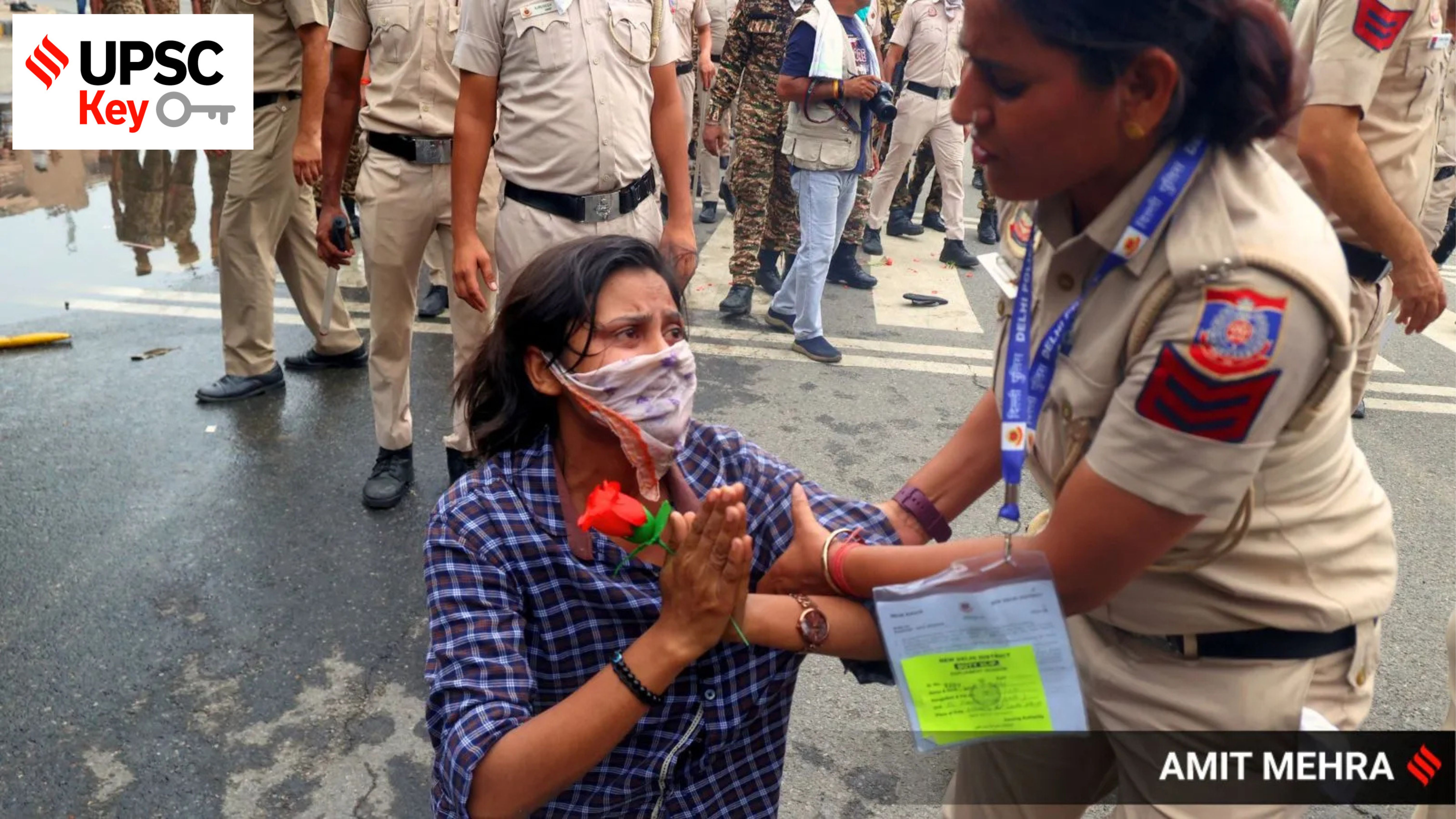
What’s the ongoing story: When tens of thousands of protesters attempted to march from New Delhi’s Jantar Mantar to Parliament on Monday (July 20) as part of the “Sansad Chalo” protest, videos emerged showing Delhi Police and Rapid Action Force (RAF) personnel in civilian clothes or without visible nameplates. This raised questions over police identification and accountability.
Key Points to Ponder:
• What happened during the CJP protests?
• Is it legal to hide identification?
• What is the importance of visible police identification in strengthening public confidence?
• In the DK Basu vs State of West Bengal (1997), the Supreme Court laid down detailed safeguards for arrests and detention, including the requirement that the arresting officer bear clear and visible identification-Know in detail
• Which Articles from the Constitution are closely associated with police action during public protests?
• Examine the constitutional balance between the right to protest and the State’s responsibility to maintain public order.
• Know the need for police reforms in India in light of increasing concerns regarding accountability and transparency.
• What are the challenges faced by police while maintaining law and order during protests?
• Connect the dots the between policing and human rights in a constitutional democracy.
• How can police maintain neutrality during political demonstrations?
Key Takeaways:
• The protests organised by the Cockroach Janata Party (CJP) over the NEET paper leak and demanding the resignation of Education Minister Dharmendra Pradhan swelled beyond expectations on Monday. As the crowd marched towards Parliament, the police lathi charged it, leading to violent clashes between police and protestors. Both the police and members of the crowd sustained injuries. One protester is still in the ICU.
• While certain operations, such as those involving intelligence collection, genuinely require hiding identification or even impersonation, regular policing is guided by statutory procedure and judicial guidelines.
Do You Know:
• The maintenance of public order and tranquillity is governed by Chapter XI of the BNSS (Sections 148 to 160, formerly Chapter X of the CrPC). While it does not specifically state whether policemen or armed forces personnel are required to identify themselves during a law and order situation, sources said, the very fact that the law allows only a magistrate or a “police officer” to disperse a crowd implies identification. The argument is that an unidentified crowd of armed men cannot legally demand a public gathering to disperse. “If a police officer is unidentifiable, his command to disperse cannot carry statutory weight,” said a criminal lawyer practising in Delhi.
• In DK Basu vs State of West Bengal (1997), the Supreme Court laid down detailed safeguards for arrests and detention, including the requirement that the arresting officer bear clear and visible identification. Although the ruling addressed arrests rather than crowd control, lawyers say it reflects the broader judicial emphasis on the identifiability of police officers while exercising coercive powers.
• In August 2025, the Andhra Pradesh High Court, while hearing a petition filed by YSRCP MLA Nallapareddy Prasanna Kumar Reddy, questioned how citizens were expected to recognise plainclothes personnel as police officers while they were performing official duties. Reddy, who was facing charges of obstructing a police officer in discharging his duty, had argued that the police officers were not in uniform.
• Police officers argue that visible identification can expose individual personnel to prolonged litigation, online harassment and even threats to their families.
Other Important Articles Covering the same topic:
📍Staging a protest: Rights, restrictions in the law
Previous year UPSC Prelims Question Covering similar theme:
7) Under which of the following Articles of the Constitution of India, has the Supreme Court of India placed the Right to Privacy? (UPSC CSE, 2021)
(a) Article 15
(b) Article 16
(c) Article 19
(d) Article 21
|
PRELIMS ANSWER KEY |
|
1.(d) 2.(d) 3.(b) 4.(c) 5.(b) 6.(a) 7.(d) |
For any queries and feedback, contact priya.shukla@indianexpress.com
Subscribe to our UPSC newsletter. Stay updated with the latest UPSC articles by joining our Telegram channel – IndianExpress UPSC Hub, and follow us on Instagram and X.