Preliminary Examination: Current events of national and international importance.
Mains Examination: General Studies II: Important aspects of governance, transparency and accountability, e-governance applications, models, successes, limitations, and potential; citizens charters, transparency & accountability and institutional and other measures.
What’s the ongoing story: Official panel disbursed National Sports Development Fund money to build, refurbish sports facilities in showpiece New Delhi residential complex for bureaucrats. Funds also went to Civil Services Officers’ Institute.
Key Points to Ponder:
• What is National Sports Development Fund (NSDF)?
• What are the top sports missions funded by NSDF?
• The NSDF fund comes under which ministry?
• What is the primary objective of the National Sports Development Fund?
• Diversion of funds from National Sports Development Fund (NSDF) to private consumption-how ethical it is?
• What is sports governance?
• Do you believe that sports governance shouldn’t involve bureaucracy?
Story continues below this ad
• What is the prevailing framework of sports governance in India?
• What are the rules and regulations governing good governance in the field of sports?
• What are the concerns pertaining to sports governance in India?
• What strategies can be employed to tackle the challenges associated with sports governance?
Story continues below this ad
• Why transparency and accountability is required in sports governance for improving India’s sporting ecosystem?
Key Takeaways:
• An investigation by The Indian Express has found that the money used to build, or refurbish, these world-class facilities meant for some of the country’s top bureaucrats came from the National Sports Development Fund (NSDF) — a fund created to train athletes and build sporting infrastructure, and allotted by a committee of bureaucrats.
• The Indian Express investigated five years of official records and data obtained under the RTI Act, and interviewed current and former Government officials, to find that while a chunk of these funds was indeed allotted for sports facilities, a slice of the pie was also channelled into civil services institutions and the Delhi colony for bureaucrats.
• Among the well-known sports missions funded by NSDF: the flagship Target Olympic Podium Scheme (TOPS) for elite athletes. Among the not-so-well-known beneficiaries: facilities for senior bureaucrats, two RSS-linked institutions in Rajasthan and Chhattisgarh, and even some lesser-known cricket boards in Asia and the Caribbean.
Story continues below this ad
• The NSDF fund is governed by a 12-member Council under the Union Sports Minister. But the body that clears grant proposals is a six-member committee of officials under the Sports Ministry — from the same system that benefits from the grants.
Do You Know
• The NSDF was established in 1998 under the Charitable Endowments Act, 1890. It is funded by donations from the public and private sectors, Non-Resident Indians (NRIs), and charities or non-profits, with contributions from the Government.
• The fund is governed by a Council headed by the Union Sports Minister — currently Mansukh Mandaviya. The Council also includes top
office-bearers from Public Sector Undertakings, which are the biggest donors to the NSDF, industry bodies like FICCI and CII, private-sector representatives and sports ministry officials.
• Its current members are: Sports Minister Mansukh Mandaviya (Chairperson); MoS Sports Raksha Khadse (Vice-Chairperson); Sports Secretary Hari Ranjan Rao, who is also Sports Authority of India (SAI) DG; Additional Secretary and financial advisor to sports ministry; representatives from Railway Sports Promotion Board and All India Police Sports Control Board; CMDs or MDs of The New India Assurance Co Ltd, Indian Oil Corporation Ltd, ONGC Foundation, REC Foundation and NTPC Foundation; and, a Sports Ministry joint secretary.
Story continues below this ad
• Day-to-day operations and grant approvals are handled by a six-member executive committee chaired by the Sports Secretary. Its other members are SAI Director General, SAI Executive Director (Teams), Financial Advisor to Sports Ministry, a Sports Ministry Joint Secretary and a Sports Ministry Director.
Other Important Articles Covering the same topic:
📍Parliament panel’s red flag: Fund is shrinking, use it responsibly
📍Fund managed by 12-member council, grants okayed by panel of six officials
Previous year UPSC Prelims Question Covering similar theme:
1) Consider the following pairs with regard to sports awards: (UPSC CSE, 2023)
Story continues below this ad
| 1. | Major Dhyan Chand Khel Ratna Award | For the most spectacular and outstanding performance by a sportsperson over period of last four years |
| 2. | Arjuna Award | For the lifetime achievement by sportsperson |
| 3. | Dronacharya Award | To honour eminent coaches who have successfully trained sportspersons or teams |
| 4. | Rashtriya Khel Protsahan Puraskar | To recognize the contribution made by sportspersons even after their retirement |
How many of the above pairs are correctly matched?
(a) Only one
(b) Only two
(c) Only three
(d) All four
Previous year UPSC Mains Question Covering similar theme:
📍”The ‘Code of Conduct’ and ‘Code of Ethics’ are the sources of guidance in public administration. There is code of conduct already in operation, whereas code of ethics is not yet put in place. Suggest a suitable model for code of ethics to maintain integrity, probity and transparency in governance. (UPSC CSE, GS4, 2024)
📍What do you understand by the terms ‘governance’, ‘good governance’ and ‘ethical governance’? (UPSC CSE, GS4, 2016)
📍Initially Civil Services in India were designed to achieve the goals of neutrality and effectiveness, which seems to be lacking in the present context. Do you agree with the view that drastic reforms are required in Civil Services. Comment. (UPSC CSE, GS1, 2017)
📍An athlete participates in the Olympics for personal triumph and nation’s glory; victors are showered with cash incentives by various agencies, on their return. Discuss the merit of state sponsored talent hunt and its cultivation as against the rationale of a reward mechanism as encouragement. (UPSC CSE, GS1, 2014)
NATION
India, UAE may sign pacts on strategic petroleum reserves, LPG during PM visit
Mains Examination: General Studies II: Bilateral, regional and global groupings and agreements involving India and/or affecting India’s interests.
Story continues below this ad
What’s the ongoing story: At a time when the Indian government is adopting austerity measures amid the looming energy crisis due to the closure of the Strait of Hormuz, India and the UAE are likely to sign two pacts in the areas of “LPG and Strategic Petroleum Reserves” during Prime Minister Narendra Modi’s visit on May 15
Key Points to Ponder:
• India and the UAE-know the bilateral relation
• What are the present areas of cooperation and development between India-UAE?
• Why is UAE is important for India?
• Map Work– UAE
• What are Strategic Petroleum Reserves (SPR)?
• What are the implications of partially empty SPRs?
• Know India’s energy security challenges in the context of ongoing war.
• What are the challenges in expanding Strategic Petroleum Reserves (SPR) capacity?
• Map Work– Strategic Petroleum Reserves in India
• Which countries have strategic oil reserves?
Key Takeaways:
Story continues below this ad
• During the PM’s visit to the UAE, sources stated that one of the key areas of focus will be “energy security”. “Two important MoUs in the areas of LPG and Strategic Petroleum Reserves are likely to be concluded during this visit,” the source said.
• Underlining that the UAE has been an important partner in India’s energy security, sources said that “last year, the UAE was the 4th largest source of crude oil meeting nearly 11% of our requirement”. UAE is the largest source of LPG for India, meeting nearly 40 per cent of India’s requirement, sources said. Sources said that through the current turmoil, the UAE has remained one of India’s most reliable energy partners and continues to be so. “With long term supply agreements in place, India’s energy security has been bolstered. Enhancing energy cooperation will be a key agenda of the visit,” the source said.
• According to the current itinerary, PM Modi will visit the UAE on May 15 to meet the UAE President Sheikh Mohamed bin Zayed Al Nahyan (MBZ). The PM has visited UAE seven times since 2014 and MBZ has visited India five times, last in January this year, accompanied by the next generation of UAE leaders — projected as marking the resilience of the bilateral relationship which has strengthened across generations. At a time when India is navigating security and economic challenges amidst the instability in West Asia, the UAE, which has a comprehensive strategic partnership with India and is home to a large Indian diaspora, has been included in the Prime Minister’s itinerary at the last minute.
Do You Know
• The UAE has been the first country to partner with India in the “Strategic Petroleum Reserves”. In 2018, Indian Strategic Petroleum Reserves Limited (ISPRL) and Abu Dhabi National Oil Company entered into an agreement for the UAE to store over 5 million barrels of crude oil reserves in ISPRL’s facility in Mangaluru. ISPRL is a specialised Indian public sector company under the Petroleum ministry, responsible for maintaining the nation’s strategic crude oil reserves, holding 5.33 million metric tonnes of crude across three underground facilities to ensure energy security against supply disruptions.
• The UAE has been one of the main targets of Iranian missile attacks ever since the start of the West Asia war on February 28. Tehran accuses the emirates of providing safe space to American military bases, facilities and personnel. And amid the crisis in the Strait of Hormuz, which has impacted energy supplies to much of the world, including India, the UAE announced it was exiting the OPEC, the bloc of oil-producing exporters headed by Saudi Arabia.
• The concept of dedicated strategic reserves was first mooted in 1973, after the first oil crisis. Western strategic reserves have been tapped during the first Gulf War (1991), after Hurricane Katrina (2005), and in 2022 after global oil prices surged in the wake of Russia’s invasion of Ukraine.
• International Energy Agency (IEA) members have now decided to release 400 million barrels of oil from their emergency in view of the current supply disruption and oil price surge caused by the West Asia war. Countries like the US, China, and Japan maintain massive strategic petroleum reserves.
• In India, the ISPRL is a special purpose vehicle floated as a wholly-owned subsidiary of the Oil Industry Development Board for building and managing the strategic crude storage. Currently, it has three underground caverns at Visakhapatnam (1.33 million tonnes), Mangaluru (1.5 million tonnes), and Padur (2.5 million tonnes).
Other Important Articles Covering the same topic:
📍Of India’s 5.33 mn tonne of strategic oil reserve capacity, 36% is empty
Previous year UPSC Prelims Question Covering similar theme:
2) Which of the following is not a member of ‘Gulf Cooperation Council’? (UPSC CSE, 2016)
(a) Iran
(b) Saudi Arabia
(c) Oman
(d) Kuwait
Previous year UPSC main Question Covering similar theme:
📍The question of India’s Energy Security constitutes the most important part of India’s economic progress. Analyse India’s energy policy cooperation with West Asian countries. (UPSC CSE, GS2, 2017)
EXPLAINED
How farm exports have grown despite US tariffs
Preliminary Examination: Economic and Social Development
Mains Examination: General Studies III: Transport and marketing of agricultural produce and issues and related constraints
What’s the ongoing story: India’s farm exports grew 2.3% year-on-year in 2025-26 (April-March), despite the steep tariffs imposed by the United States President Donald Trump’s administration.
Key Points to Ponder:
• What items are there in “agricultural exports”?
• India’s agricultural exports in 2025–26-what data says?
• The Trump administration’s tariffs on Indian goods primarily affected which sectors?
• Why agricultural exports are important for India?
• Marine products, Buffalo meat and Coffee exports in India’s agricultural export basket-Know in brief
• What is export diversification?
• How tariffs imposed by major economies affect developing countries’ exports?
• What factors contributed to the resilience of India’s farm exports despite higher US tariffs?
Key Takeaways:
• Farm produce shipments were valued at $53.1 billion during the last financial year, up from $52 billion in 2024-25 and marginally below the all-time-high of $53.2 billion for 2022-23.
• The 2.3% agri exports growth was higher than the 0.9% increase in India’s overall merchandise exports, from $437.7 billion in 2024-25 to $441.7 billion in 2025-26. The latter figure was also down from the $451.1 billion peak of 2022-23.
• The Trump tariffs – 25% effective from August 7 and raised to 50% from August 27, before being cut to 18% on February 10 and 10% on February 24 – hurt key Indian exports to the US.
• That included pharmaceuticals (from $9.7 billion in 2024-25 to $8.6 billion in 2025-26) readymade garments ($5.3 billion to $4.8 billion), gold and jewellery ($4.2 billion to $2.8 billion) and leather products ($948.5 million to $887.7 million). Among agri items, the significant drops were of marine products (from $2.7 billion to $2.3 billion), spices ($654.7 million to $578.7 million), basmati rice ($337.1 million to $285.9 million) and processed fruits & vegetables ($274.3 million to $214 million).
• Indian marine products exporters more than offset the impact of the Trump tariffs on their largest market – US, especially for frozen shrimps and prawns – by augmenting shipments to other destinations.
Do You Know
• India’s agri imports, unlike exports, are confined to a few commodities
• The value of marine products exports grew by 13.9% to over $8.4 billion. Indian marine products exporters more than offset the impact of the Trump tariffs on their largest market – US, especially for frozen shrimps and prawns – by augmenting shipments to other destinations.
• Having a diversified market also helped buffalo meat exports, whose value soared by 25.6% to $5.1 billion in 2025-26, surpassing the previous record of $4.8 billion in 2014-15.
• The US Department of Agriculture has projected global ending stocks for 2025-26 at 20.1 million bags, marking a fifth consecutive year of decline. Brazil and Vietnam, the world’s biggest producers of arabica and robusta varieties respectively, have had subpar crops. India mostly exports robusta beans and powder used in instant coffee and espresso blends, with Italy, Germany, Russia, UAE and Belgium being major markets.
India’s fresh fruits & vegetables exports largely comprise grapes, pomegranates, mangoes, bananas, oranges, onion, tomato, potato, green chilli and mixed vegetables. The important markets are UAE, Iraq, Netherlands, Bangladesh and Malaysia.
Exports of other big-ticket items – rice (both basmati and non-basmati), spices, tobacco and processed fruits & vegetables – were down compared to their all-time-highs in 2024-25.
Other Important Articles Covering the same topic:
📍How India’s farm exports are faring better than overall goods exports
Previous year UPSC Prelims Question Covering similar theme:
3) Consider the following statements: (UPSC CSE, 2024)
Statement-I: India does not import apples from the United States of America.
Statement-II: In India, the law prohibits the import of Genetically Modified food without the approval of the competent authority.
Which one of the following is correct in respect of the above statements?
(a) Both Statement-I and Statement-II are correct and Statement-II explains Statement-I
(b) Both Statement-I and Statement-II are correct, but Statement-II does not explain Statement-I
(c) Statement-I is correct, but Statement-II is incorrect
(d) Statement-I is incorrect, but Statement-II is correct
4) With reference to the international trade of India at present, which of the following statements is/are correct? (UPSC CSE, 2020)
1. India’s merchandise exports are less than its merchandise imports.
2. India’s imports of iron and steel, chemicals, fertilisers and machinery have decreased in recent years.
3. India’s exports of services are more than its imports of services.
4. India suffers from an overall trade/current account deficit.
Select the correct answer using the code given below:
(a) 1 and 2 only
(b) 2 and 4 only
(c) 3 only
(d) 1, 3 and 4 only
Why NEET is more prone to paper leaks than JEE
Preliminary Examination: Current events of national and international importance.
Mains Examination: General Studies II: Issues relating to development and management of Social Sector/Services relating to Health, Education, Human Resources.
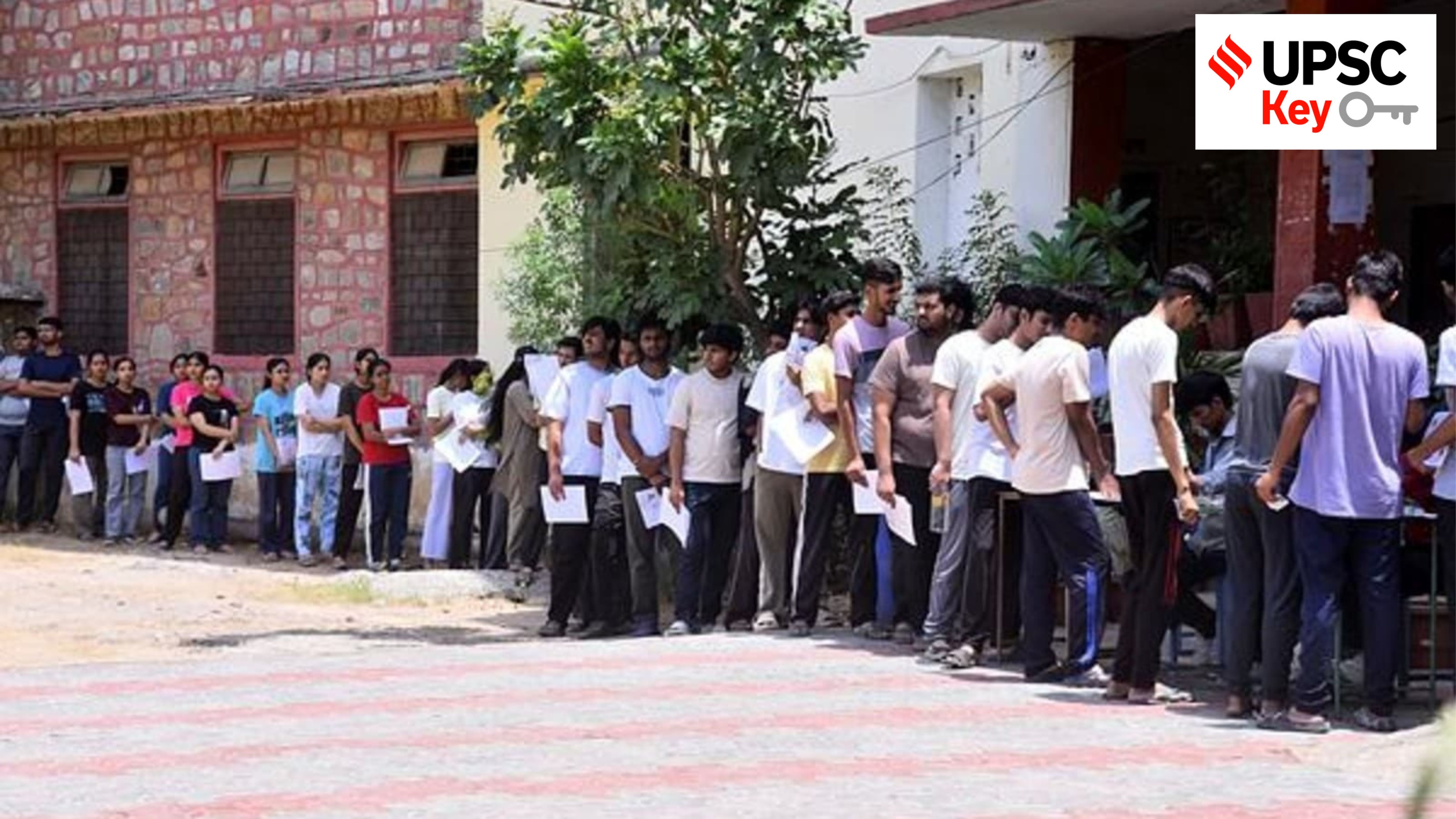
What’s the ongoing story: Multiple people have been detained in Maharashtra and Rajasthan amid a widening probe into the NEET-UG paper leak, which led to the exam being cancelled.
Key Points to Ponder:
• What is National Eligibility cum Entrance Test (NEET)?
• What is JEE?
• What is National Testing Agency (NTA)?
• Why NEET is considered a “high-stakes” examination?
• The paper leak in competitive examinations-know its impact on administration, students, and parents.
• Why are large-scale pen-and-paper examinations vulnerable to paper leaks?
• Discuss the importance of examination integrity in ensuring fairness and equality of opportunity.
• “Technology can strengthen examination systems, but accountability and institutional ethics remain equally important”-discuss
• What were the recommendations of committee led by former ISRO Chairman K Radhakrishnan for exam reforms?
Key Takeaways:
• The NEET-UG examination, which is the only way for students to get admission to a medical course, remains extremely competitive. Nearly 23 lakh students appear for around 1 lakh medical seats across the country. The competition is fierce, considering students strive to get into government colleges that account for around half the medical seats. These colleges have a much lower fee structure than private medical colleges, where the fee may run into crores.
• Another aspect, experts pointed out, was the coaching industry. With the coaching industry mushrooming across the country, there is an incentive for classes to pay to get question papers. “After all, the admissions for their next batch would depend on how many of their students get through the admission process,” said an expert, on condition of anonymity.
• After the 2024 NEET-UG irregularities, admission of 14 students was cancelled, candidature of 215 was put on hold, 26 students already enrolled in medical courses who participated in the malpractice were suspended, and several were debarred from taking the test for two to three years.
Do You Know
• The National Eligibility cum Entrance Test (Undergraduate) is a pen-and-paper entrance exam for admission to undergraduate medical institutions. It is conducted by the National Testing Agency (NTA) in 13 languages — English, Hindi, Assamese, Bengali, Gujarati, Kannada, Malayalam, Marathi, Odia, Punjabi, Tamil, Telugu and Urdu.
• The Joint Entrance Examination (Main), meanwhile, is for admission to Centrally Funded Technical Institutes. Students who clear JEE (Main) are then eligible to sit for JEE (Advanced), for admission to IITs.
• While JEE (Main) is conducted by the NTA, with some involvement of the IITs, JEE (Advanced) is handled completely by the IITs.
• The two main differences in how the exams are held is that more students take NEET than JEE, and JEE is a computer-based exam instead of pen and paper. An online test removes several vulnerabilities from the examination process, like the possibility of question paper leak during transport and distribution to the centres. It also reduces the involvement of outside agencies, such as a printing press or a transport company.
Other Important Articles Covering the same topic:
📍 After last leak, ex-ISRO chief’s panel had called for reforms; all gather dust
Previous year UPSC Prelims Question Covering similar theme:
5) Which of the following provisions of the Constitution does India have a bearing on Education? (UPSC CSE, 2012)
1. Directive Principles of State Policy
2. Rural and Urban Local Bodies
3. Fifth Schedule
4. Sixth Schedule
5. Seventh Schedule
Select the correct answer using the codes given below:
(a) 1 and 2 only
(b) 3, 4 and 5 only
(c) 1, 2 and 5 only
(d) 1, 2, 3, 4 and 5
Previous year UPSC main Question Covering similar theme:
📍How have digital initiatives in India contributed to the functioning of the education system in the country? Elaborate on your answer. (UPSC CSE, GS2, 2020)
THE IDEAS PAGE
At India-Nordic summit, turn historical sambandh into future partnership
Main Examination: General Studies II: Bilateral, regional and global groupings and agreements involving India and/or affecting India’s interests.
What’s the ongoing story: Shashi Tharoor Writes- At a time when the turbulence of the Trumpian era has unsettled global norms, India and the Nordic countries share a common interest in defending world order and stability.
Key Points to Ponder:
• India-Nordic Summit-Know the background
• Nordic countries-know in detail
• Which countries are Nordic countries?
• Map Work– Nordic countries
• Why they are called Nordic?
• Nordic Countries are constantly among the happiest in the world-why?
• What were the highlights of the first India-Nordic Summit?
• Why Nordic Countries are important for India?
• Why India is important for Nordic Countries?
Key Takeaways:
Shashi Tharoor Writes-
• As Prime Minister Narendra Modi arrives in Oslo next week for the forthcoming India-Nordic Summit, the visit carries the weight of a long-overdue diplomatic milestone. This is the first time an Indian Prime Minister has set foot on Norwegian soil since Indira Gandhi’s visit in June 1983 — a gap of over four decades that belies the profound, if often understated, historical and contemporary linkages between our two nations.
• The Nordic region, often viewed through the prism of its exceptional social models and tranquil landscapes, has emerged as a powerhouse of specialised technology and capital. For an India navigating a volatile global order, the “Nordic Way” offers more than just inspiration; it offers concrete solutions to the most pressing challenges of our century. The Oslo Summit represents a pivot from traditional diplomacy toward a “Green Strategic Partnership” that spans the blue economy, renewable energy, and deep-tech innovation.
• Today, the opportunity exists to replicate this model of localised excellence by deepening cooperation with selected Indian states — such as Kerala, Tamil Nadu, and Gujarat — that possess the coastal or industrial infrastructure to absorb Norwegian expertise. The economic logic for a deeper engagement is now irrefutable, especially following the landmark EFTA-India Trade and Economic Partnership Agreement (TEPA). This agreement is a game-changer, committing EFTA countries — including Norway — to a target of $100 billion in investments in India over the next 15 years.
Do You Know
• The 3rd India-Nordic Summit is scheduled for May 19, 2026, in Oslo, Norway, hosted by Prime Minister Jonas Gahr Støre. Prime Minister Narendra Modi will join leaders from Denmark, Finland, Iceland, and Sweden to focus on strengthening partnerships in clean energy, technology, innovation, the blue economy, and Arctic cooperation.
• Norway occupies a unique position in this constellation. It was among the first countries to recognise an independent India in 1947, and our developmental journey has been quietly intertwined ever since. In the early 1950s, Norway launched its first-ever international development programme in Kerala. This pioneering initiative, focused on modernising fisheries and introducing motorised boats, was a hallmark of the Nehru-Gerhardsen era. It is a testament to the project’s success that its legacy lives on through the National Institute of Fisheries Post Harvest Technology and Training (NIFPHATT), remaining a vital part of Kerala’s coastal economy.
• According to Britannica, Nordic countries, group of countries in northern Europe consisting of Denmark, Finland, Iceland, Norway, and Sweden. The designation includes the Faroe Islands and Greenland, which are autonomous island regions of Denmark, and the Åland Islands, an autonomous island region of Finland.
The term is sometimes used interchangeably with Scandinavia, a peninsular region of northern Europe that serves as the geographic core of the Nordic countries. Scandinavia is typically defined more restrictively, however, and refers primarily to Norway, Sweden, and Denmark
Other Important Articles Covering the same topic:
📍Modi may travel to Europe in May for India-Nordic Summit
India’s Africa policy needs continuity
Main Examination: General Studies II: Bilateral, regional and global groupings and agreements involving India and/or affecting India’s interests.
What’s the ongoing story: Gurjit Singh Writes- The fourth India-Africa Forum Summit (IAFS IV), scheduled for May 28-31, is a moment to rethink how India engages Africa in a rapidly changing world, and find ways to keep the relationship anchored in, but not dependent on, a summit.
Key Points to Ponder:
• India and Africa-know the historical and present similarities
• What is India-Africa Forum Summit (IAFS)
• Can you mark on map the African regions which are strategically important for India due to maritime trade routes?
• ‘Maritime security and the Indian Ocean are central to India’s Africa strategy’-can you attest the given statement with some examples?
• Why Africa is becoming increasingly important in global geopolitics?
• India’s Africa policy emphasises what?
• What is the significance of Africa in India’s foreign policy?
• What are the strengths and limitations of India’s current engagement with Africa?
Key Takeaways:
• IAFS IV was due in 2020, but the COVID-19 pandemic, followed by a period of intense global diplomatic churn, resulted in a prolonged pause. Africa’s global partnerships have deepened and diversified since. The resumption must therefore contend with a far more competitive landscape. The European Union and Japan held summits with African partners in 2025, South Korea convened ministerial consultations. Germany hosted discussions on the Sudan crisis in April, and France is advancing its own outreach this month.
• China continues its structured engagement through the Forum on China-Africa Cooperation. In this crowded field, India retains significant goodwill, but the challenge is to convert historical affinity into sustained, structured, and visible engagement. The appointment of Mahamoud Ali Youssouf as chairperson of the African Union Commission (AUC) signals an openness to reinvigorating partnerships.
• The five-year summit cycle remains useful at the leadership level, but in the absence of a robust inter-summit mechanism, engagement defaults to bilateral interactions. India’s earlier three-tier Africa framework, structured across bilateral, regional, and pan-African levels, remains conceptually sound. While implementation challenges limited its impact, abandoning it altogether would be erroneous. India could reinstate the practice of inviting the AUC chairperson for annual visits; the AU’s annually rotating Country Chair could be hosted for a state visit. This would deepen political engagement and ensure geographic diversity, bringing to the fore countries that may otherwise remain outside India’s bilateral radar.
Do You Know
•According to MEA website, India will host the fourth India-Africa Forum Summit (IAFS-IV) on 31 May 2026 in New Delhi in collaboration with the African Union Commission. The IAFS-IV will bring together leaders from across the African continent, the African Union Commission, along with representatives from regional organizations to strengthen the enduring India-Africa partnership, and layout a roadmap for further expanding cooperation across diverse sectors.
• The India-Africa Forum Summit is an important platform for fostering dialogue with African countries and the AU Commission and advancing mutually beneficial collaboration, guided by the principles of mutual respect, equality, solidarity and shared prosperity. The last edition of the India-Africa Forum Summit resulted in a major expansion of Indian development assistance and capacity building programs for Africa.
Other Important Articles Covering the same topic:
Previous year UPSC Prelims Question Covering similar theme:
6) In which one of the following groups are all the four countries members of G20? (UPSC CSE, 2020)
(a) Argentina, Mexico, South Africa and Turkey
(b) Australia, Canada, Malaysia and New Zealand
(c) Brazil, Iran, Saudi Arabia and Vietnam
(d) Indonesia, Japan, Singapore and South Korea
Previous year UPSC main Question Covering similar theme:
📍The long-sustained image of India as a leader of the oppressed and marginalised nations has disappeared on account of its new found role in the emerging global order.’ Elaborate. (UPSC CSE, GS2, 2019)
📍The anti-colonial struggles in West Africa were led by the new elite of Western educated Africans. Examine. (UPSC CSE, GS1, 2016)
📍Africa was chopped into States artificially created by accidents of European competition.” Analyze. (UPSC CSE, GS1, 2013)
THE WORLD
Trump in Beijing for key summit with Xi amid Gulf and trade wars
Main Examination: General Studies II: Bilateral, regional and global groupings and agreements involving India and/or affecting India’s interests.
What’s the ongoing story: US President Donald Trump on Wednesday landed in Beijing for bilateral meeting with Chinese President Xi Jinping and discuss trade, Iran war and America’s arms sales to Taiwan among other issues.
Key Points to Ponder:
• The recent summit between Donald Trump and Xi Jinping-what are the key highlights?
• What are the major and minor dimensions of contemporary US–China relations?
• Why does Taiwan remain one of the most sensitive issues in US–China relations?
• Why India is relevant in the context of Trump–Xi discussions?
• What factors make India strategically important to both the US and China?
Key Takeaways:
• The summit is scheduled to begin on Thursday, when the two leaders will hold bilateral talks and a formal banquet. Trump is accompanied by CEOs of tech firms including, Elon Musk, Nvidia’s Jensen Huang among others.
• Before departing the White House on Tuesday, Trump talked about US-China relations and told reporters, “We’re two superpowers. We’re the strongest nation on Earth in terms of military. China’s considered second.”
• Trump, who is scheduled to remain in China for the next two days, will have meetings including a grand reception at The Great Hall of the People, a tour of UNESCO heritage site Temple of Heaven and a state banquet.
• Talks between Trump and Jinping would cover range of issues, including Iran war, US’ arms sales to Taiwan among others. Beijing had earlier objected to Washington’s sales of arms to Taiwan, which is a democratically governed island claimed by China.
Do You Know
• When Beijing officially confirmed the date of the state visit earlier this week, it marked the first visit to China from a sitting
American president since Trump’s 2017 visit during his last term. This summit would be Trump’s seventh in-person meeting with President Xi Jinping.
• Trump is taking a big business delegation of over a dozen American CEOs with him, with Apple’s Tim Cook, Boeing chief Kelly Ortberg and Tesla’s Elon Musk part of his business entourage. The one conspicuous absence was Nvidia’s Jensen Huang, who did not figure on an initial list of executives provided by the White House earlier this week. Reuters, however, reported on Wednesday, quoting two sources familiar with the matter, that Huang will join Trump’s delegation to China. Nvidia’s new H200 chips, which have not yet been sold to China, remain a point of contention between the two sides.
• The choice of the people on the delegation is being read as harbingers of what the administration in Washington, D.C., is pivoting towards in terms of its business priorities with China. “Trump visiting China and meeting with Xi Jinping this week, surrounded by businessmen instead of China hawks, is incredibly helpful in yielding positive outcomes from discussions,” according to Brian Tycangco, analyst at Baltimore-based Stansberry Research.
• In the Iran conflict, China is now wading in as a mediator, alongside Pakistan. Iranian Foreign Minister Abbas Araghchi’s visit to Beijing last week seemed to signal the clout China wields in West Asia.
Other Important Articles Covering the same topic:
📍Trump-Xi summit: Iran war, trade, Taiwan and AI on the agenda, why China has the upper hand
Previous year UPSC main Question Covering similar theme:
📍The West is fostering India as an alternative to reduce dependence on China’s supply chain and strategically to counter China’s political and economic dominance.’ Explain this statement with examples. (UPSC CSE, GS2, 2024)
|
PRELIMS ANSWER KEY |
|
1.(b) 2.(a) 3.(d) 4.(d) 5.(d) 6.(a) |
For any queries and feedback, contact priya.shukla@indianexpress.com
Subscribe to our UPSC newsletter. Stay updated with the latest UPSC articles by joining our Telegram channel – IndianExpress UPSC Hub, and follow us on Instagram and X.