

Over four weeks after the United States and Israel attacked Iran in a bid to degrade its nuclear program and set in motion a regime change, there is still little certainty around its endgame.
At various points, US President Donald Trump has claimed that victory was imminent and that the US had largely met its objectives, even as Iran has pushed back at statements about the two countries engaging in negotiations.
An Axios report said earlier this week that the White House and the Pentagon are now “considering sending at least 10,000 additional combat troops to the Middle East in the coming days, according to a senior U.S. defense official.” The Wall Street Journal first reported the story, citing Department of Defense officials. More reinforcements, “including several fighter jet squadrons and thousands of troops, are expected to arrive in the Middle East in the coming days and weeks,” Axios said.
While there is no confirmation of putting boots on the ground, Iranian Parliament Speaker Mohammad Bagher Ghalibaf has said that Iranian forces are “waiting for American soldiers to enter on the ground so they can rain fire upon them”.
If a ground invasion were to happen, how might it unfold? Are such plans likely to enjoy support among the US public? And finally, what does it say about the state of war? We explain.
4 main options before the US
Axios cited officials and sources offering four “final blow” options Trump could choose from:
1. “Invading or blockading Kharg Island, Iran’s main oil export hub.”
Story continues below this ad
Kharg Island is a narrow, 8-km-long rocky outcrop that sits deep inside the Persian Gulf, around 50 km off the coast of Iran. The US bombed military targets on the island on March 13 but spared its oil facilities, which help export Iran’s oil.
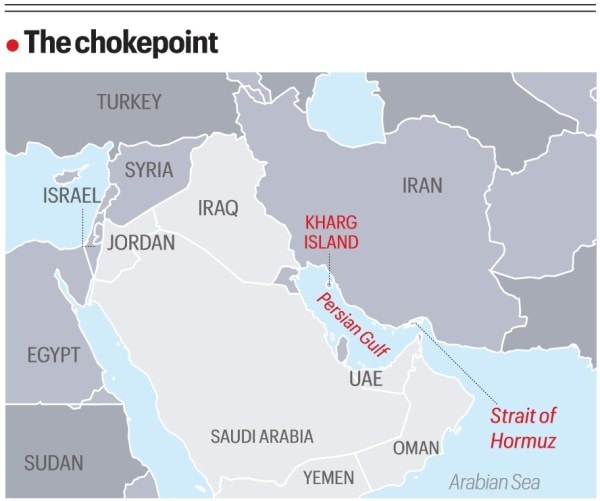 Kharg Island is a tiny speck on the Persian Gulf (Express graphic).
As The Indian Express reported earlier, “Any move to take control of Kharg Island could potentially put American troops directly in the line of fire. This would be something that Trump would be reluctant to do, given his pre-electoral promise of ending America’s “forever wars” and the general opposition to any such move within his MAGA (Make America Great Again) base.”
But if sending troops is indeed being considered seriously, Kharg would be an important entry point. Gaining control of the island would give the US an upper hand over Iran’s oil exports and, in turn, a major source of funds for the regime. Prolonged fighting, however, would risk damage to the already fragile passage of ships and fuel through the Strait of Hormuz, which Iran has effectively blockaded.
A recent Financial Times report said that in such a scenario, “US troop casualties would be all but certain,” given that Kharg is within the range of Tehran’s remaining missiles, drones and artillery. This brings us to the second alternative.
Story continues below this ad
2. “Blocking or seizing ships that are exporting Iranian oil on the eastern side of the Hormuz Strait.”
The risks linked to Kharg Island can prompt the US to first secure the Strait of Hormuz by restricting Iranian ships and cutting off the Islamic Republic’s economic avenues, which were already restricted in the face of years of Western economic sanctions.
But this, too, is complicated. Jennifer Parker, an adjunct professor at the Defence and Security Institute, The University of Western Australia, told The Conversation that it would require destroying Iran’s ability to attack ships by “taking out its radar facilities, command and control structure and weapons bunkers” along its coast.
With the geographical advantage of mountains in southern Iran that could have bunkers for missiles, it would require diverting significant military assets, not just to counter Iran but to ensure continued security for the ships passing through. It could also lead to loss of life and personnel.
Story continues below this ad
3. “Invading Larak, an island that helps Iran solidify its control of the Strait of Hormuz.”
Axios described Larak, which lies at the narrowest point of the strait, as a strategic outpost that hosts Iranian bunkers, attack craft that can blow up cargo ships and radars that monitor movements in the strait. However, it is also heavily fortified.
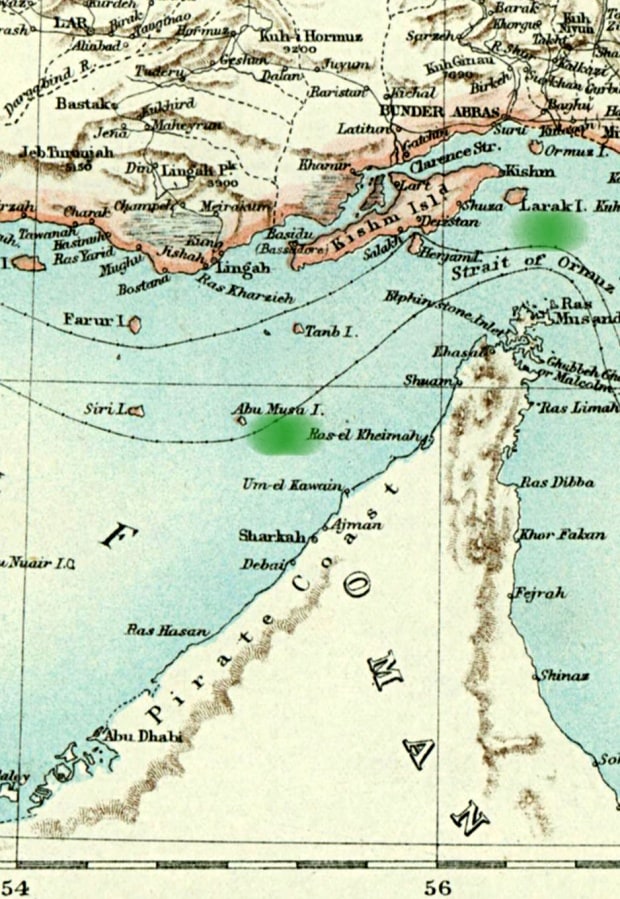 An old map showing Larak on the top right and Abu Musa near the centre. (Wikimedia Commons)
4. “Seizing the strategic island of Abu Musa and two smaller islands, which lie near the western entrance to the strait and are controlled by Iran but also claimed by the UAE.”
The two islands are Greater Tunbs and Lesser Tunbs. Lesser Tunb, which Iran has controlled since 1971, is at the heart of a decades-long dispute with the neighbouring UAE.
Story continues below this ad
Just recently, Iranian Speaker Ghalibaf wrote on X that their intelligence suggested “Iran’s enemies, with the support of a country in the region, are preparing an operation to occupy one of Iran’s islands,” which Axios said was likely a reference to the UAE and Abu Musa. He threatened, “All the vital infrastructure of that regional country will be targeted without limitation by relentless attacks.”
How might the decision be received back home?
Since the beginning of the war, which has not touched the United States directly, public surveys have shown low approval for Trump’s actions.
A March 2 CNN survey reported that shortly after the first few strikes, around 60% of the people surveyed said they did not think Trump had a clear plan for handling the situation, and 62% said he should get congressional approval for any further military action.
This poll covered a little over a thousand respondents, with the opinion on Trump split along party lines (82% Democrats did not think Trump had a clear plan, while 23% Republicans did not think so).
Story continues below this ad
In the fourth week of the war, an Associated Press-NORC Center for Public Affairs Research survey found that about 59% of Americans say US military action in Iran has been excessive. Meanwhile, 45% are “extremely” or “very” concerned about fuel affordability over the next few months, even as about 66% Americans said that preventing Iran from acquiring nuclear weapons should be an “extremely” or “very” important foreign policy goal for the US.
Experts have also pointed out that a ground invasion will go against Trump’s past electoral promises. Earlier this month, National security analyst Alex Plitsas, associated with the think tank Atlantic Council, wrote that “Looking back to the Iraq war, Trump has cited the deployment of conventional ground forces and the disbanding of the Iraqi army and government as the reasons the United States became ensnared in a costly insurgency. He is seeking to avoid that.”
“Iran is a massive country with very difficult topography and would require hundreds of thousands of troops to occupy. Any use of ground forces would likely be limited to special operations forces for specific missions,” he added.
What this says about the war
The possibility of deploying troops suggests that Trump’s past claims of victory were either only claims or show an underestimation of the regime in Iran. One prevalent argument is that Trump’s more recent and repeated mentions of a pause in hostilities and his emphasis on negotiations with Iran speak to his intentions to end the conflict soon.
Story continues below this ad
It might stem from a realisation that the Iranian regime, despite losing its top leaders, seems to be enduring nonetheless, which was perhaps not anticipated going into the war. There is little in the name of the ground resistance that Trump and other US leaders called for by asking Iranians to take to the streets.
A more prudent strategy would, then, be to indicate victory and point to specific objectives, such as the killing of the Supreme Leader, and stop the conflict.
Then there is the economic imperative. Rising oil prices and inflation risks could affect the US public sooner rather than later. Earlier in the week, the AP reported that the S&P 500 index, which tracks the top 500 US companies, slumped 1.7% for its worst day since January.
Even then, the strategy remains unclear, so far. As the BBC put it, “Trump’s mixed messaging suggests he’s still undecided about what would work best: ramping up the conflict to try to end it as quickly as possible, or pushing for a negotiated settlement with Tehran.” In urging for more troops, as well as a recent 15-point peace plan that asks for Iran to abandon its nuclear programme and limit its ballistic missiles, he may try both.

.jpeg "IPL 2026: Irfan Pathan backs Mumbai Indians to break 13-year season opener jinx | CricTracker")