On the campaign trail in rural Tamil Nadu, Premalatha Vijayakanth brushed aside comparisons of her late husband and actor-politician “Captain” Vijayakanth with poll debutant Tamilaga Vettri Kazhagam’s (TVK) Vijay.
“I don’t have any opinion,” said Premalatha, chief of the Desiya Murpokku Dravida Kazhagam (DMDK) that was founded by her husband in 2005, before returning to a familiar refrain – that Vijayakanth was not just another actor-turned-politician, but also a leader who stood “among the people”.

In the afternoon heat of Mangalampettai town, near Virudhachalam – the constituency where Vijayakanth once carved his lone but symbolic victory in 2006 – that distinction hung in the air, unspoken but firm: Vijay is not Captain.
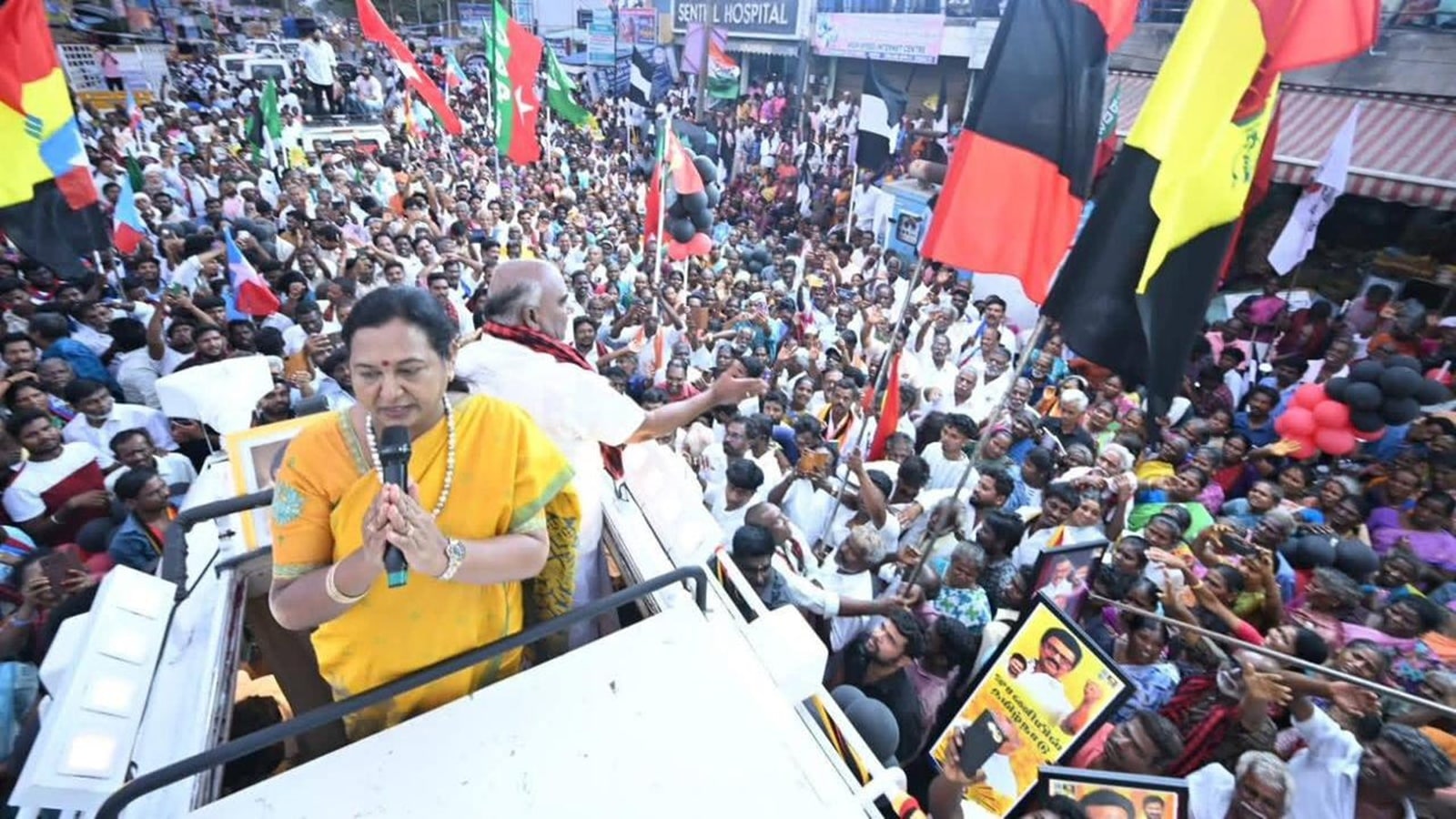
The convoy arrived first — a string of SUVs cutting through narrow roads that opened into small junctions and interior stretches of Cuddalore district. Premalatha stepped out into the scorching sun, her voice steady as she moved from one micro-gathering to another.
Around her, the echoes of Vijayakanth lingered in curious ways. Local functionaries, men rushing to arrange chairs or guide crowds, carried his imprint – the same thick, carefully combed back hair, and streaks of vibhuti (ash) across foreheads. It was as if the party had, over time, learnt to resemble its founder.
For Premalatha, the resemblance is less physical than political inheritance – one she now carries almost entirely on her own. “Captain was a people’s leader,” she said. “With the intention of serving the people, he transformed his fan clubs into a political party and entered elections.”
It is a story that has been told often in Tamil Nadu’s cinema-politics continuum, but Vijayakanth’s version had its own grammar. When his DMDK contested all 234 seats in its debut 2006 Assembly election, it won just one. But it secured 8.38% of the vote – a number Premalatha still repeats.
“We must prove the percentage,” she said. “Even if success does not come.”
The numbers tell a story of both rise and erosion. From a 8.4% vote share in 2006 and 10.3% in the 2009 Lok Sabha elections, the party slipped to 7.9% in 2011 but won 29 seats, its highest ever tally and the last time it won an Assembly seat in the state. In the 2014 Lok Sabha polls, it fell further to 5.1%, then to 2.4% in 2016, and eventually into statistical marginality at 0.43% in 2021.
Memory of better times
But for Premalatha, the emphasis remains not on the decline, but on what those early vote shares represented: a direct connection with people.
“For any problem, he would be the first to go there,” Premalatha said. She listed them like markers in a political pilgrimage – floods, the 2004 tsunami, the sandalwood smuggling crackdown, an explosion in a small village. “He would fold his dhoti and stand with the people,” she said. That, she added, is the quality missing in many who come after. “If the leader is different and the people are different, that bond will never come.”
The statement doubles as both instruction and critique – not just of Vijay, but of an entire generation of leaders shaped in a different media age. Premalatha herself belongs to an in-between moment. Not a mass leader, not a traditional politician, but a figure who has grown into politics through proximity, management and, eventually, necessity. Her transition – from what party insiders once described as Vijayakanth’s “manager” to the DMDK’s principal voice – has been gradual, and not without friction.
In 2019, Premalatha negotiated simultaneously with rival alliances – led by the DMK and AIADMK – seeking maximum seats. “In parliamentary politics, there are no permanent enemies,” she had said, a statement that had then sat uneasily with the party’s anti-establishment origins.
Before sealing the DMDK’s seat-sharing deal with the DMK in February, party insiders said Premalatha had reached out to the AIADMK, BJP and even Vijay’s TVK. This election will see the DMDK’s first tie-up with the DMK, for which the value of the partnership lies less in the DMDK’s recent electoral performance and more in what party strategists describe as durable residue: Vijayakanth’s followers – a base that, even after repeated defeats, has continued to gather in campaigns out of memory, loyalty and cultural attachment.
Today, Premalatha frames her role less as negotiation and more as continuity. “Fulfilling Vijayakanth’s dreams, his goals – that is now the only goal of DMDK,” she said.
That clarity extends, at least rhetorically, to questions of gender. Asked about navigating a space dominated by male leaders like M K Stalin and Edappadi K Palaniswami, she dismissed the premise.
“There is no gender discrimination in politics,” she said. “All are citizens. All are human beings with responsibilities.” Indira Gandhi and J Jayalalithaa – two figures who dominated their political landscapes – remain her role models. “I never think in terms of male or female. Whatever is right, that is what we follow.”
The DMDK today is a diminished force, with fewer second-rung leaders and a shrinking vote base. Much of its identity remains tied to Vijayakanth – his charisma, cinematic memory, and moral positioning as an anti-corruption figure.
His absence, Premalatha acknowledged, is not just emotional but structural. “For the party members and the people, it is a huge loss,” she said. His health setbacks before his death in 2023, she added, “prevented his dream from being fulfilled”.
On policy, she returns to clarity again, especially on Tamil Nadu’s language debate. “Protect the mother tongue, learn all languages,” she said, invoking what she described as Vijayakanth’s position. “The mother tongue is like our eyes. Other languages are like spectacles. We use them when needed.” It is a formulation that sits comfortably within the state’s long-standing two-language framework. “Tamil Nadu has always had the two-language policy,” she said. “There is no three-language policy.”
What remains less clear is where the party itself stands in the current political churn. Once a disruptor, now a negotiator; once a third force, now fighting for relevance.
In Mangalampettai, however, those questions dissolve briefly into performance. Premalatha moves through crowds that still respond to the memory of Captain, invoking his name as both shield and signal.
Her return to Vriddhachalam carries both memory and risk. It is here that Vijayakanth secured his first Assembly victory in 2006. Two decades later, Premalatha is attempting to reclaim that emotional geography, even as the DMDK’s electoral graph has plummeted. For Premalatha, the constituency is not just another electoral battle; it is a test of whether the memory of Captain can still translate into votes in a much-altered political field.