

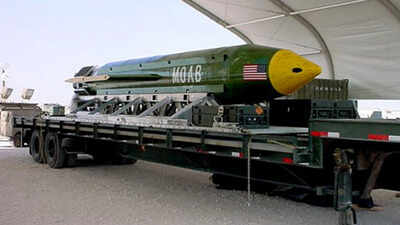
The ‘Mother of All Bombs’ has the name, the weight and the explosive punch. What it may not have is the right tool for the job the US wants it to do.Reports of possible US discussions about deploying the GBU-43/B Massive Ordnance Air Blast (MOAB) against Iran have put the giant conventional bomb back in focus. Weighing just under 10,000 kg, it made its combat debut in April 2017 against an Islamic State tunnel complex in Afghanistan, producing the kind of images that cemented its fearsome reputation.But Iran’s most important nuclear and military facilities are not sitting ducks in the open. Many are buried beneath mountains or shielded by reinforced concrete. And the MOAB, despite its enormous explosive power, is an air-burst weapon, not a specialised bunker-buster.In other words, a spectacular explosion does not necessarily mean a successful strike. Against Iran’s deeply buried infrastructure, the bomb’s biggest strength could also prove to be its biggest limitation.
A big blast, not a bunker-buster
The central problem is the MOAB’s design. Unlike penetrator bombs, which burrow through soil, concrete and rock before detonating, the MOAB is an air-burst weapon that explodes above the surface, spreading a powerful overpressure wave across a wide area.This makes it effective against personnel and structures in the open, lightly protected infrastructure, cave entrances and exposed military positions. But much of its energy dissipates horizontally rather than downward. While surface structures can be flattened, heavily fortified underground complexes are far more likely to survive.Iran’s most important assets are not housed in vulnerable surface buildings. Many are concealed beneath mountains and protected by reinforced concrete, meaning the MOAB’s explosive power may not translate into the ability to destroy the targets that matter most.
An MOAB strike by US may fail to achieve total annihilation or destruction of a target for several key structural, technical, and operational reasons such as inability to penetrate especially in the mountainous terrain with heavy doors which may absorb the blast effect and since the bomb’s lethal over pressure radius could be localised.
Lt Gen KR Rao (retd), Former Director General Artillery
Iran’s underground defence
Iran’s nuclear programme illustrates the challenge. Since the early 2000s, Iranian planners have anticipated that key facilities could be targeted by American or Israeli air strikes. As a result, they have placed considerable emphasis on underground construction and hardening.The enrichment facilities at Natanz include underground sections reportedly protected by thick layers of concrete and located roughly 40 to 50 metres below the surface.Satellite imagery and open-source analysis have also pointed to extensive tunnelling in mountains near the site. Analysts estimate that some sections could lie even deeper beneath the rock. Such depths pose a challenge even for specialised bunker-busting weapons.A weapon designed to create a blast wave above the surface would have little prospect of destroying these facilities, since mountain rock absorbs and disperses shockwaves.Iran’s wider military doctrine reinforces this strategy. Over the past two decades, Tehran has publicised underground missile depots, tunnel networks, protected command centres, drone facilities and hardened storage sites.This tunnelling is a direct response to the conventional air superiority of the United States and Israel. By dispersing vital assets beneath mountains and across multiple locations, Iran has sought to blunt precision-strike campaigns. The assumption is that even an adversary that controls the skies would find it extremely difficult to destroy every critical underground installation.The MOAB does not change that equation because it was never designed to defeat deeply buried infrastructure on a large scale. North Korea, too, has tunnelled beneath mountains to protect key military infrastructure.Mountains further complicate the task. While blast waves travel freely across open terrain, natural barriers can absorb, redirect and diffuse the energy of an explosion. Even a weapon with the MOAB’s explosive power would face limitations against installations hidden inside or behind mountain formations.
Aircraft carrying MOAB faces its own risks
Operational factors also count against the bomb. Unlike many precision-guided munitions that can be carried by fighter aircraft or stealth bombers, the MOAB must be dropped from a specially modified MC-130 transport aircraft.Transport aircraft are far less survivable in contested airspace than stealth bombers. Before a MOAB could be used against a strategic target in Iran, American forces would probably have to suppress large parts of Iran’s air defence network and establish air superiority. That would be a major campaign in itself.Securing the airspace would take time. Once that was achieved, planners would have a wider range of strike options and would likely favour weapons better suited to hardened underground targets.
Why GBU-57 is better suited
The GBU-57 Massive Ordnance Penetrator offers a clear contrast to the MOAB. It was developed to attack deeply buried facilities that conventional bombs cannot reliably destroy.Where the MOAB relies on blast, the GBU-57 has a hardened casing designed to penetrate layers of rock and reinforced concrete before exploding. American B-2 bombers used it against Iranian nuclear sites in June 2025.Planning discussions about hardened underground sites have centred on penetrator weapons rather than large air-blast munitions. The reasoning follows a basic military principle: the target dictates the weapon.Against caves, trenches and exposed positions, the MOAB may be effective. Against deeply buried nuclear facilities protected by mountains, penetrator weapons are far more relevant.Psychological impact could outweigh military gainsThe MOAB’s reputation may be disproportionate to its practical military utility. The weapon is designed not only to destroy certain targets but also to intimidate.Images of an enormous explosion can carry strategic messaging value, as they did after its use in April 2017. This can be particularly important when policymakers seek to demonstrate resolve or deterrence. A MOAB strike could therefore generate significant psychological and propaganda effects, dominating media coverage.But strategic success depends not on headlines but on outcomes.If Iran’s critical facilities survived an attack involving one of America’s most powerful conventional weapons, the Iranian regime could present it as a propaganda victory. Surviving such a strike could allow Tehran to portray its investments in underground defences as vindicated.Rather than demonstrating overwhelming American power, an unsuccessful strike against hardened facilities could reinforce perceptions of Iranian resilience.Escalation is another concern. Any operation against Iran would take place amid maritime trade routes, energy infrastructure, proxy networks and missile forces.If a MOAB strike failed to destroy its intended target, the United States could still face serious retaliation from Iran and its partners. Military planners generally look for a clear relationship between operational risks and potential gains. A highly visible weapon that raises tensions while inflicting limited damage on the facilities that matter most would be difficult to justify.
A mismatch between weapon and target
The MOAB’s limitations against Iran come down to a mismatch between the weapon and its intended targets. It was built to produce devastating blast effects over exposed areas, destroy cave complexes and shock an opponent.Iran’s strategic infrastructure has been adapted to withstand precisely these kinds of conventional threats through deep underground construction, mountainous geography, hardened facilities, dispersed networks and extensive tunnelling.The MOAB could inflict significant damage on selected surface targets, but it would probably struggle to neutralise Iran’s most important nuclear and military facilities. Specialised bunker-busting weapons and broader air campaigns offer more credible options for such targets.The MOAB remains a formidable weapon, but its strengths are poorly matched to the realities of Iran’s defensive architecture.