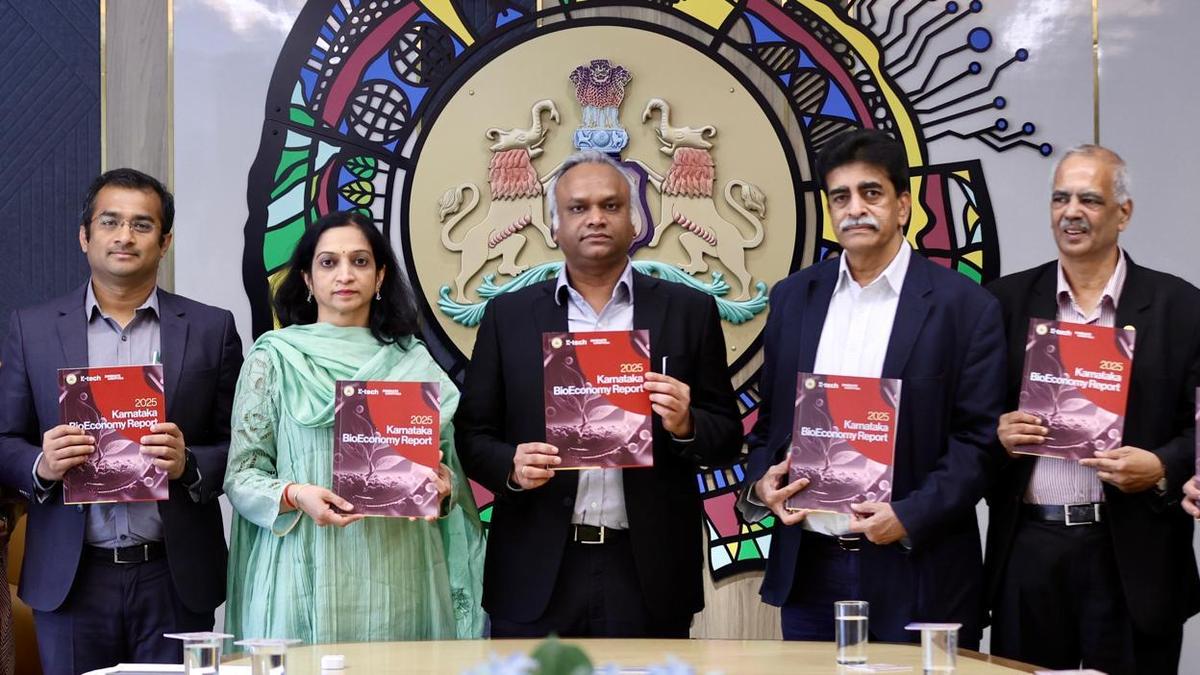
Karnataka’s bioeconomy, a $39 billion enterprise, contributes over one-fifth to the national bioeconomy and over 10% to the Gross State Domestic Product (GSDP) as of 2025, observes a newly launched report.
The Karnataka BioEconomy Report 2025, prepared by the Association of Biotechnology-Led Enterprises (ABLE) for the Karnataka government, was released on Monday.
Production-oriented
Between 2023 and 2025, the State’s bioeconomy expanded from $31 billion to $39.2 billion, representing a cumulative rise of 26.5%. The growth has been attributed to a robust biopharmaceutical base, rapid bioindustrial diversification, and strong bioservices integration.
“Karnataka’s innovation ecosystem — anchored in research institutions, start-ups, and global R&D centres — has transitioned from being research-heavy to production-oriented and globally competitive,” reads the report, which pins the State’s contribution to India’s bioeconomy at 20.63%.
While biopharma has remained the anchor with over 40% share (about $16.44 billion), driven by biologics, biosimilars, vaccines and diagnostics, bioindustrial has emerged as the fastest-growing segment (about $11.46 billion, around 29% share), led by fermentation-based industries, biofuels, enzymes and sustainable materials.
Bioservices has also displayed steady growth, contributing about 25.8% share.
Economic pillar
According to the report, Karnataka’s bioeconomy accounted for 10.51% of the GSDP in 2025. This is more than twice the share of the biotech sector to India’s GDP (4.57%).
“This positions biotechnology not merely a scientific discipline but as an economic pillar central to the State’s development model,” notes the report.
Jump in startup numbers
Karnataka’s biotech start-up ecosystem continued to grow, with 218 new biotech start-ups being added in 2025 alone, marking the highest annual start-up additions in three years. With this, the cumulative number of biotech start-ups in the State stands at 1,451, up from 1,233 in 2024.
The State currently holds a 12–13% share of the national biotechnology start-up pool and more than 75% of them startups are focused on life sciences and health-tech. Bengaluru accounts for about 54% of the biotech start-ups.
Mysuru contributes around 8.7% to the bioeconomy of the State, while Belagavi and Dakshina Kannada together account for over 9%.
On the investment front, between January 2024 and October 2025, Karnataka attracted $1.14 billion across around 40 deals, spanning biopharma, medtech, precision fermentation, digital health, and agribio.
Collaboration critical
“The rapid expansion of biomanufacturing shows a sector moving decisively from research to global-scale production. Continued collaboration between government, industry and academia will be critical to sustaining Karnataka’s leadership in India’s next phase of bio-led growth,” said G.S. Krishnan, honorary president, ABLE.
Priyank Kharge, Minister for Information Technology, Biotechnology and Rural Development, noted that biotechnology is no longer confined to laboratories, but is now a central driver of economic growth, industrial innovation and societal impact.
“Our focus is on building a full-spectrum biomanufacturing economy by supporting deep-tech start-ups, strengthening innovation infrastructure, and ensuring that growth reaches beyond Bengaluru to every region of the State,” he said.
Published – February 23, 2026 09:14 pm IST