

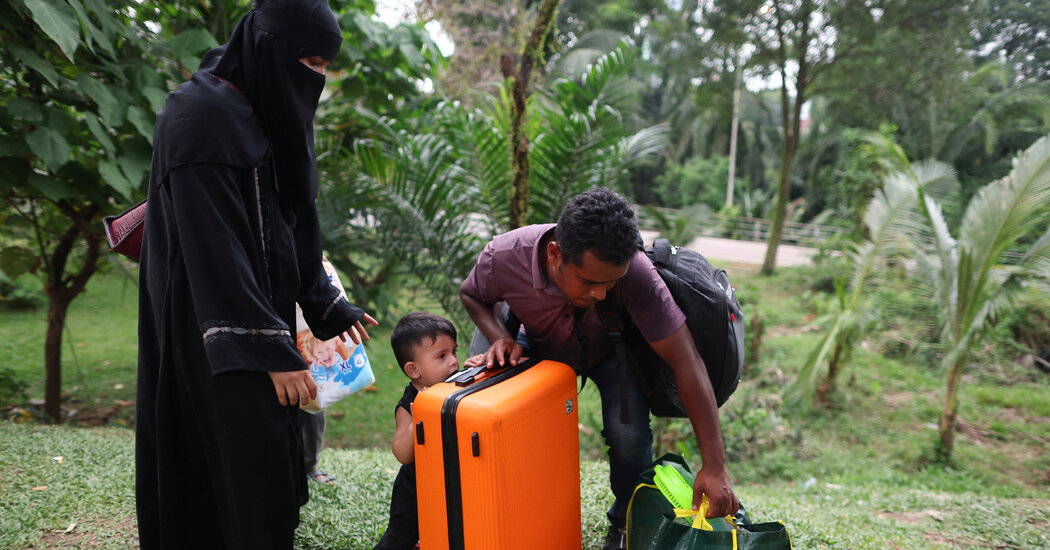

Two years ago, Muhiduzamal fled religious persecution and civil war in his native Myanmar, traversing land and sea for four months before arriving in Malaysia. As at home, he found work in a paddy field, and moved into a traditional Malay home, a wooden structure on stilts.
He tried to register as a refugee with a United Nations agency in Malaysia, and was waiting for an appointment. But without that status, Malaysia considered Mr. Muhiduzamal, 35, who is a Rohingya Muslim and uses only one name, to be in the country illegally. In June, he was arrested and sent to a detention center, his brother said.
Malaysia has more than 10,000 undocumented migrants from Myanmar in custody. Last month, it announced plans to send about half of them back home. The migrants, their families and rights groups say that they are worried that once the migrants are back in Myanmar, the military government there will conscript them — men and women — and force them into battle. Rohingya fear the worst: They are stateless in their own country and have suffered what the United Nations and the United States have determined was a genocide conducted by the Myanmar military.
“It is better to kill us in Malaysia rather than send us back to Myanmar,” said Mohammad, 25, who has refugee status and lives in Kuala Lumpur, Malaysia’s capital, but asked to be identified only by part of his name while discussing his brother’s case.
“My brother will be killed if he is sent back, as the junta in Myanmar will send him to the frontline to fight.”
Over the past decade, hundreds of thousands of people from Myanmar have sought refuge in Malaysia in the hope of escaping ethnic cleansing and a brutal junta. Tens of thousands have refugee status in Malaysia but they still face intensifying discrimination. Hundreds of undocumented migrants have died in detention.
In a statement released on Thursday, Malaysia’s Home Ministry said that the influx of migrants had become a “major financial burden, caused serious social problems and created a real security threat to the country.” It added that about 1,500 migrants in detention centers would be “voluntarily repatriated” next month, using a Myanmar Navy fleet of two warships and a hospital ship.
“There is no clarity on what the government means by voluntarily,” said Ramachelvam Manimuthu, the president of the National Human Rights Society, a prominent nonprofit in Malaysia. “Was it a free and informed choice? Does voluntary deportation also mean detainees were given a choice of being registered as refugees?”
Fear and panic is rippling through the Myanmar migrant community.
“Everyone is on alert,” said Bibi, an undocumented 18-year-old Rohingya woman who has lived in Malaysia for over a year and asked to be identified only by part of her name. “We are scared of the authorities and the public.”
Yap Lay Sheng, of Fortify Rights, a nonprofit, said, “People are skipping work even when it means losing daily income and keeping their children from refugee schools because they fear being targeted by the public and authorities.”
Malaysia does not grant political asylum to migrants. But if they are given refugee status by the United Nations High Commissioner for Refugees — even after arriving illegally — Malaysia allows them to stay.
Now Malaysia is starting its own registration system for refugees. On Thursday, the Home Ministry said that over 4,000 detainees, primarily Rohingya, will be subject to this program. Migrant advocates say the registration process must provide every person with a fair, individualized assessment of their protection needs, including access to interpreters, legal assistance, and a right of appeal.
“The government must expedite the refugee registration, and make sure that refugee cardholders have lawful access to work, education, housing, and guarantee against the arbitrary arrests, detention and pushbacks,” Mr. Yap said.
Fahmi Fadzil, Malaysia’s communications minister and the government spokesman, has said that migrants would not be deported if their lives are threatened in Myanmar, saying that the authorities had been assessing who could be returned and under what conditions.
About five years ago, soon after the coup that brought the military to power in Myanmar, Malaysia said it repatriated over a thousand migrants. It is unclear how they fared.
“For people who fled Myanmar seeking safety, forced return represents a profound betrayal of the protection they sought abroad,” said Nickey Diamond, who is originally from Myanmar and on Fortify Rights’ board.
Hla Maung Thein, 32, an undocumented ethnic Chin migrant from Myanmar, was arrested this month and is being held at a detention center in Kuala Lumpur, according to his wife. She added that sending him back to Myanmar, even if he got home to his native Rakhine state, would amount to a death sentence.
“I have heard that people who were previously sent back by ship never made it home,” said Nwe Nwe, his wife, who also asked to be identified by part of her name. “Even if my husband makes it home, he will certainly be forced to serve military service in the Arakan Army,” she said, referring to the rebel group that controls most of the state.
The U.N. refugee agency has said that conditions in Myanmar are not safe for migrants to return.
Mr. Manimuthu of the National Human Rights Society said the Malaysian government should put a hold on the deportations until there is an international consensus that it is safe for detainees to return.
“History has shown we cannot accept the words of Myanmar authorities,” he added. “The repatriation of refugees cannot be based on hope and prayer. It must be solid evidence that it is safe for returning.”