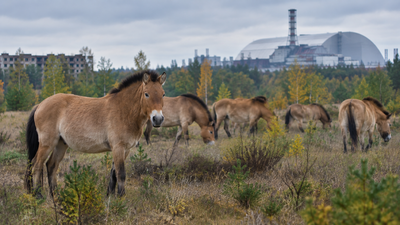
When the Chernobyl Exclusion Zone was abandoned after the 1986 nuclear disaster, it was not expected to become part of the future of a horse that had already vanished from the wild. Yet, more than a decade later, Przewalski’s horses were brought into the largely empty landscape in an effort to establish a free-ranging population. According to the study published in Theriologia Ukrainica, titled ‘Przewalski`s horse (Equus ferus przewalskii) in the Chornobyl Exclusion Zone after 20 years of introduction’ claim that 31 horses were released in 1998 and multiplied. The records tell a more complicated story. The animals arrived over two years, some died before joining the wild population, and poaching caused serious losses during the first decade. Even so, the horses continued breeding. By 2018, 137 had been documented in Ukraine, with others across the Belarusian border.
How Przewalski’s horses were introduced to the Chernobyl Exclusion Zone
The introduction began in 1998 and continued into 1999. Twenty-eight Przewalski’s horses came from the Askania Nova Biosphere Reserve, made up of 10 males and 18 females. Three more males were brought from the zoo at the Lozovski stud-farm.That is the origin of the familiar total of 31, although saying that all 31 became the founders of Chernobyl’s free-ranging population leaves out what happened next, as reported by Chernobyl, Pripyat, Chernobyl Exclusion Zone.Eight animals died during transport or shortly afterwards, with injury and stress among the recorded problems. Those that survived were not immediately turned loose. They spent anything from several weeks to eight months in large enclosures while they acclimatised.When the early history of the population was later examined, the animals identified as successful reproductive founders were a much smaller group: two stallions and 15 mares from Askania Nova. The purpose of the project was also broader than simply putting an endangered animal into an abandoned radioactive area. The plan was to create a free-ranging population while increasing biodiversity and helping restore ecological processes in a landscape that had been heavily altered by human activity before the disaster.
The uncertain history behind Przewalski’s horses
Przewalski’s horses had disappeared from the wild during the twentieth century. Their survival depended on captive breeding programmes, from which later reintroduction projects were developed.The species has often been described as the world’s last truly wild horse, sometimes with the added claim that it was never domesticated. That description has become less straightforward as archaeological evidence has been re-examined.A reassessment published in Scientific Reports in 2021, titled ‘Rethinking the evidence for early horse domestication at Botai’ looked again at evidence from Botai in Kazakhstan, a site long associated with early horse domestication. The authors argued that the remains could instead reflect large-scale hunting of wild Przewalski’s horses. Their interpretation did not settle every question about the species’ past relationship with people, but it made the old certainty harder to maintain. For Chernobyl, the more immediate fact was simpler. A horse that had survived only through captive populations was being given space to live and breed freely again.
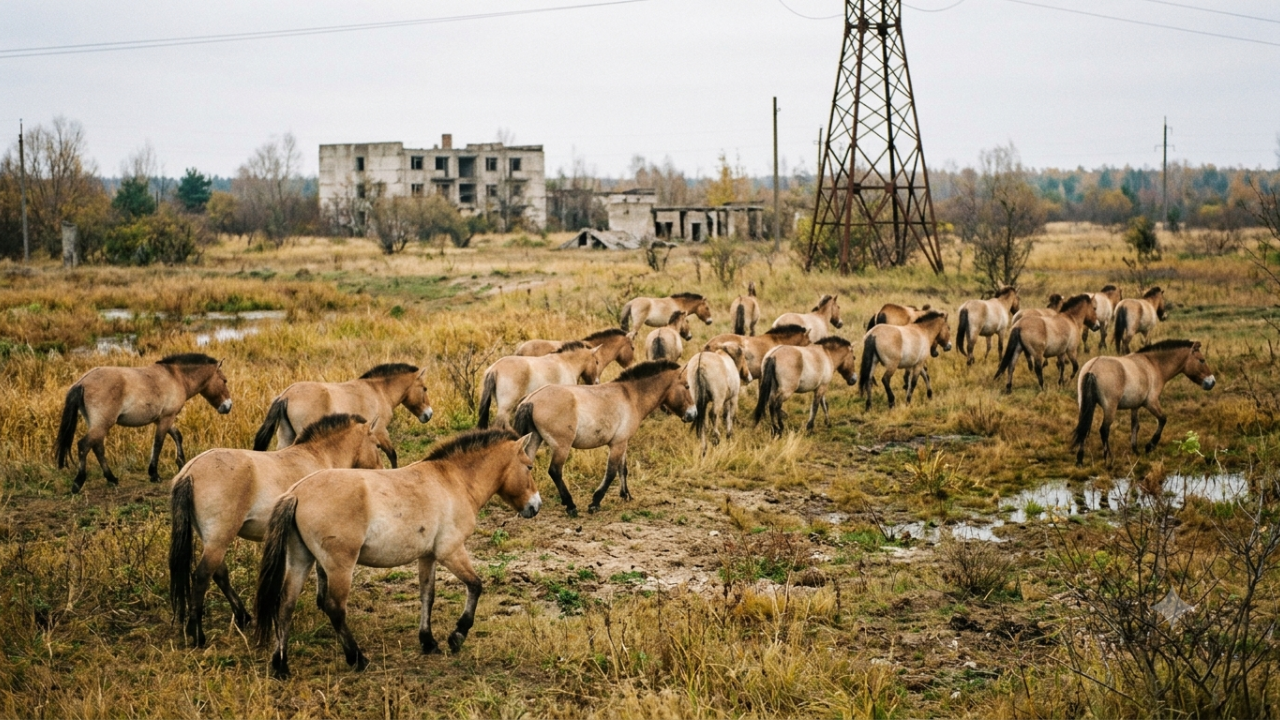
Przewalski’s horses grew in number but faced early losses
Once breeding began, numbers increased quickly. The population reached 65 animals in both 2003 and 2004. That growth did not continue without interruption. By 2007, the number had fallen to around 50. At the end of the following year, 64 horses were counted.Illegal hunting was part of the problem, although the surviving records do not allow every loss to be assigned a cause. Between 1999 and 2006, 55 free-ranging horses were lost. A cause of death could only be determined in 18 cases, and 13 of those deaths were attributed to poaching.The early study therefore found that poaching accounted for more than 70 per cent of the deaths for which a cause was known. It could not say the same about all 55 losses. The horses were reproducing and establishing themselves, but the population was also vulnerable to pressures that could not always be measured clearly from the available records.
Chernobyl’s Przewalski’s horses were no longer just scattered survivors
A more detailed picture emerged from camera-trap work carried out in 2018. In the Ukrainian part of the exclusion zone, 137 Przewalski’s horses were recorded. According to the Food and Agriculture Organization of the United Nations, the count included 47 stallions, 66 adult mares and fillies, and 24 foals. Beyond the Ukrainian survey area, at least four more animals were recorded at a remote site in the Belarusian exclusion zone: one stallion, two mares and a foal.These were not simply scattered individuals moving randomly through the landscape. The survey recorded 13 harem groups containing foals, along with four small groups that were not breeding, around six groups of stallions and at least one solitary male.Some of the horses were using territory on both sides of the international border.Their presence in Belarus had developed over several years. Horses were reported crossing the Prypiat River between 2007 and 2010, after which a breeding subpopulation became established there. By the time of the 2018 survey, the original introduction was already becoming part of the population’s distant history. Almost every horse recorded belonged to the second generation or a later one. Only two mares still carried brands linking them directly to the animals brought into the zone at the end of the 1990s.
Chernobyl’s wild horses adapted to a landscape far beyond open meadows
Przewalski’s horses are usually associated with open country, and meadows remained an important part of their habitat in Chernobyl. The 2018 survey, though, showed that the animals were not avoiding forested areas. That is significant because the exclusion zone is far from an open grassland. Woodland and reforested ground cover large areas, and the changing landscape has also made it harder to count animals by direct observation.The horses were using a broader range of habitat than a simple steppe image might suggest. Their movements through forests also help explain why camera traps and repeated field observations became important for understanding how the population was distributed.
Population growth cannot answer every question about radiation
The presence of a growing Przewalski’s horse population in Chernobyl does not mean that radiation has no biological effects. Population numbers and the health of individual animals are different questions. A population can grow while some animals experience effects that are not visible in a basic count. At the same time, many pressures disappeared or were greatly reduced when people left the area after the disaster.Farming, traffic, development and regular human disturbance were no longer shaping the landscape in the same way. Those changes created conditions that cannot easily be separated from radiation exposure when looking only at the population’s overall increase.The 2018 work was concerned with where the horses lived, how they were organised socially and how the population had developed over time. It was not a controlled experiment designed to isolate radiation as a single variable.Its results show that the horses reproduced successfully and remained established in the exclusion zone. They do not establish that radiation is harmless, nor do they identify one factor as the explanation for the population’s survival.