

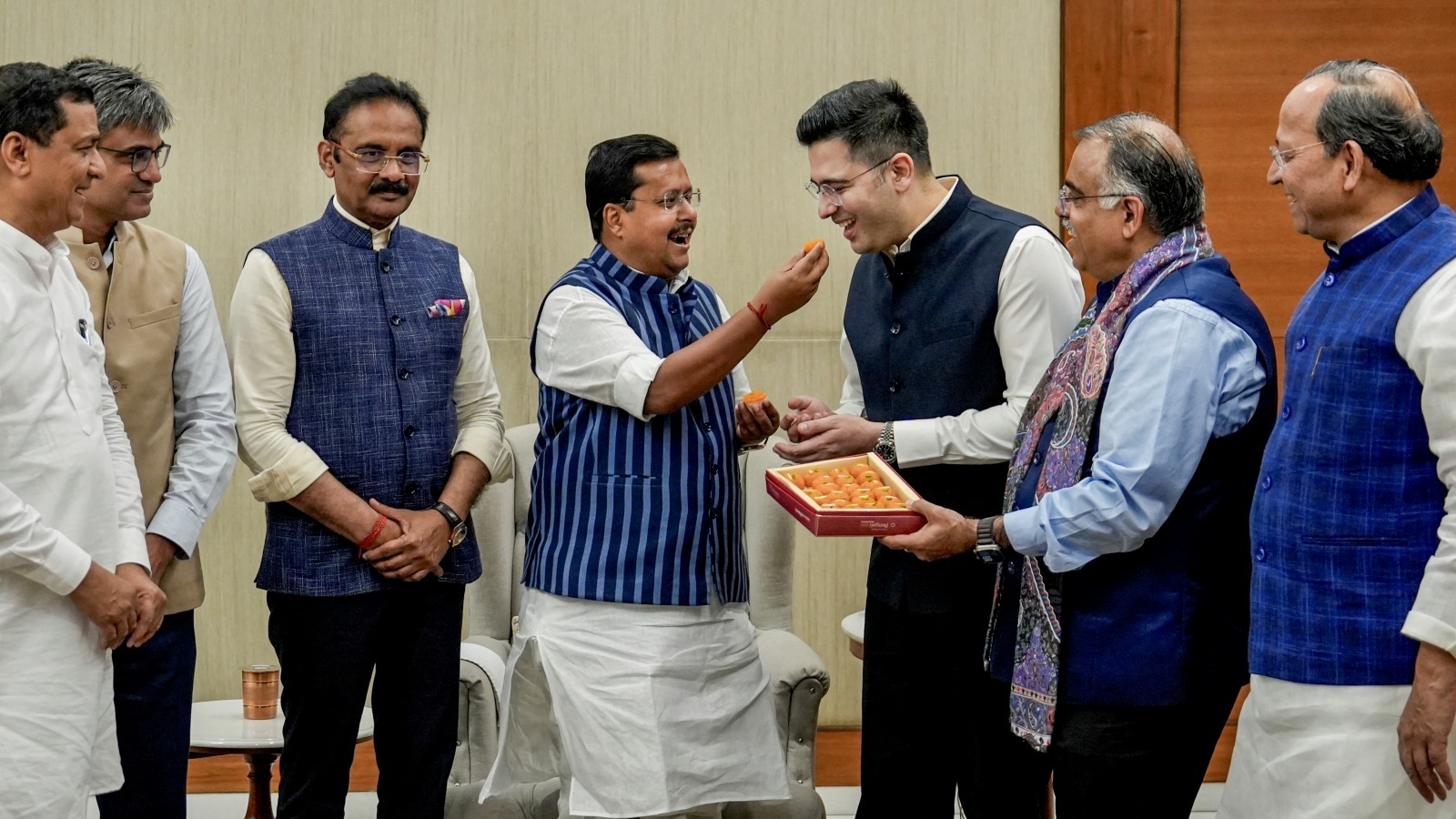
There have been multiple instances of the Opposition MPs and MLAs changing their party loyalties and switching to the BJP since 2014, when the latter swept to power at the Centre with its first absolute majority. The crossing over of seven Aam Aadmi Party (AAP) Rajya Sabha MPs, led by Raghav Chadha, to the BJP Friday falls in one of the ways this has happened – seeking to beat the anti-defection law through a two-thirds strength of the defecting faction.
Some of its other methods have included resignations – such as the resignations of 22 Congress MLAs in Madhya Pradesh in March 2020 to topple the Kamal Nath government – and aiding the BJP without shifting to it, like eight Congress MLAs defying party whip and abstaining during a trust vote to help the BJP government in Manipur survive in 2020, besides the cases of individual leaders joining the BJP.

The seven rebel AAP MPs used a method that has been used several times in the past – that of breaking more than two-thirds of the party in a House in a bid to avoid disqualification under the anti-defection law and claiming a merger with the BJP, subject to the ruling of the presiding officer.
Their objective may not be to topple a government – the AAP government in Punjab has an absolute majority even as the BJP has just two MLAs in the 117-member House.
The AAP MPs’ defection is more a blow to party chief Arvind Kejriwal, sending out a message that he is not in command of his party. The BJP has also again raked up the design plan of the spruced up chief ministerial residence of Kejriwal when he held the office, thus seeking to revive its “Sheesh Mahal” pitch against him.
Even before the AAP crisis, the Opposition parties have repeatedly accused the BJP of conducting its “Operation Lotus” to split their parties and form a coalition government with the breakaway faction in state after state. There have also been several cases of the Opposition legislators merging with the BJP to help the latter form a government.
Maharashtra
In 2023, Ajit Pawar split the NCP, with a majority of party legislators and leaders backing him. “A resolution dated June 30, 2023, signed by an overwhelming majority of members of NCP, both from the legislative and organisational wing, was passed thereby electing Ajit Anantrao Pawar as the president of NCP…. The NCP also decided to appoint Ajit Pawar as the leader of NCP Legislature Party in the Maharashtra Legislative Assembly and the said decision was also ratified by the resolution passed by an overwhelming majority of NCP MLAs,” an NCP statement had then said.
Subsequently, the late Ajit Pawar wrote to the Election Commission (EC) to seek his faction’s recognition as the “real NCP”, even as he joined the NDA government, led by Shiv Sena leader Eknath Shinde, as the Deputy Chief Minister.
In 2022, Shinde split the Uddhav Thackeray-led Shiv Sena, taking 40 out of its 55 MLAs and 12 of its 19 MPs with him to the BJP-led NDA.
In both these cases, the EC granted the original party symbol to the breakaway factions, recognising both the Shinde Sena and the Ajit NCP as the “real party”.
Shinde’s objective was to split the Uddhav Sena to become the CM with the BJP’s support. In the case of the NCP, Ajit Pawar’s aim was not just to join the government but also to stake claim on the Sharad Pawar-led party’s legacy and sideline his cousin Supriya Sule. In both instances, the BJP gained, as the NDA came to power after toppling of the Uddhav government and then reinforced itself.
After the NDA swept the November 2024 Assembly polls, the BJP installed Devendra Fadnavis as its CM, and the allies settled for the post of his deputies.
Andhra Pradesh
In 2019, four of the six Rajya Sabha MPs of the TDP crossed over to the BJP, making it two-thirds of the party’s strength in the Upper House. A day later, then Rajya Sabha Chairman M Venkaiah Naidu issued orders for the TDP Parliamentary Party in the House to merge with the BJP. The party’s Lok Sabha MPs wrote to Naidu that under the 10th Schedule of the Constitution, a merger could take place at the organisational level and not at the legislature party level. In this instance, the breakaway MPs enhanced the BJP’s strength in the Upper House.
Now, the N Chandrababu Naidu-led TDP has been a key ally of the BJP in both the Andhra Pradesh government and at the Centre.
Goa
In Goa, such mergers have happened a few times. In 2019, 10 of the 15 Congress MLAs switched to the BJP, taking its strength to 27 in the 40-member House. It was challenged in the courts. The Supreme Court ruled in February 2026 that in view of the fact that fresh Assembly polls have already taken place in the state, the matter had become infructuous.
In 2022, too, eight of the 11 Congress MLAs in Goa announced their merger with the BJP, taking the party, which had 20 legislators, to a comfortable majority. In 2024, state Assembly Speaker Ramesh Tawadkar dismissed the Congress’s petition to disqualify them for violation of the 10th Schedule.
These mergers enabled Pramod Sawant, who became the CM after the death of Manohar Parrikar, to lead stable governments. The 2019 merger enabled him to have a majority without relying on regional allies like Goa Forward Party and MGP. In the 2022 polls, the BJP won 20 seats, and Sawant won his own election by just 666 votes, but the merger reinforced the BJP government.
Arunachal Pradesh
In Arunachal Pradesh, in 2016, 43 of the 44 Congress MLAs, led by then CM Pema Khandu, joined the People’s Party of Arunachal (PPA), an ally of the NDA’s North-East Democratic Alliance (NEDA). Two months later, Khandu split the PPA itself, walking away to the BJP with 32 MLAs. While Khandu remained the CM, he was able to switch from a diminished Congress to a formidable BJP ruling at the Centre.
Sikkim
In Sikkim in 2019, after the defeat of the Sikkim Democratic Front in the Assembly elections, 10 of the party’s 13 MLAs switched to the BJP. This made the BJP, which had no MLA, the main Opposition party in the state ruled by the Sikkim Krantikari Morcha.
(With inputs from Jatin Anand)


