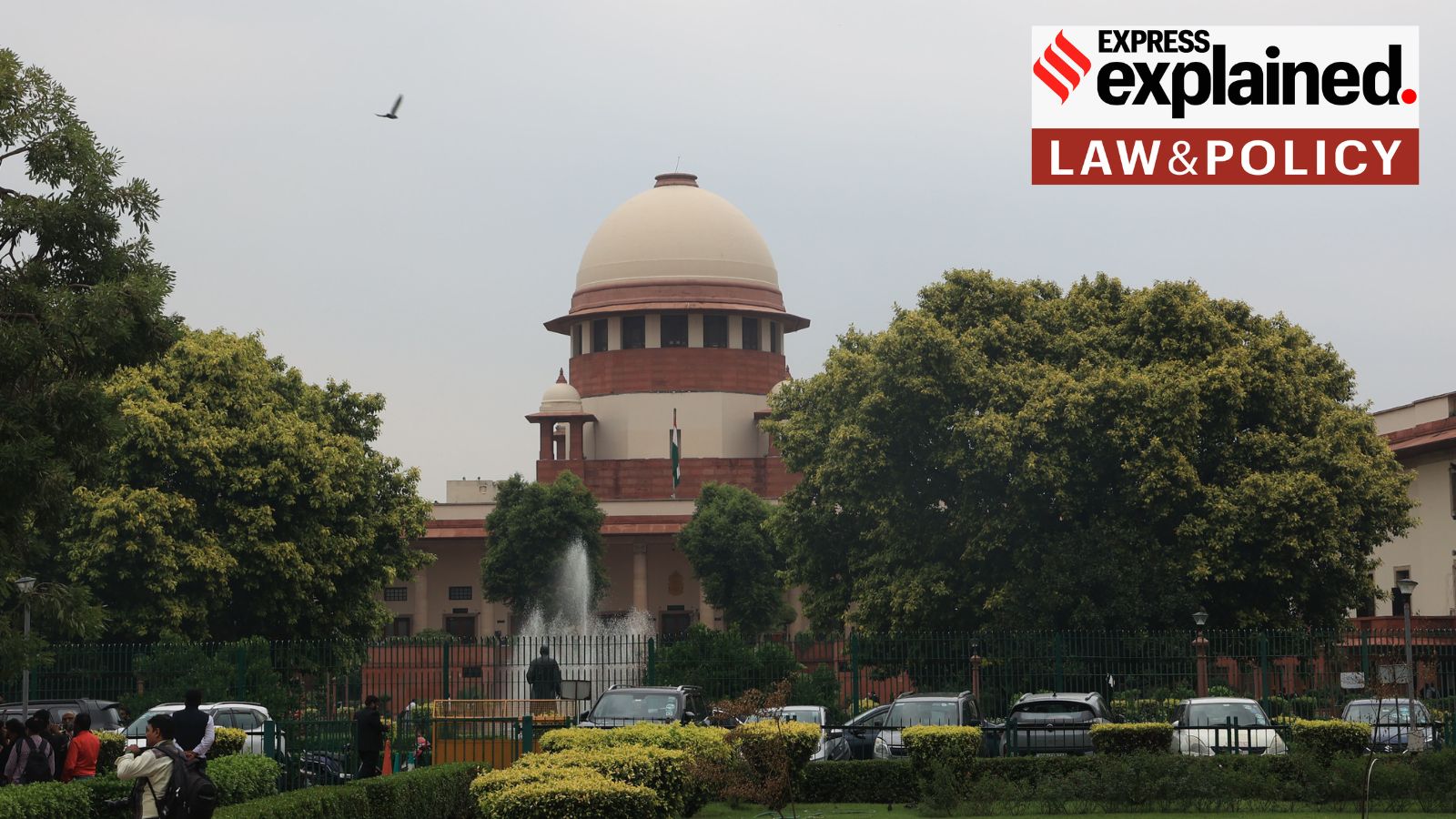
The Supreme Court on Tuesday suspended a Look-Out Circular (LOC) issued by the CBI against a businessman who had been stopped at the Mumbai airport despite having permission from the trial court to travel abroad.
The bench comprising Justices Vikram Nath and Sandeep Mehta was hearing a petition challenging the LOC. The court also sought a response from the Ministry of Home Affairs on the power to issue such orders.
A separate circular issued by the bank is pending before the High Court.
Earlier this month, while hearing the petition, Justice Vikram Nath observed that “LOC is not a confidential document,” saying that reasons to issue such a circular should be communicated and that it cannot operate without disclosure.
Here is what to know about the case and the laws governing Look Out Circulars.
Facts of the case
The petitioner, Nimesh Shah, was part of a company that dealt with printing materials. In November 2022, the CBI registered an FIR alleging that the company had caused a loss of Rs. 464 crore to a consortium of banks by inflating its financials and diverting funds. The ED followed with a money-laundering case under the PMLA.
Shah was not arrested during the investigation. In March 2025, a special court granted him bail and allowed him to travel abroad. Upon reaching Mumbai airport, Shah was stopped at the immigration counter, where the officials told him that there were Look-out circulars against him, one issued at the instance of the CBI and another by a bank.
Story continues below this ad
His challenge to the CBI-issued LOC had failed before the Bombay HC in February 2026.
What is a Look-Out Circular?
A Look-Out Circular is a communication circulated to the immigration authorities at airports and other exit points, asking them to monitor, detain or prevent the departure of a person.
It is not an arrest warrant and does not originate from the court. It is merely an administrative alert which is triggered by a request from an authorised agency.
The concept of LOC does not emerge from any standalone statute. Their operation is mostly governed by the executive instructions issued by the MHA. Relevant office memos issued by the MHA date back to 1979 and the 2000s. A 1979 communication described LOCs as alerts issued by various authorities, including the police, CBI, customs, and intelligence agencies, to watch the arrival and departure of individuals. It also stated that unless otherwise stated, such circulars would be invalid after a year.
Story continues below this ad
An OM dated 2000 laid a more structured procedure mandating the request for opening an LOC be made in a prescribed format and approved by officers of certain ranks, such as the Deputy Secretary in the Union Government, Joint Secretary in the State Government, SP of the district concerned, SP in the CBI, or an officer of equivalent level working in the CBI, etc.
What law supports LOC?
LOCs are understood as tools to secure the presence of a person required in connection with legal proceedings, for instance, to ensure that the accused does not evade an arrest or a trial. While LOCs are not created by statutes, courts have located their legal basis in a combination of executive instructions and criminal law provisions.
The right to travel abroad is a recognised fundamental right under the right to life as enshrined under Article 21, subject to reasonable restrictions. Because LOC is an administrative tool that restricts this liberty, its use has to remain constitutionally valid. The petition states that, “the mere inability to repay loans, absent any criminal wrongdoing or material to show or squandering or siphoning off public money, cannot justify curtailing the Petitioner’s right to travel, as guaranteed under the Constitution of India.”
The closest statutory framework is the Passports Act, 1967, which regulates departure from India. The Act allows authorities to refuse, impound or revoke a passport on the grounds such as “in the interests of the sovereignty and integrity of India, the security of India, friendly relations of India with any foreign country, or in the interests of the general public,” which are enumerated as “reasonable restrictions” under Article 19(2) of the Constitution.
Who can issue a LOC?
Story continues below this ad
Judicial interpretation has been central in defining the scope of LOC.
In Sumer Singh Salkan v Assistant Director (2010), the Delhi High Court clarified that LOCs can be issued in cognizable offences where the accused is deliberately evading arrest or not appearing before the court, and there is a likelihood of the person leaving the country to evade legal process. The court described LOCs as a “coercive measure to make a person surrender to the investigating agency or court of law.”
The judgment also laid down procedural safeguards. The investigating officer must make a written request, giving reasons. The competent authority must apply its mind before approving the LOC.
Subsequent guidelines expanded the scope. LOCs may also be issued when departure is considered detrimental to the sovereignty or economic interests of the country. Public sector banks have been permitted to request LOCs in cases involving wilful defaulters.
Story continues below this ad
In exceptional cases, including matters involving national security, LOCs may be issued even without complete identifying details. In Vikram Sharma v. Union of India (2010), the Delhi High Court held that bodies such as the National Commission for Women cannot directly seek a LOC. Any such request must be routed through law enforcement authorities.
“The power to suspend, even temporarily, a passport of a citizen, the power to issue an LOC… are all extraordinary powers,” the Court said. “These are powers that are required under the law, to be exercised with caution.”
Does a person have to be informed?
The framework is silent on intimation. There is no clear requirement that a person must be informed in advance that a LOC has been issued against them. In practice, individuals often discover the existence of a LOC only when they are stopped at the airport.
In the present case, the petitioner argued that the LOC was issued in 2022 and repeatedly renewed without his knowledge. He was stopped only when attempting to travel, despite having court permission.
Story continues below this ad
The Supreme Court took note of this. Referring to the agency’s own guidelines, it observed that reasons must be recorded and that a LOC cannot operate without a basis. The question of prior intimation also arose during the hearing, with the court directing the impleadment of the MHA.