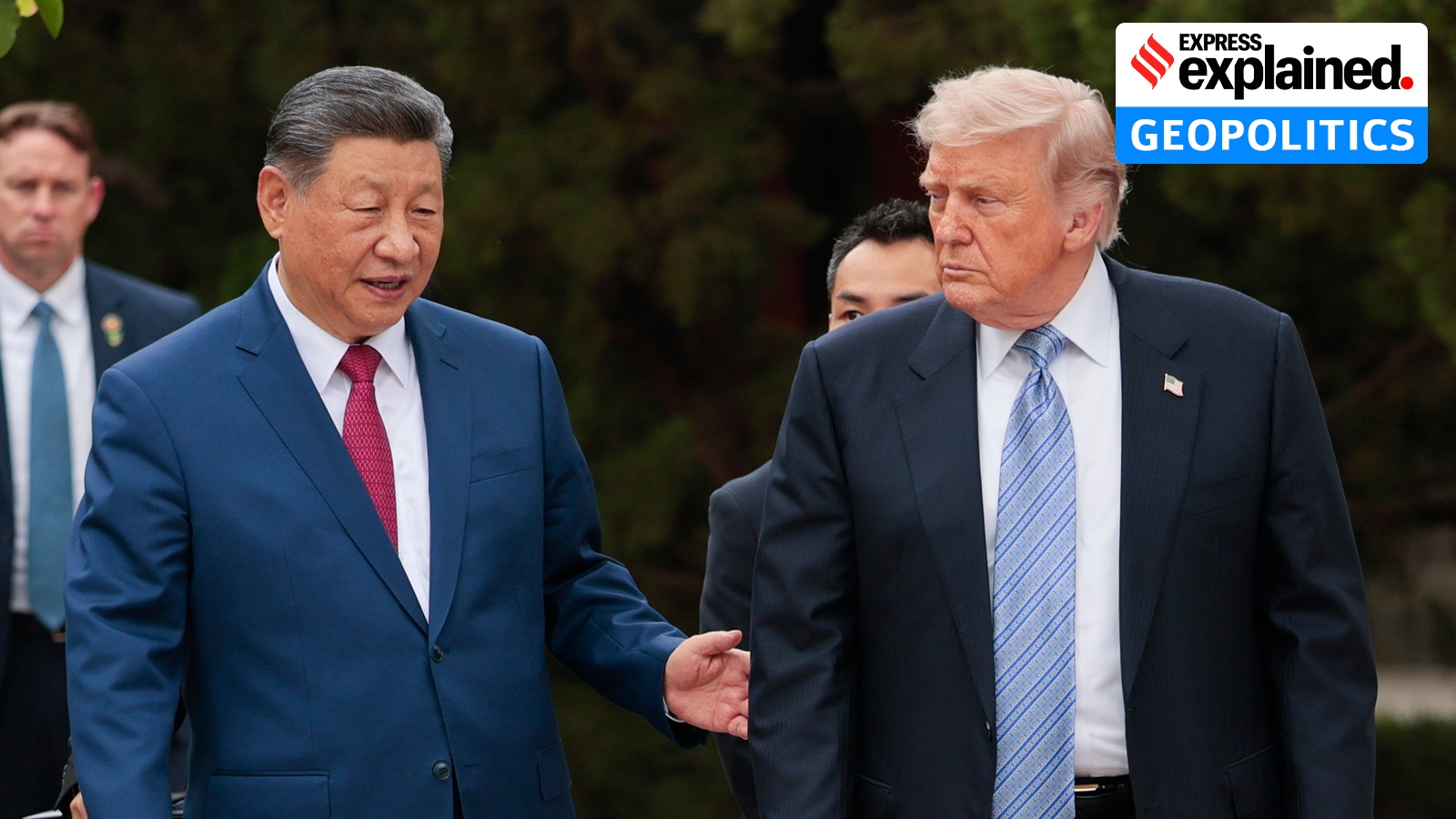
At the recent US-China summit in Beijing, Xi Jinping said the two countries should avoid falling into the ‘Thucydides Trap’.
The Chinese President’s use of the term, referring to an ancient rivalry, has drawn considerable attention across the world, and strategy experts believe he used it not so much as prediction of war but as caution against strategic miscalculation.
What is the Thucydides Trap, can it be used to describe the US-China relationship, and why did Xi invoke it?
The Thucydides Trap refers to a historical pattern where rivalry between a rising and an established power — and the resultant structural pressures such as fear, insecurity, prestige and competition — can drift towards conflict.
The concept of the deadly trap was identified by the ancient Greek historian, Thucydides. Writing about the devastating Peloponnesian War (431-404 BCE) that destroyed two leading city-states of classical Greece, he noted; “It was the rise of Athens and the fear that this instilled in Sparta that made the war inevitable”.
Development of the concept by Graham Allison
It was Dr Graham Allison, political scientist and founding dean of the Harvard Kennedy School (HKS), who coined the term in 2010, to describe structural power transition.
As part of the ‘Thucydides Trap’ project, which Allison directs at Harvard, it was found that over the past 500 years, there were 16 cases where major nations’ rise disrupted the position of the dominant state. Twelve of these rivalries ended in conflict. For instance, during the last century, industrial Germany rattled Britain and Imperial Japan challenged US dominance in the Pacific, leading to World Wars. In contrast, the rise of the US vis-à-vis Britain was a peaceful transition.
Story continues below this ad
In 2015, The Atlantic published an essay, ‘The Thucydides Trap: Are US and China Headed for War’, by Allison, where he argued that the historical metaphor provides the best lens to illuminate relations between the US and China today. Since then, the concept has ignited considerable debate. Presidents Obama and Xi discussed the trap at length during their summit in 2015 at the White House.
During the ‘Senior Executives Programme’ at HKS in 2016, where this writer was also a participant, Allison as faculty had taken sessions on ‘China’s rise’. He had brought out that the ‘long peace’ of over seven decades after World War II, as part of the rule-based framework led by the US, was being taken as ‘normal’, but an increasingly powerful China could unravel this order, hence the need to be cognisant of the ‘Thucydides Trap’.
Allison has outlined the concept extensively in his book Destined for War: Can America and China Escape Thucydides Trap? published in 2017. The book highlights that the ‘Thucydides Trap’ is neither fatalism nor pessimism. Instead, it underscores the need to recognise the tectonic structural stress that Beijing and Washington must master to construct peaceful relationship.
Xi’s invoking of the phrase
The context behind Xi using the phrase was the intensifying tensions between Washington and Beijing. These include strategic rivalry in the Indo-Pacific, trade and technology competition, rare earth and semi- conductor restrictions, economic decoupling, military competition in South China Sea, and most importantly, Taiwan, which could become a trigger point for US-China confrontation.
Story continues below this ad
China has sought to frame relations with the US as a managed competition rather than an uncontrolled confrontation. Xi’s invocation, therefore, sought to serve as a reminder that great powers often enter wars not as a deliberate choice but through miscalculation and unmanaged rivalry.
Trump’s response
Rather than directly engaging with the theory of a rising China challenging an established America, Trump reframed the discussion. He brushed aside the premise that the US had entered the phase of strategic erosion, attributing the period of decline to his predecessor Joe Biden’s administration, and projected continuity of growing American strength.
Notably, Trump also chose not to engage in a broader philosophical or geopolitical discussion on power transition. Instead, he remained focused on practical issues — trade, economic cooperation and stable relations, reflecting his preference for transactional diplomacy over structural strategic debate.
In contrast to Xi’s approach to the summit marked by historic and grand strategy, Trump’s response was through political messaging, prioritising immediate interests.
Broader takeaway
Story continues below this ad
The ‘Thucydides Trap’ has broader relevance in highlighting the dangers associated with the phenomenon of power transition. It serves as cautionary strategic lens rather than deterministic law. The concept per se, has limitations, given that unlike classic rivalries, today, the contemporary powers operate in a deeply interconnected world with overlapping interests and vulnerabilities.
(The Writer is a War Veteran, alum of Harvard Kennedy School, currently Professor, Strategic and International Relations at Lal Bahadur Shastri Institute of Management, Delhi).