

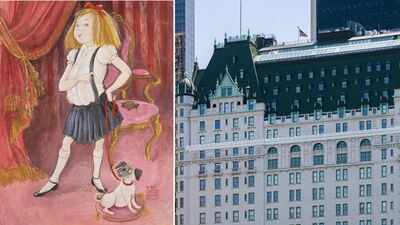
The original Plaza Hotel portrait of Eloise has one of the strangest histories in American illustration. Painted by Hilary Knight in 1956 as a birthday gift for Eloise co-creator Kay Thompson, the tempera-on-board artwork hung in the Plaza’s lobby before disappearing during a Junior League Ball in November 1960. More than half a century later, after being found in a dumpster and forgotten in Knight’s closet, it sold at Bonhams for $100,000.The painting’s journey was as lively as the character it depicted. It became national news when it vanished, was eventually recovered frameless, then spent roughly 50 years rolled up in storage before being rediscovered for a 2017 exhibition at the New-York Historical Society. Bonhams listed it in its December 5, 2018 Fine Books and Manuscripts sale, The World of Hilary Knight, with an estimate of $100,000 to $150,000.
Eloise became part of the Plaza
As reported by Art & Object, Eloise was created by Kay Thompson and illustrated by Hilary Knight. The mischievous six-year-old who lived at the Plaza Hotel became one of the most influential children’s book characters of the 20th century, and her connection to the hotel became inseparable from the story’s charm.Knight painted the original portrait in 1956 as a birthday gift for Thompson. The artwork captured Eloise’s irrepressible personality and soon became a physical tribute to the Plaza’s most famous imaginary resident.Thompson loaned the painting to the Plaza, where it hung ceremonially in the lobby. Its presence turned the fictional child into part of the hotel’s public identity, giving visitors a tangible link to the character who had made the Plaza feel like a playground.
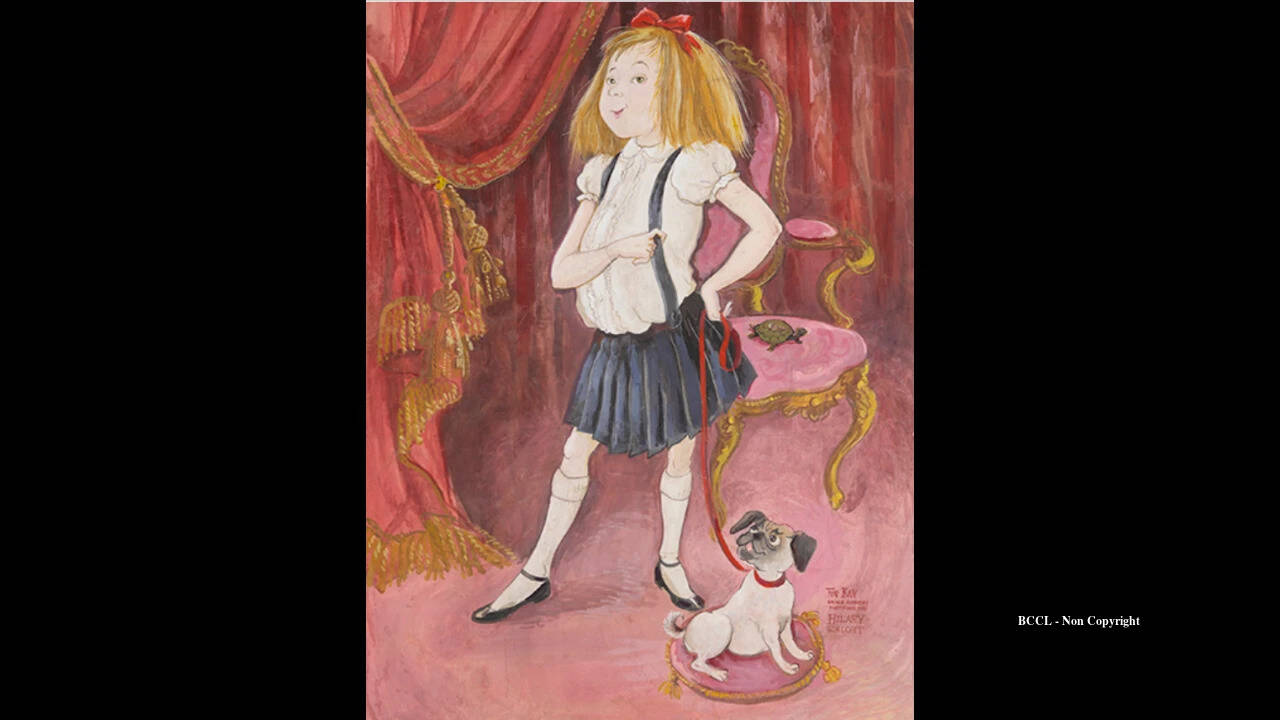
Photo credit: Bonhams
The night the portrait disappeared
The portrait vanished on the night of the Junior League Ball at the Plaza in November 1960. Knight later recalled, according to Art & Object, that Thompson calling him with the memorable explanation: “Drunken debutantes did it!”The theft quickly attracted widespread attention. The story appeared in newspaper columns, and Walter Cronkite confirmed it on the evening news. Despite the publicity and the search that followed, the portrait did not resurface at the time. For a while, the original Eloise portrait seemed lost. Its disappearance added an unexpected chapter to the Eloise legend, turning a beloved illustration into a small New York mystery.
Found in a dumpster, then forgotten
Some years later, Knight received a call with surprising news. The painting had been found in a dumpster, stripped of its frame. Once identified as the missing Plaza portrait, it was returned to him. By then, Knight had already created a replacement for the Plaza. His new oil painting still hangs in the hotel, while the recovered original went into his closet. He rolled it up and, according to Bonhams, forgot about it for the next 50 years.The artwork’s survival is remarkable. A tempera painting on board could easily have been damaged beyond repair after being stolen, discarded and stored rolled up for decades. Instead, it remained recognisable enough to be identified and eventually restored to public view.
Rediscovery and auction
The portrait reappeared in 2017 for an Eloise exhibition at the New-York Historical Society. That exhibition revived interest in the original artwork and set the stage for its first appearance at auction.Bonhams included the painting in The World of Hilary Knight, a December 5, 2018 sale in New York. The auction house described the work as a tempera-on-board portrait and gave it an estimate of $100,000 to $150,000.The final result was $100,000, according to ArtDaily. While that figure fell at the lower end of Bonhams’ estimate, it confirmed the enduring cultural and commercial value of Eloise and Knight’s original vision.
Why the portrait still matters
Eloise is more than a children’s book character. She represents a particular vision of New York: playful, privileged, chaotic and full of possibility. Knight’s illustrations helped define that world, and the Plaza portrait became one of the most recognisable images associated with it.The painting’s history also reflects how artworks can acquire value beyond their materials. A tempera portrait painted as a personal gift became a stolen hotel treasure, a discarded object, a forgotten closet find and finally a six-figure auction lot.Its sale at Bonhams closed one chapter, but the story remains irresistible. Eloise may have been imaginary, yet the portrait of her had a real life full of theft, loss, recovery and rediscovery, making it one of the most memorable artworks ever connected to New York’s Plaza Hotel.