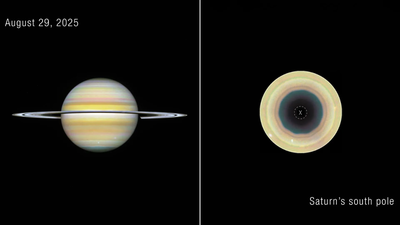
A mysterious ripple spotted on Saturn from an amateur astronomer’s backyard in Australia has helped lead to the identification of a giant, 10-sided atmospheric wave around the planet’s south pole. Trevor Barry, a former miner from Broken Hill, New South Wales, had been observing Saturn from his homemade backyard observatory when he noticed an unusual feature in 2024. His observations became part of an international research effort that ultimately confirmed the structure using years of observations from NASA‘s Hubble Space Telescope. The findings were published in the journal Science Advances. According to NASA, the feature is the first large, regular-sided jet pattern identified in Saturn’s southern hemisphere.
From a backyard telescope to a planetary discovery
Barry has been observing the night sky and collecting planetary images from his observatory in Broken Hill since the early 2000s. His observations of Saturn became particularly important in 2024, when he noticed what appeared to be a subtle ripple developing around the planet’s southern polar region. He shared his observations with Agustín Sánchez-Lavega, a researcher at the University of the Basque Country in Spain with whom he had worked since 2008. Barry initially described the feature as a “ripple”, but Sánchez-Lavega recognised that it could represent something more significant and encouraged him to continue monitoring it.Barry’s observations were not enough by themselves to establish the nature of the feature. However, they provided an important piece of evidence that could be compared with observations from professional astronomical facilities. The research team also included French amateur astronomer Jean-Paul Oger, who, like Barry, contributed observations through the Planetary Virtual Observatory Laboratory, a platform operated by the University of the Basque Country that collects ground-based images of planets from observers around the world.
Hubble reveals Saturn’s 10-sided wave
The feature eventually emerged as a striking geometric pattern around Saturn’s south pole. Rather than forming six sides like Saturn’s famous northern feature, the newly identified structure has 10 sides, giving it the description “decagon”. NASA says the decagon is a large atmospheric wave embedded within one of Saturn’s powerful jet streams. Observations show that it extends through multiple layers of the planet’s atmosphere, indicating that it is not simply a feature visible at one cloud level. The discovery was confirmed using observations from Hubble, whose view from space provides sharper images of Saturn without the blurring caused by Earth’s atmosphere.Researchers examined Hubble observations collected over several years through NASA’s Outer Planet Atmospheres Legacy, or OPAL, programme. Although the decagon became much clearer in later observations, scientists found evidence that the structure was already beginning to appear in Hubble data from 2023. This long-term record was crucial because it allowed researchers to study the feature as it developed rather than treating it as a single isolated observation.
Saturn already has a famous polar shape
The discovery is particularly intriguing because Saturn’s north pole is already home to an extraordinary geometric atmospheric feature. NASA’s Voyager spacecraft first observed the six-sided northern polar pattern, known as Saturn’s hexagon, during flybys in 1980 and 1981. The structure has remained visible for decades, making it one of the most recognisable atmospheric phenomena in the solar system.Scientists had looked for a comparable structure around Saturn’s south pole for years. NASA notes that researchers had been searching for a southern counterpart to the northern hexagon in Hubble observations since 1990. Even NASA’s Cassini spacecraft, which studied Saturn from 2004 to 2017, did not reveal evidence of a comparable long-lived formation in the southern hemisphere. Therefore, the newly discovered decagon differs from simply finding another long-established feature. Researchers now have an opportunity to watch a large atmospheric pattern develop.
Why the discovery matters
The southern decagon is not simply a geometric shape appearing in Saturn’s clouds. It is associated with the planet’s atmospheric circulation and powerful jet streams. NASA researchers say the feature appears to be evolving and strengthening. Its presence in several atmospheric layers could provide clues about how Saturn’s atmosphere moves and how large-scale waves form within rapidly rotating giant planets. However, scientists still do not know exactly when the decagon formed or what caused it to develop. The available observations leave an important gap. Saturn’s south pole was not readily visible from Earth for part of the period before it came back into view in 2023, while Cassini’s mission ended in 2017. That means researchers cannot pinpoint the moment when the structure first appeared.
Amateur astronomers played an important role
Barry’s involvement highlights how modern planetary science can draw on observations made outside major research institutions. His equipment is based in his own backyard in Broken Hill, yet his observations became part of an international scientific investigation involving researchers, Hubble and data collected over several years. NASA identifies Barry and Oger among the amateur astronomers whose ground-based images helped reveal the subtle southern-polar pattern.For Barry, the discovery also means his hometown appears alongside major scientific institutions and researchers in the work. ABC News reported that he plans to continue observing Saturn from his backyard as scientists try to understand how the feature changes over time.
Scientists will keep watching Saturn
The discovery raises several questions that cannot yet be answered. Scientists want to determine how the decagon formed, how long it will survive and whether it could eventually settle into a stable configuration like Saturn’s northern hexagon. Further observations from Hubble, NASA’s James Webb Space Telescope and computer modelling could help researchers investigate the atmospheric conditions behind the unusual pattern.For now, Saturn has offered astronomers something they had never previously seen there: a large, regular-sided atmospheric wave around its southern pole. And the story of that discovery began not only with a space telescope, but with a former Australian miner watching the ringed planet through a telescope in his backyard.