China is viewed more favourably than the United States in many countries today, according to a recent survey conducted by the think tank Pew Research Center. Pew has been tracking views of the two nations since 2002, and this year’s report saw many firsts, including China enjoying a better perception in relation to the US. It also marks a reversal after Covid-19 — when the favourability of China hit near-historic lows.
Speaking of Covid-19, China released economic data for Q2 (April to June) that showed a GDP growth rate of 4.3%. China has targeted an annual growth rate of between 4.5 and 5% for this year, and Q1 growth rate stood at 5%. However, the latest quarterly growth rate was among the lowest in years, with a lower figure last reported during 2022, amid Covid-19 restrictions.

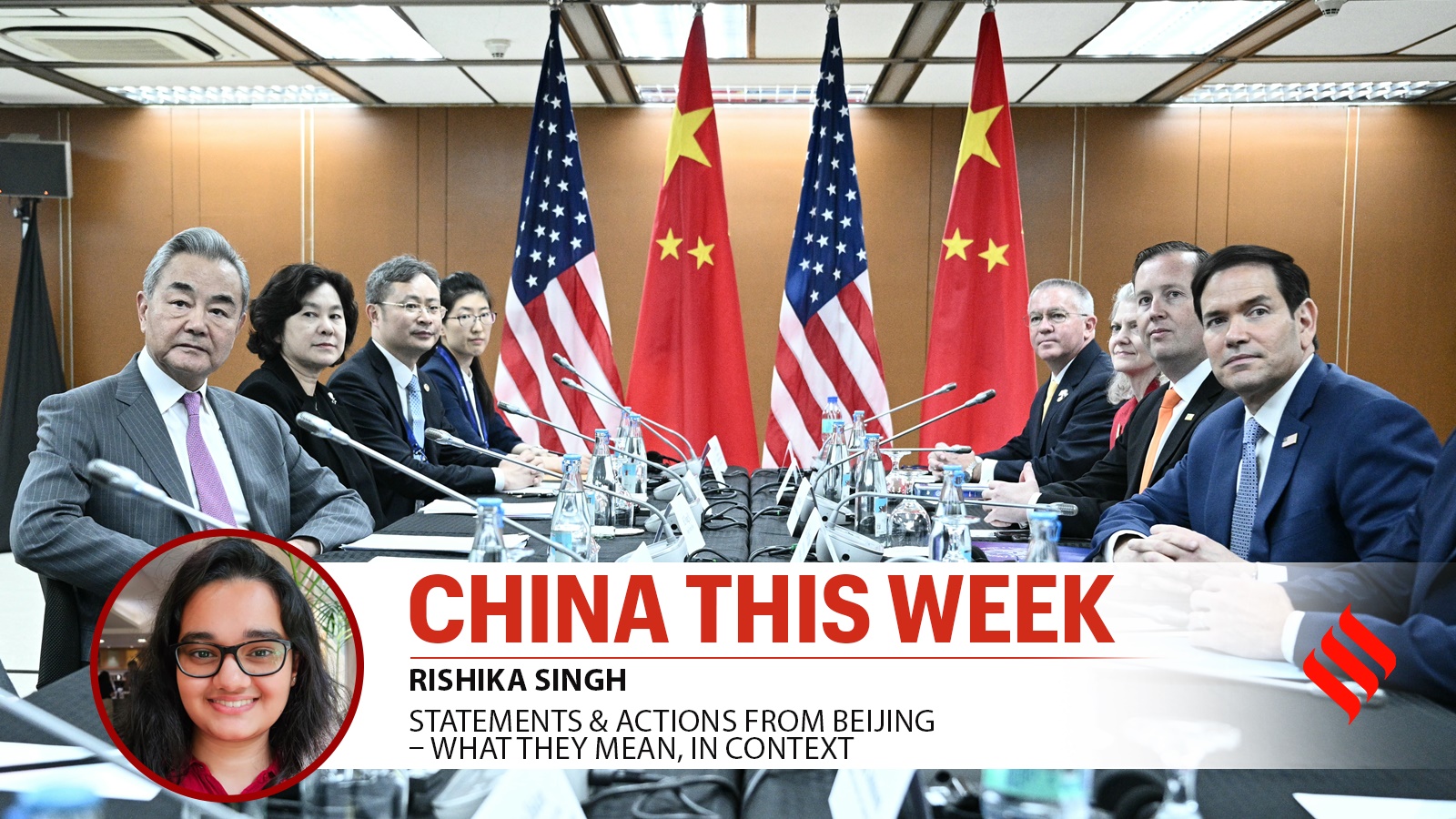
Finally, we look at a meeting between US Secretary of State Marco Rubio and Chinese Foreign Minister Wang Yi, who discussed areas of mutual significance ahead of Chinese President Xi Jinping’s official visit to the US in September.
Here is a closer look at these developments:
1. China, Xi enjoy better perception than US, Trump
The report surveyed 42,151 people across 36 countries, including India, the UK, Israel, Pakistan, Singapore, Sri Lanka and Bangladesh, between February and May. Some of its key findings are:
*China is now seen more positively than the US in most of the 36 countries surveyed.
*While many people still lack confidence in Xi, positive views of him have become more widespread, and more people overall say they have confidence in Xi than in Trump.
*One area where the US still gets a higher rating: More say the US government respects the personal freedoms of its people than say the same of the Chinese government.
Story continues below this ad
*Pakistan recorded the most favourable views about China compared to the US within the country, while Israel had the most favourable views of the US than China. India also had more positive views of the US than China.
*China being assessed more positively than the US is a relatively recent shift in most countries surveyed. This reversal in favorability is often driven by shifting views of both superpowers: improving views of China coupled with worsening views of the US.
UPSHOT: Many think tanks have conducted similar surveys in the past with different outcomes, although at least one other major poll from Gallup also showed China seeing an uptick in perceptions. Pew’s data help show a measurable impact of a turbulent year for US policy — and how the world has perceived it — under Trump 2.0
What is also noteworthy is that while many developed and Western nations continue to view the US more favourably, the gap has narrowed.
Story continues below this ad
China, on the other hand, is not viewed as well in its own neighbourhood, with four of the six countries that put the US ahead located in the Asia-Pacific region: India, Japan, the Philippines and South Korea. Despite their economic ties with China, many of these countries have engaged or continue to engage with it on major security and territory-related issues.
China’s heavily censored media published multiple stories celebrating the report. An editorial in the Communist Party’s mouthpiece, Global Times, was headlined: “Is it really surprising that a US poll finds China’s popularity rising?”
In a thinly veiled comment, it argued that “Some major powers pursue the erratic policies, repeatedly resorting to military force or tariffs as tools of coercion, triggering humanitarian disasters and economic turmoil time and again. By contrast, the stability and predictability of China’s policies give people around the world reassurance.”
Story continues below this ad
2. What China’s Q2 economic data reveals
Despite lower-than-expected overall growth, Chinese exports grew by 27% in June compared to last year. AI-related exports also played a role.
At the same time, domestic consumption remained low. China’s fixed-asset investment (in assets required over the long term, such as equipment and office space) shrank 5.7% year-on-year from January to June, Reuters reported.
UPSHOT: The latest data continue to reflect several longstanding problems of mismatch and structural problems within the Chinese economy. Consider this from a report in The Guardian: “Monthly car exports topped 1m for the first time in June, but Wednesday’s statistical release showed domestic vehicle sales plummeted by more than 16%.”
Story continues below this ad
In the absence of significant domestic demand, due to factors such as youth unemployment and a years-long real estate crisis, Chinese companies have looked outward to drive economic growth. Whether this can sustain is the question, as offering low prices to remain competitive further erodes their own profitability and raises complaints of unfair practices from domestic industries in regions like Europe.
While the state has of late identified an “overcapacity” problem in manufacturing, there is little incentive to bring about drastic changes to a system that has worked so far. And, with growth figures not too far off from the annual target still, an economic stimulus package may not be on the horizon.
3. Marco Rubio and Wang Yi meet
Wang met Rubio in Manila on the sidelines of a gathering led by the Association of Southeast Asian Nations (ASEAN), where Rubio said both sides had to manage their differences and make sure they did not go out of control, Reuters reported.
Story continues below this ad
UPSHOT: Among the major issues raised during the meeting was “Beijing’s conduct in the South China Sea,” with Rubio saying that regional US allies faced “new and coercive threats”. China’s coast guard and the Philippines’ navy personnel recently reported an altercation.
The region continues to frequently see such skirmishes, over a decade after an arbitration award set aside China’s territorial claims in the region. China has rejected the jurisdiction of the body and the ruling since the beginning, and several reports from its state media criticised it on its anniversary.
Alongside the potential that the region holds for extracting oil and gas, the claims have also come to form a part of China’s larger aggressive positioning in its neighbourhood. With the 2022 election of the Philippines’ President Ferdinand Marcos Jr., who has adopted a sterner approach towards China compared to his predecessor, incidents have increasingly flared up in the region.