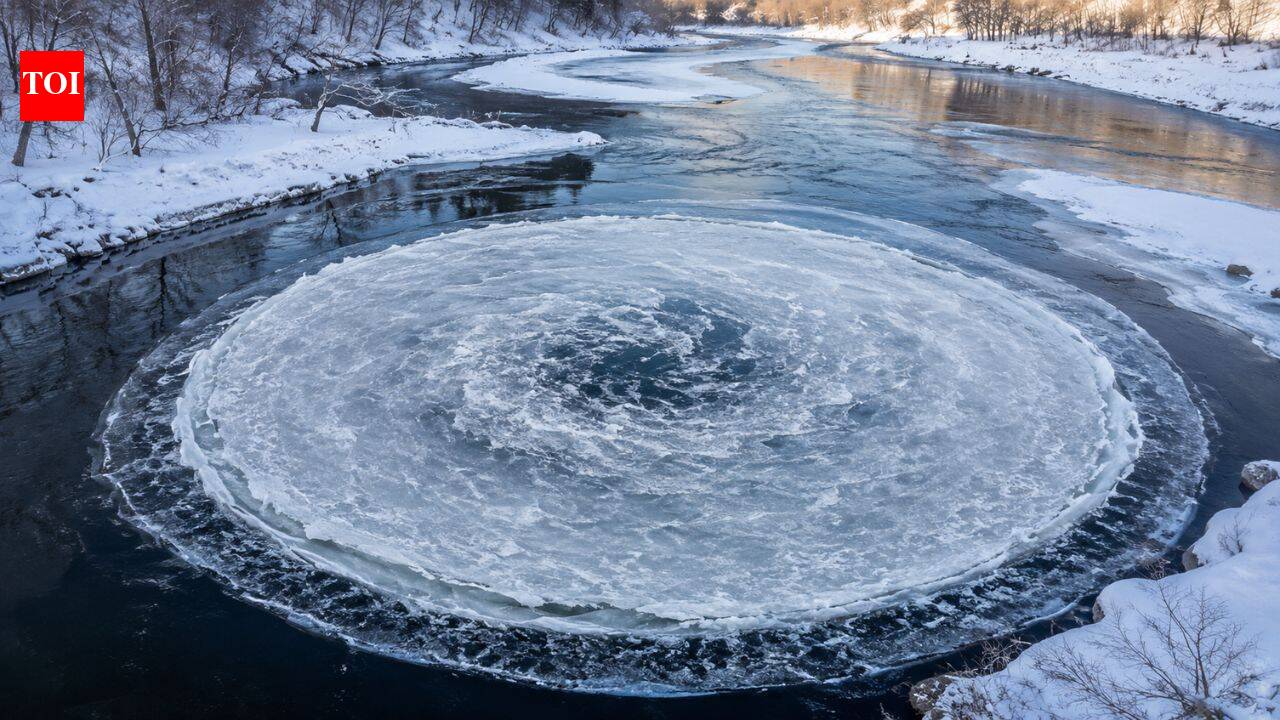
In the colder parts of Canada, winter occasionally produces a sight that seems more suited to a drawing than a river. A large disc of ice appears on the water, almost perfectly round, turning so slowly that its movement is easy to miss. These formations have been reported in places such as Quebec, Alberta and British Columbia, where long winters and steady waterways create the right conditions for unusual ice behaviour. To anyone seeing one for the first time, the obvious question is how nature manages to produce something so symmetrical. The answer lies in a combination of flowing water, changing temperatures and a few quirks of physics that only become visible when rivers begin to freeze.
How river currents and eddies shape giant spinning ice circles in Canada
Long before scientists began studying ice circles in laboratories, observers suspected that river currents played an important role. The idea was fairly straightforward. A sheet of young ice breaks free from the surrounding surface and becomes trapped within a slow-moving whirlpool, known as an eddy. As the slab turns, its edges brush against neighbouring ice and the riverbank, gradually wearing away rough corners.According to Canadian Geographic, over time, that constant grinding smooths the shape into a rounded disc. The process is similar to how pebbles become polished after years in flowing water. Earlier explanations for ice circles focused largely on this whirlpool effect, particularly after several well-known examples were documented in rivers where moving currents were clearly present.That theory still explains part of the story. The circular shape itself is strongly linked to rotation within the water, and many of the largest ice circles have appeared in rivers where eddies naturally form behind bends or obstacles.
Hidden physics that makes ice circles spin on rivers
The spinning motion, however, appears to involve more than river flow alone. According to the study published in Physical Review E, titled “Rotation of melting ice disks due to melt fluid flow”, physicists from the University of Liège investigated why floating ice discs sometimes rotate even when the movement of the surrounding water seems too weak to explain it. Their experiments revealed an unexpected process taking place beneath the ice.According to the researchers, melting ice cools the water directly underneath it. As that water approaches 4°C, the temperature at which freshwater reaches its greatest density, it becomes heavier and sinks. This downward movement creates a vertical plume beneath the disc. As the plume develops, a small vortex forms underneath, producing a rotating flow.The team observed that this hidden vortex could transfer motion to the ice above it. In effect, the water beneath the disc begins turning first, and the ice gradually follows. The researchers wrote that the rotation results from the vortex generated by the descending plume of dense water, which then induces the ice to spin through friction between the water and the floating disc.
Why Canada’s rivers are ideal for ice circle formation
Ice circles have been recorded in several countries, including Russia, the United States and parts of northern Europe. Yet Canada’s rivers provide conditions that seem particularly favourable.Many waterways remain cold for long periods while still maintaining enough flow to create local eddies. Winter temperatures are often low enough to produce fresh ice, but not always cold enough to freeze entire rivers solid. That combination allows detached ice sheets to continue floating and rotating rather than becoming locked in place.As per Canadian Geographic, calm weather also helps. Strong winds can disrupt the delicate balance needed for a disc to remain stable. When conditions stay relatively quiet, a rotating slab can continue turning for hours or even days, slowly refining its shape.Some recorded examples have reached impressive sizes. While many are only a few metres across, others have expanded into giant floating circles large enough to be spotted easily from bridges or nearby riverbanks.
Why ice circles are a natural winter phenomenon
Despite their unusual appearance, ice circles are not evidence of anything mysterious. They are the result of ordinary natural processes acting together in a particularly neat way.A free-floating piece of ice, a gentle river current and the unusual behaviour of water near 4°C can combine to produce one of winter’s most striking patterns. What looks at first like a carefully crafted geometric shape is really the outcome of moving water responding to temperature differences.For most of the year, those forces remain hidden beneath the surface. During a Canadian winter, they occasionally reveal themselves as a slow-turning circle of ice, quietly tracing the physics of a river in motion.