5 min readJul 13, 2026 10:10 PM IST
In theory, Alexander Zverev should have been the happier man walking off Centre Court on Sunday. He out-aced Sinner 17 to 15 and landed 80 per cent of his first serves to Sinner’s 66. He lost anyway, 6-7(7), 7-6(2), 6-3, 6-4.
The difference wasn’t power, it was what each man did with the points that followed. Sinner won 80 per cent of points on his first serve to Zverev’s 71, and 65 per cent on his second to Zverev’s 61. He also out-returned Zverev, 43 return points to 34. Whenever the match needed deciding, Sinner had more ways to decide it.
That efficiency has been rebuilt from close to nothing. Two years ago this would have sounded absurd. At the 2025 US Open final, also against Carlos Alcaraz, Sinner’s first serve landed just 48 per cent of the time. He lost. Days later, leaked practice footage showed him back on court working on the shot that had failed him under exactly that pressure. He won his next tournament.
The rebuild started in 2022, under Riccardo Piatti, with a platform serve, feet planted wide, the racket arm arriving from well behind the body. First-serve percentage sat below 60. When Piatti gave way to Simone Vagnozzi, the serve was the first thing he wanted to fix. Jim Courier remembers cornering him at the 2022 Miami Open to ask the plan. “The serve, it’s got a hitch in it,” Vagnozzi told him. “We’ve got to get rid of the hitch and smooth it out. I want the toss more in front so he can be more offensive.”
By mid-2023, Vagnozzi and Darren Cahill had switched Sinner to a pinpoint stance, back foot drawn up to meet the front at contact, modelled on John Isner, a six-foot-ten American who serves nothing like Sinner otherwise plays. It made no obvious sense on paper. It took years to show in the numbers: gains in 2023, more in 2024, and by 2026, a first-serve percentage above 65 with roughly 80 per cent of those points won.
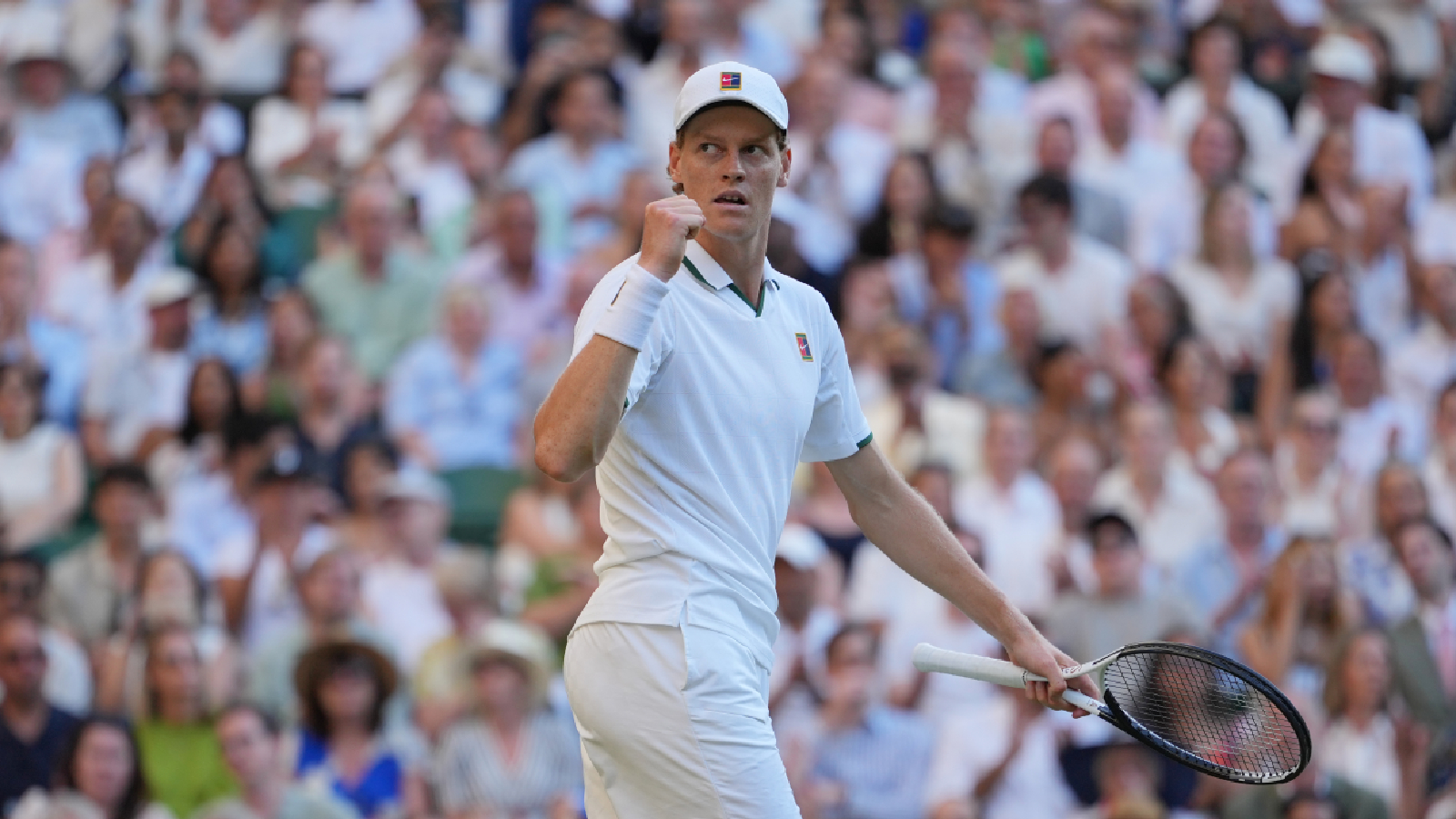 Jannik Sinner of Italy celebrates after winning a point against Alexander Zverev of Germany men’s singles final at Wimbledon Tennis Championships in London, Sunday, July 12, 2026. (AP Photo/Kin Cheung)
Paolo Bertolucci, the former Italian Davis Cup player who has watched the rebuild unfold in Gazzetta dello Sport, has pointed to smaller, recent adjustments beneath the mechanical one, the toss brought closer to the body, the right elbow held further back while loading. Together, he has written, they turned the serve from a shot Sinner had to protect into one that protects him.
“You cannot attack Jannik Sinner’s first serve,” Djokovic said after his own straight-sets semi-final defeat, in which he lost only five points behind it. “You can try to read it, block it, get it back and play.” Asked to explain the shift, he didn’t stop at mechanics. “It’s become an incredible weapon in the last two years. Very unpredictable, great variety, great balance. He is using his height extremely well.”
Story continues below this ad
The scale of it becomes clear against history. Sinner is the first Wimbledon champion since Roger Federer in 2003 to win without losing a single service game across the semi-final and final. Across both matches, he faced exactly two break points, one against Djokovic, one against Zverev, and saved both.
Sinner’s own account, offered after beating Jan-Lennard Struff in the quarter-final, was plainer: he and his team changed the motion, the toss, the timing, “many things,” not chasing pace so much as learning “the right serve at the right moment.”
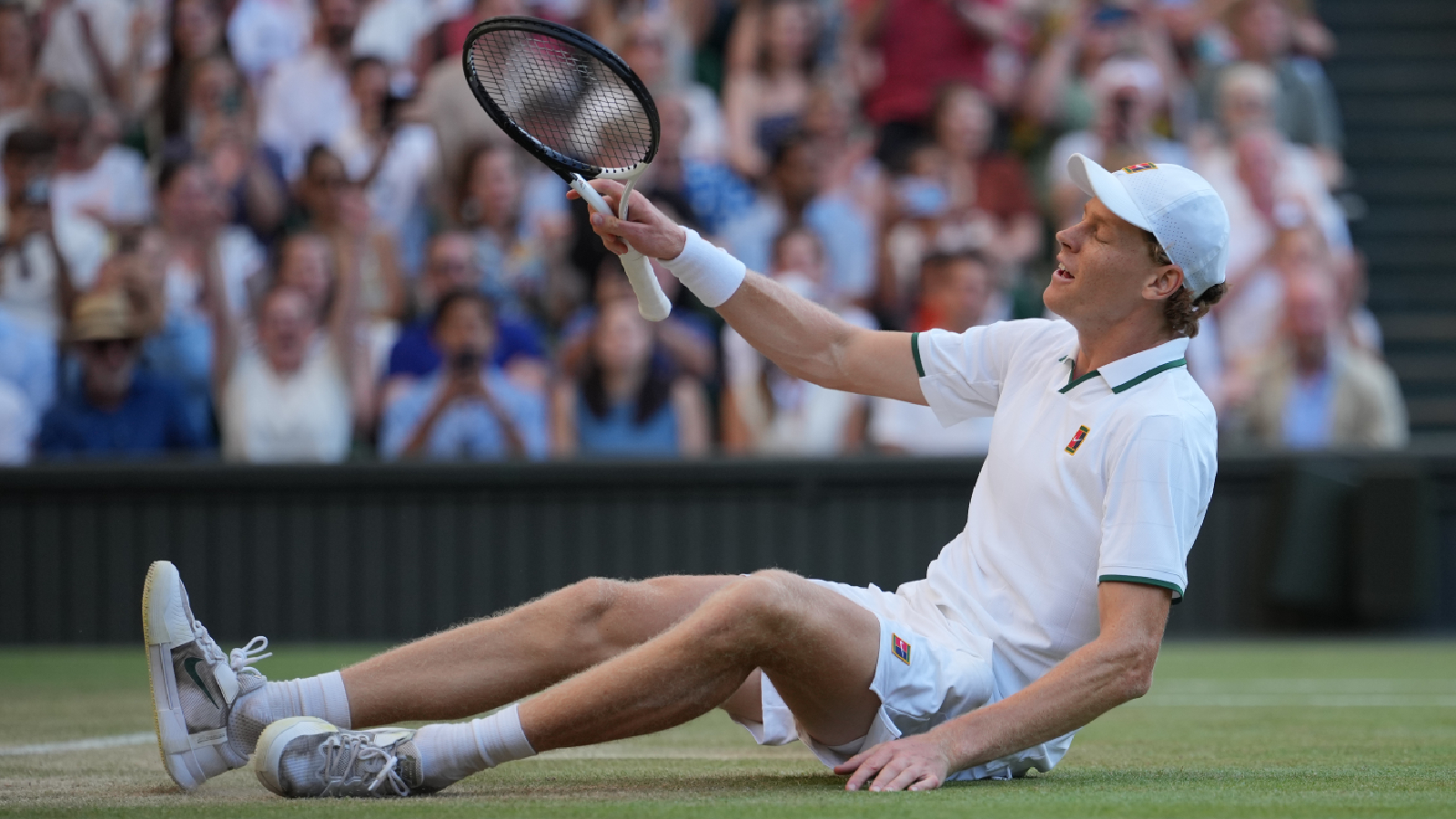
That composure had a specific test on Sunday. Two hours forty-two minutes in, locked at 3-3 in the third set, Zverev earned his first break point of the match, thirty-one straight holds between them to that point. He didn’t get to use it. Sinner played a drop shot, Zverev pushed off to chase it, and slipped, hyperextending the same knee he’d injured two years earlier. Sinner helped him up. Play resumed, but something had changed. “I was struggling to push off on the serve,” Zverev said afterward. “My serve speed went down… the fall didn’t help me in the third set.” Two games later, serving with a compromised push-off, he was broken for the first time all match. Sinner served out the set. In the fourth, Sinner created three break points in a single, gripping seventh game, at one point scrambling to the turf to keep a rally alive, converting the third, an in-form Zverev cracking under sustained pressure this time, not misfortune. Sinner faced one break point in the entire final, and saved it.
Carlos Alcaraz, sidelined all season by a wrist injury, is still to come back to a tour where the one man who might have beaten this version of Sinner hasn’t had the chance to yet.