For someone who regularly disparages France in matters of war and commerce, President Trump is not above appropriating its culture. Last year, Mr. Trump ordered up a military parade inspired by the Bastille Day celebration he was invited to watch in Paris in 2017 by President Emmanuel Macron.
Now, Mr. Trump is pressing ahead with a plan to construct a triumphal arch in Washington that he envisions, among other things, as one-upping the Arc de Triomphe in the French capital. That has prompted jaded reactions in France, a land that is no stranger to political leaders afflicted with edifice complexes.
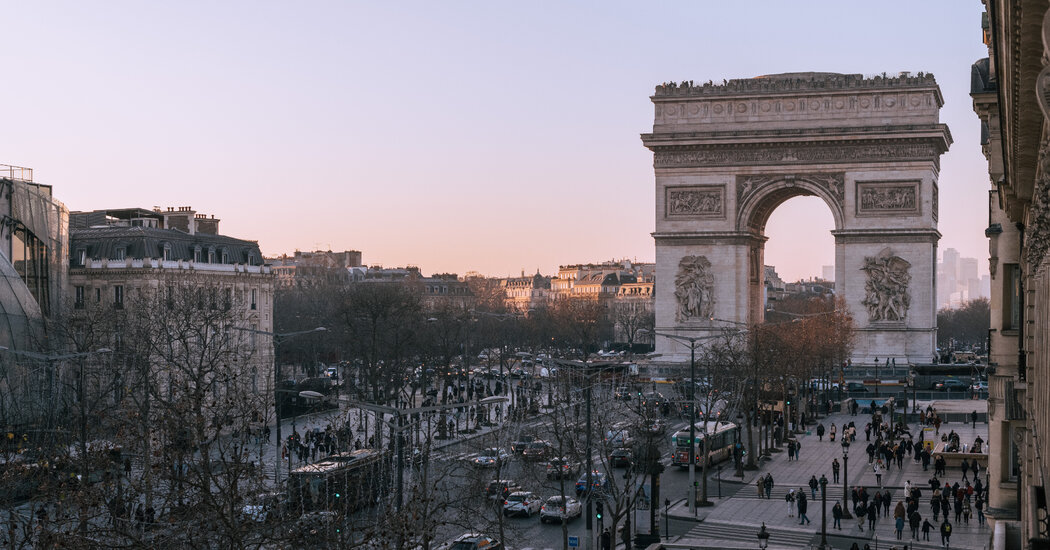
It has also cast a fresh light on the Arc de Triomphe and its tangled history, which could serve as a reminder to Mr. Trump of both the ephemeral nature of power and the contested legacy of monuments.
Conceived in 1806 by Napoleon as a tribute to military glory after the Battle of Austerlitz, the Arc de Triomphe has come to symbolize very different things in modern France. Sacred tomb for France’s unknown soldier. Jubilant destination for soccer fans after France won the World Cup in 2018. Reviled target for the “yellow vest” protesters, who vandalized it later that year.
The arch that crowns the Champs-Élysées “embodies our joys, our sorrows and also our anger,” said Jean-Yves Le Naour, a French historian.
But it does not, in any conspicuous way, embody Napoleon. Construction was halted for nearly a decade in 1814, when the emperor was first vanquished and driven into exile. Louis-Philippe, the reconciliation-minded king under whom the arch was completed in 1836, decreed that it should honor not just Napoleon’s imperial army but all those who fought in France between 1792 and 1815.
Commemorating the different chapters of France’s turbulent history in the sculptures that adorn the arch was no simple task, given Napoleon’s inglorious final defeat at Waterloo. “We had launched an arch of triumph for a defeated nation,” said Isabelle Rouge-Ducos, a scholar of 19th-century art.
France’s decision after World War I to honor an unidentified soldier by interring him beneath the arch transformed the monument yet again, turning it from “something grandiose into something breathtaking,” said Gabriel Wick, an art historian at New York University who lives in Paris. “Whenever I go there, I feel like I’m in the nave of a cathedral, but without an altar.”
Mr. Trump appears less concerned with the ghosts of history than with winning the bragging rights for tallest arch-themed monument. At 250 feet, counting a winged Statue of Liberty-like figure on top, his version would comfortably exceed the Arc de Triomphe, leaving its storied predecessor, at 164 feet, in the shade.
“The one that people know mostly is the Arc de Triomphe in Paris, France, and we’re going to top it by, I think, a lot,” Mr. Trump assured supporters last December. “The only thing they have is history.”
That history might give Mr. Trump pause, evoking, as it does, the fleeting nature of ambitious rulers. Napoleon was inspired to build a colossal monument by the pyramids of the pharaohs, Ms. Rouge-Ducos said, which he saw in 1798 during his invasion of Egypt with an army of about 36,000 troops.
French commentators often describe Mr. Trump’s ambitions as “Pharaonic.” On a recent morning radio program, the host, Sonia Devillers, noted that Mr. Trump was also building a cavernous ballroom next to the White House and mused about whether his architectural tastes ran to those of a dictator.
Others liken him to Crown Prince Mohammed bin Salman of Saudi Arabia, whose dream of a nearly 110-mile-long city in the desert appears stalled, and Nicolae Ceausescu, the Romanian dictator who built a hulking pile nearly the size of the Pentagon to house his rubber-stamp Parliament before he was deposed and executed in 1989.
And yet Mr. Trump’s penchant for grandiose projects is hardly unfamiliar in France. Long after Napoleon, French presidents have sought to build legacy-defining edifices. Georges Pompidou championed the Pompidou Center, a futuristic cultural hub, in the late 1960s. François Mitterrand initiated the pyramid entrance of the Louvre Museum, designed by the architect I.M. Pei, in the 1980s.
Mr. Mitterrand was also behind the Grande Arche de la Défense, a gigantic postmodern cube in a high-rise business district west of Paris. It was dedicated in 1989, the bicentennial of the French Revolution, much as Mr. Trump’s arch is meant to celebrate the 250th anniversary of American independence.
At 361 feet, Mr. Mitterrand’s arch is even taller than Mr. Trump’s design. The American president, who might have spied the grand arch beyond the Arc de Triomphe while attending the 2017 parade, has not mentioned its larger cousin.
The difference, Mr. Le Naour said, is that the grand arch was dedicated to the preservation of human rights. Constructing an arch in France like the celebratory one envisioned by Mr. Trump would be unthinkable, he said.
“We laugh a bit about it in France, but behind it, there is meaning,” Mr. Le Naour said. “It is glorifying strength. Maybe soon there will be a Russian triumphal arch as well.”