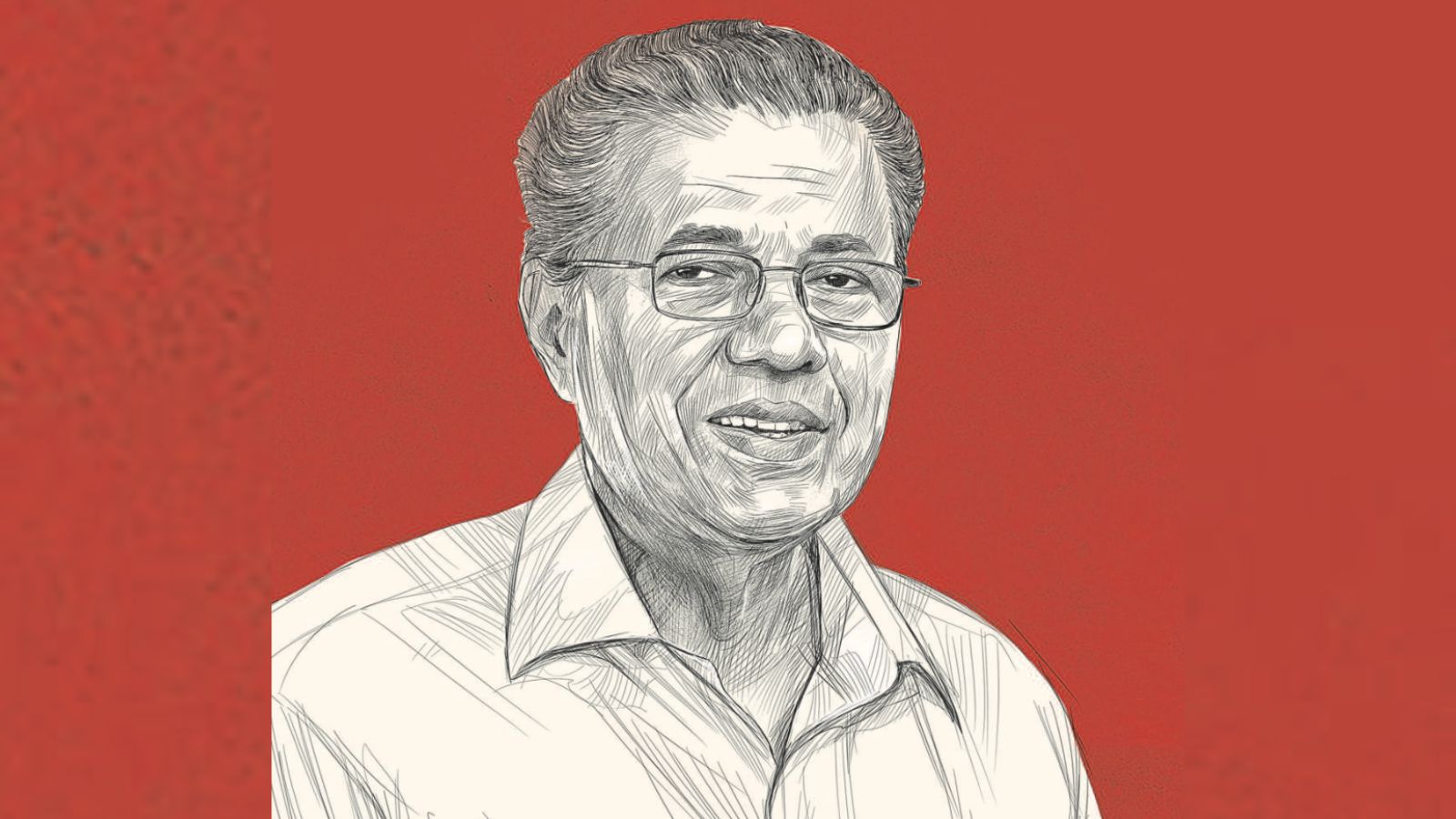
Hamlet did not ask to be remembered. He asked to be understood — and knew, in his final breath, that the two are never the same. There is something of that sorrow in the twilight of Pinarayi Vijayan. A leader who built roads through mountains and broadband amidst poverty. Who governed with the cold precision of someone who had never once confused sentiment with strategy. And yet — power, when it finally leaves, does not ask permission. It simply goes. He is, in the grand Shakespearean tradition, both architect and ruin — the strong hand that steadied the ship, and the fist that, gripped too long, forgot how to open. Kerala moves on. The story stays. And like Horatio on that blood-soaked Danish stage, it falls to the rest of us — breathless, uncertain, grieving a little — to tell it. What remains is not the record he wrote, but the story others will now tell.
Vijayan’s journey started in 1964, at the bottom of a ladder he would spend the next five decades climbing — rung by rung, district committee to state secretariat, not a step skipped, not a year wasted. By 1998, when the incumbent secretary died, he was the only man the party could imagine stepping forward. He would hold the secretaryship for 17 unbroken years.

What he did with those years was not administration. It was architecture. While communist parties across India were collapsing — West Bengal lost, national influence dissolving like salt in rain — Kerala held. Vijayan overhauled the party’s inner culture, purging factional rot with surgical discipline, binding together a coalition that, by every political logic, should have long since splintered. His bruising rivalry with V S Achuthanandan was the most visible crack in the edifice — yet the edifice stood. He was the proof, and Kerala was the argument: That the Left could still govern, still win, still matter.
He became chief minister in May 2016, carrying the same faith that had sustained him through five decades — not in speeches, but in systems; not in promises, but in execution. Through KIIFB’s audacious billions, highways merged into hillsides and coastlines. Through Aardram, hospitals stopped being places people went to die. LIFE raised five lakh rooftops over the roofless. K-FON threaded light through the poverty line itself — gifting bandwidth as birthright. A communist-led state had authored what markets draft but never deliver: Infrastructure as dignity, encoded in fibre, brick, and political will.
When floods and landslides tore into Kerala, the government did not scramble. Years of quiet institutional investment meant Nipah was strangled at its root, Covid-19 turned Kerala into a global case study in statecraft, and floodwaters receded into the Rebuild Kerala Initiative — infrastructure redrawn for a stormier world.
His 2021 victory — guiding the LDF to a second consecutive term, the first coalition in Kerala to achieve this since 1977 — was a verdict that said, at the ballot box, what he had spent decades arguing in committees: The Left, when it governs seriously, earns the right to govern again.
Power, held long enough, begins to leave its bruises on the hand that holds it. Vijayan’s command instinct, so effective in an emergency, hardened over time into something less flexible and more personal. Voices within the CPI(M) itself noted his distance from the rank and file, his imperviousness to internal criticism, a quiet departure from the culture of self-scrutiny which had once been the party’s highest honour. Corruption allegations involving his daughter Veena Vijayan and the Cochin Mineral and Rutile Limited controversy were never judicially proven, but his silence cost more than any verdict could have. The 2024 PR agency controversy, in which a fabricated quote hostile to Malappuram, a Muslim majority district, was nearly planted in a major newspaper through an agency with alleged BJP links, raised questions about political judgment that no rebuttal fully answered.
Kerala spoke in the 2024 Lok Sabha polls, and the CPI(M) was left holding a single seat. By 2025, the opposition’s sweep through local body elections confirmed what many had sensed, but few had said aloud: That the party’s decade of governance, however impressive in blueprint, had stopped breathing at street level. The developmental record gleamed from a distance. Up close, the grassroots felt the cold. Then came the assembly verdict — the LDF collapsing to 35 seats in a 140-seat house, a number that stings beyond arithmetic. Remarkably, the sharpest accusations flew not from the opposition but from within the Left’s own house, pointing with unusual aggression toward one failure: Vijayan’s high-handedness, which transformed what should have been an honourable retreat into something closer to an unravelling. Anti-incumbency may have set the wind blowing, but it was the force of a single, centralised, unaccountable authority that filled the sails.
The very discipline that had built the machine had, over time, made the machine indifferent to the people it was built to serve. A governing party that campaigns on its leader’s face rather than its fingerprints on the world is a painter who signs a canvas they neglected to fill. The paradox of charisma is this: The brighter the leader burns at the campaign’s centre, the deeper the shadow cast over everything the government actually did. What wins elections is the quiet, cumulative weight of a people who feel, in their bones, that someone has been paying attention to their lives.
With M V Govindan holding the secretaryship of the party more in title than in temperament, and no charismatic second rung permitted to step into the light, the entire machinery of both government and party contracted inward toward a single sun: Vijayan. What had once been a movement of collective ideology had re-engineered itself into a one-person solar system — every orbit dutiful, every voice calibrated never to outshine the centre.
Vijayan changed Kerala. That cannot be argued away. He held a party together through national collapse, governed through catastrophe with rare competence, and made Kerala — for a decade — the most serious case the Indian Left had to offer. He is also the man around whom power gathered and hardened, whose late years dimmed what his early years had built, whose greatest virtues — discipline, control, single-mindedness — carried, as all great virtues do, the quiet seed of their own excess.
Pinarayi Vijayan is not asking to be remembered. He asks, through every road built and fibre cable laid, to be understood. Whether the story others now tell will honour that distinction — that, finally, is not his to decide.
Kamalram Sajeev is Chief Editor, truecopythink.media