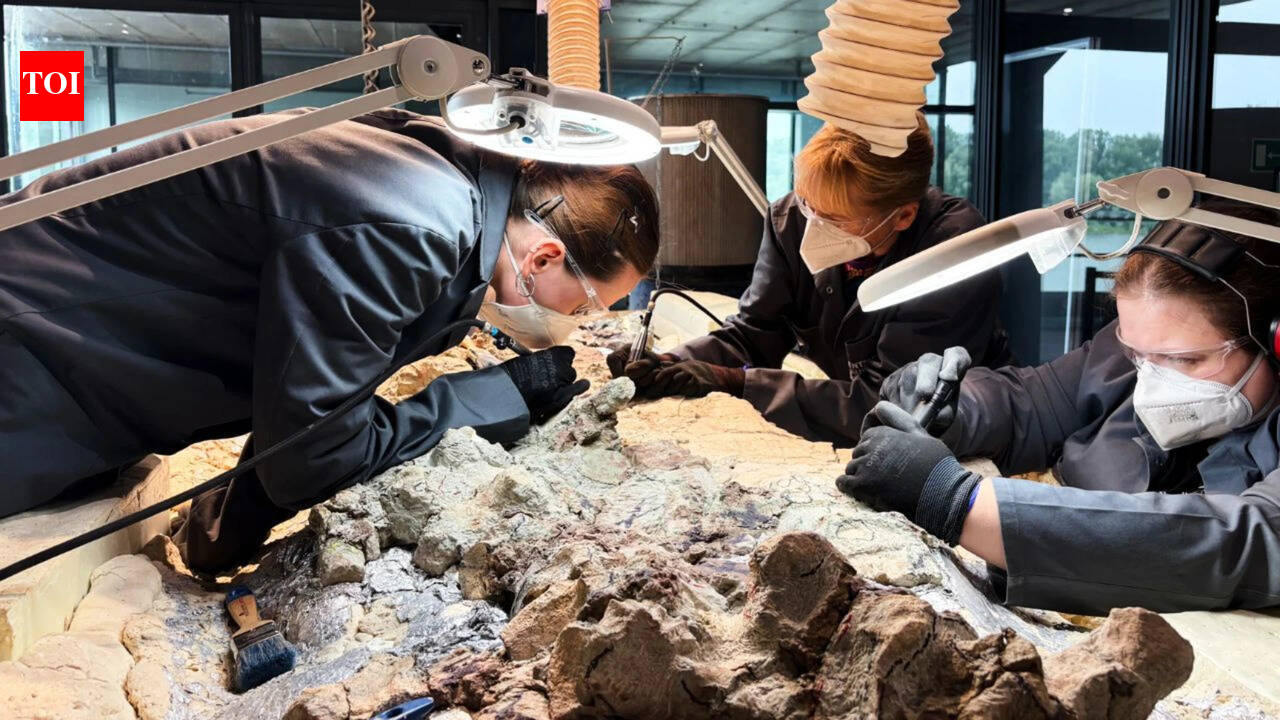
A huge fossilised skeleton weighing 1,300 kilograms (2,865 pounds) that was found in southern Poland is currently being chipped out of solid rock by a group of more than 2,000 public volunteers.According to a report by the Associated Press, this unusual public science project is happening inside a special glass-walled lab on the ground floor of Warsaw’s Copernicus Science Centre. Museum visitors frequently stop on the other side of the glass wall to watch as volunteers wearing safety goggles use special tools to clean the fossil. Children point with excitement while parents look at the massive creature the bones once belonged to.The careful cleaning work needs great focus. Each bone must be cleared from the rock around it millimetre by millimetre using a small air-powered chisel. The tool’s thin needle gently breaks away the hard stone, while special ultraviolet light shows the exact line where the fossil bone ends and the rock begins.The project relies completely on everyday citizens instead of expert geologists or fossil scientists. The helpers include managers, cleaners, tattoo artists, and local people from many non-scientific jobs. After getting basic training, volunteers receive safety gear and join supervised two-hour chipping sessions.Tatyana Kozyk, the leader of the volunteer teams, shared the deep feeling helpers get while working on the old bones.“I imagine that those bones were lying underground for 240 million years and I am the first human on earth to touch them,” said Kozyk. “I’m still trying to wrap my head around this experience.”
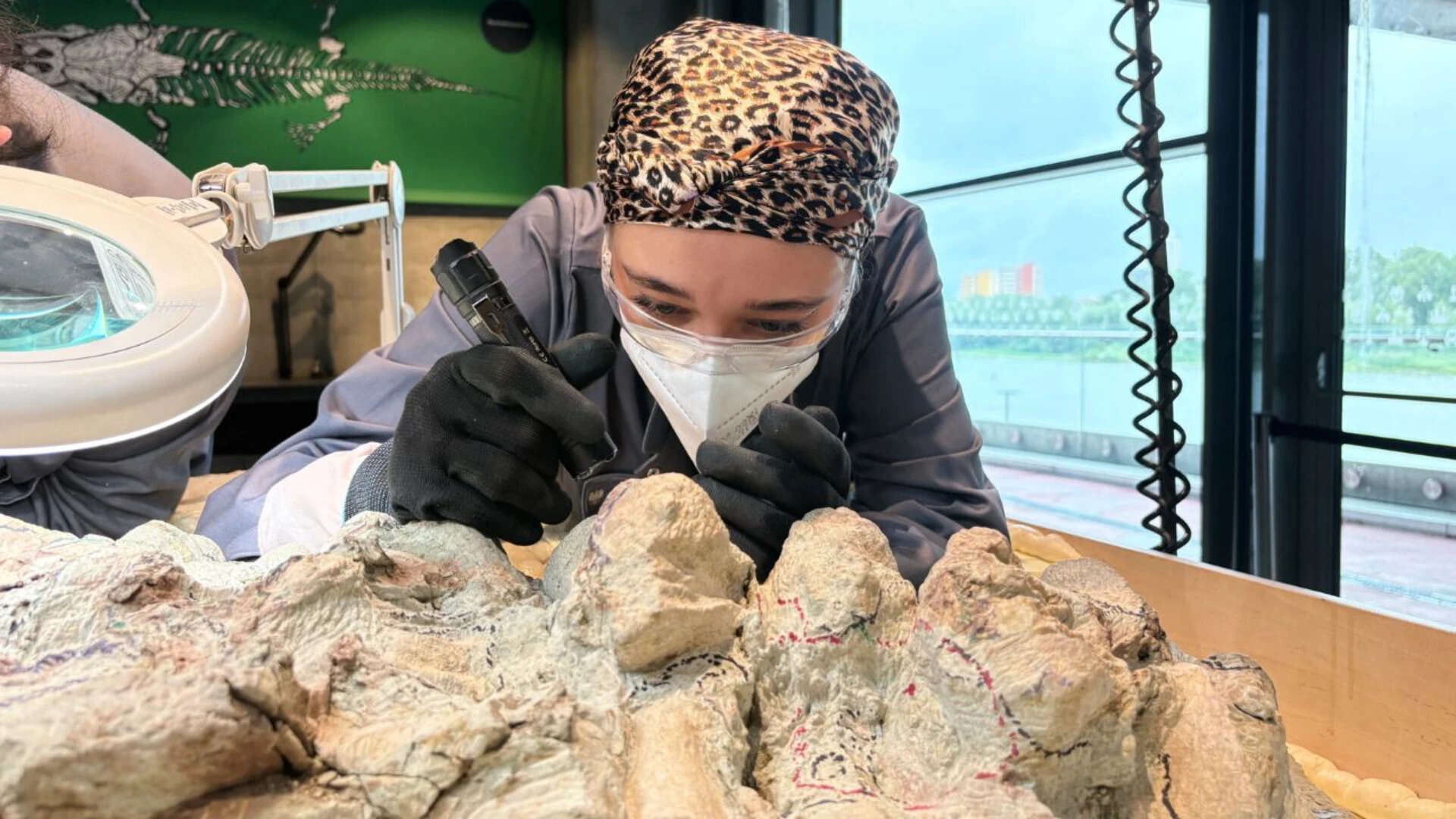
Volunteer coordinator Tatyana Kozyk cleans the skeleton of a mastodonsaurus
Unearthing an ancient giant
The skeleton belongs to a Mastodonsaurus, one of the largest amphibians ever known. Living about 240 million years ago during the Middle Triassic period, the animal lived in Earth’s waters when the very first dinosaurs were just starting to appear, long before they grew to rule the land.It lived as an underwater ambush hunter, eating mostly fish and smaller amphibians. Growing to nearly six metres (20 feet) long, it had a wide, flat head, long strong jaws, and sharp pointed teeth. Even though its body looked very much like a modern crocodile, it actually belonged to a totally different group of animals with backbones.The fossil was found in southern Poland in 2023 by Tomasz Sulej, a fossil expert and professor at the Institute of Paleobiology at the Polish Academy of Sciences, along with his colleague Wojciech Pawlak from the Faculty of Geology at Warsaw University. Knowing how much hard work was needed to clean the fossil, the pair came up with the plan to invite the public to help.When the cleaning is finished, it will be the biggest Mastodonsaurus skeleton shown in any museum in the world. While other Mastodonsaurus fossils have been found in places like Germany and Russia, those finds usually measure only about two to three metres (6½ to 10 feet) long.Sulej pointed out that the massive size and great condition of this find offer unique scientific value, promising to show brand-new facts about how the species lived and grew.“The structure of the body is different from what we knew so far,” said Sulej. “This is information that is completely new to the scientific world.”
Lessons from Earth’s past
For those working on the bones, the experience gives both a mental break and a rare link to deep history. Dorota Serafin, a 51-year-old manager from Warsaw who volunteers for the project, said working with the skeleton of an ancient animal is an experience that is at the same time “relaxing and philosophical, even mystical.”Serafin plans to return for more work sessions and eventually bring her family to see the finished display when the built skeleton goes on public view, which organizers expect to happen around October or November.Beyond the excitement of clearing ancient history, those taking part in the project say the Mastodonsaurus gives a helpful view on planetary change. The giant water animal lived in Earth’s rivers and lakes right after the biggest mass extinction event in history, acting as proof of how strong life on the planet can be.As people worry about the big effects of climate change today, Sulej notes that the story of the Mastodonsaurus brings a message of lasting strength.“The Mastodonsaurus lived after the great extinction, which shows one thing, that nature always manages,” Sulej said. “It’s not true that humans can destroy life on this planet. Nature and life always find ways to survive.”