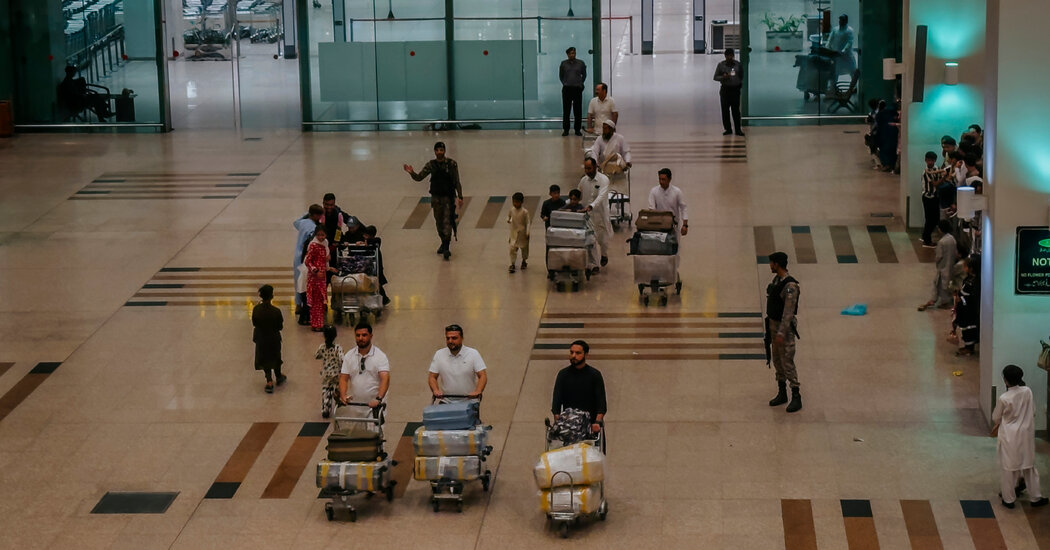
Pakistan has been trying to help end the war in Iran, but that effort is now creating problems with one of its longtime partners, the United Arab Emirates.
The rich Persian Gulf country has started a large-scale expulsion of Pakistani workers, threatening to cut off a vital source of jobs for Pakistan.
The Emirates appears to be upset that Pakistan has not condemned Iranian strikes on the Emirates more forcefully while it is trying broker a peace deal between the United States and Iran. The Emirates has borne the brunt of those attacks and has been hit by thousands of Iranian missiles and drones strikes.
The New York Times interviewed more than 20 Pakistani Shiites who worked in the Emirates as employees of Emirati companies. All said they were suddenly arrested, detained and deported in the past month.
Eight people with businesses based in the Emirates said their Pakistani employees had been deported in recent weeks.
Shiite religious leaders in Pakistan estimate as many as thousands of Shiite Pakistanis have been deported from the Emirates since mid-April. Pakistan’s 35 million Shiites, who have deep spiritual ties to Iran, have often faced sectarian violence in Pakistan, where the majority of people are Sunni Muslims.
The reasons for the expulsions are unclear, and both countries claim their ties are strong.
The Pakistani foreign ministry has denied that Pakistani citizens have been deported en masse and did not respond to questions about whether Shiites were singled out. The ministry’s spokesman, Tahir Andrabi, said the expulsions were of Pakistanis who had committed crimes in the Emirates.
The Emirati government did not respond to a request for comment.
“Pakistan embarked on this initiative without enough coordination with the U.A.E.,” said Nadim Koteich, an Emirati-Lebanese commentator who is close to the government.
Last month, the Emirates recalled a $3.5 billion loan to Pakistan — nearly a fifth of Pakistan’s foreign reserves. Saudi Arabia jumped in and offered a $3 billion deposit to bolster Pakistan’s foreign reserves.
“The U.A.E. was shocked that Pakistan did not support them against Iran, and Pakistan was shocked that the U.A.E. was shocked,” said Husain Haqqani, a former Pakistani diplomat and senior fellow at the Anwar Gargash Diplomatic Academy in Abu Dhabi.
More than two million Pakistanis live in the Emirates, sending over $8 billion in remittances last year.
“It’s important for Pakistan to keep good relations with the Emirates,” said Miftah Ismail, a former Pakistani finance minister. “And at the same time, I don’t know what other path Pakistan could have chosen in the war.”
Pakistani workers in the Emirates appear to have been caught in the middle: Community leaders say men have been sent home without their belongings or an official explanation.
Nadeem Afzal Chan, a former lawmaker, said that at least 100 laborers in his district in Punjab Province, most of them Shiite, had been deported in recent weeks.
In a cluster of mainly Shiite villages in northwestern Pakistan, nearly 900 men have returned in the last few weeks, community leaders said.
Mohammad Amin Shaheedi, an Islamabad-based cleric leading a Shiite political organization, said his organization had registered 5,000 deported families.
“There is this perception in the Gulf that every Shia supports Iran,” Mr. Shaheedi said. “But it is useless to ask the Pakistani government to talk to the U.A.E., given how bad the relationship is.”
Mr. Shaheedi and others said the deportations began after Pakistan’s leaders helped broker a cease-fire between the United States and Iran on April 8. An unknown number of Pakistani workers have also left the Emirates after losing their jobs because of the war.
On April 13, Ali Hamza, 25, a security administrator for a major Emirati logistics company, said he was picked up at his office by a plainclothes officer and taken to the Al Awir detention center. He said he was deported to Pakistan on April 21.
A dozen Pakistanis interviewed by the Times described similar experiences and requested anonymity because they hoped to recover money and assets left behind in the Emirates, or hoped to return.
They all said they were either picked up by or received a call from the Criminal Investigation Department, an Emirati law enforcement agency. They spent days in detention without being told why they had been arrested. And they were deported after Pakistani consular officers in the Emirates issued an emergency travel document, known as an “outpass.”
“They did not give us any reason,” said Haider Ali Bangash, 47, a taxi driver from Sher Kot village in northwestern Pakistan. “But we understood. Our only crime is being Shiite.”
The Times reviewed several documents from the Pakistani Consulate in Dubai shared by deportees. They said it was the only paper trail that proved their expulsions and read “Jailed/Absconding” as a reason for their deportation.
Shah, a taxi driver in Dubai, said his monthly salary of $1,000 had helped him provide for 14 family members back home. He was expelled on April 19, he said, along with at least 50 others.
The owner of a contracting company in Abu Dhabi said immigration authorities ordered him last month to bring one of his employees, a Shiite Pakistani technician, to a detention center. The authorities revoked the technician’s visa and ordered him to leave the country within 48 hours, he said.
The Times spoke to 12 business managers in the Emirates, including private schools and restaurants operators, who said that immigration officials had either deported or stopped issuing or renewing visas for Pakistani employees.
The deportations described by Pakistani workers carry echoes of the stories of some Iranians in the Emirates, who said their visas had been revoked and their loyalty questioned despite a long history of cultural and economic ties between the two countries.
The war has stoked sectarian rhetoric in some Gulf countries, which have accused some of their own citizens — largely Shiites — of passing information to Iran and its allies. After Iran began firing thousands of missiles and drones at the Emirates, “We are all Emiratis” billboards appeared across Dubai. But that patriotism has morphed into an exclusionary form of nationalism that questions the loyalty of both foreign residents and citizens.
Other populations of Shiite residents in the Emirates, such as Iraqis and Lebanese, do not appear to have faced similar deportations, suggesting the Emirati government’s strained political relationship with Pakistan may have more to do with Pakistan’s positioning in the war than sectarianism.
Pakistan also risks being caught in the middle of a split between the Emirates and Saudi Arabia, which has widened in recent months over a range of issues, including support for opposing sides in regional wars. Pakistan and Saudi Arabia signed a defense agreement last year stipulating that any attack on one would be considered an aggression on the other.
“The Emirates are unhappy with Pakistan’s continued warm ties with the Saudis, and they’re unhappy with the steps Pakistan has taken to position itself closer to Iran,” said Michael Kugelman, a senior fellow for South Asia at the Atlantic Council, a research institute based in Washington.