
As the ceasefire in the war between US-Israel and Iran was extended Wednesday, there was a collective sigh of relief in Iran. Except for one community in the country, the Baha’is, there is none — there has never been one.
As Iran’s second-largest religion after Islam, Baha’is have been claiming persecution by the authorities for ages. With war raging for over a month now, and protests preceding them, many from the community claim persecution has increased in the name of security crackdown, worrying their counterparts in India, many of those who trace their origin to Iran.
How did the Baha’is first come to settle in India, and what are their concerns with what’s unfolding in Iran? Here’s what to know.
Baha’is in Iran, and how they came to India
The Baha’i faith emerged in 19th-century Iran, and its founders and the majority of its early followers were of Iranian heritage. However, since the 1979 Islamic Revolution, many have cited religious persecution and migrated to Europe, Canada, the US, and Australia, while many also made their way to India where the faith had already taken roots. Some Persian Baha’is had migrated before 1979 for education and business purposes.
Estimates by the community’s representatives in New Delhi suggest that before 1979, there were roughly six lakh registered Baha’is in Iran — with many more as unregistered members. Following the Revolution, that has dropped to less than four lakh. However, accurate statistics were impossible owing to the “interdiction of the Baha’i administration”, according to the representatives.
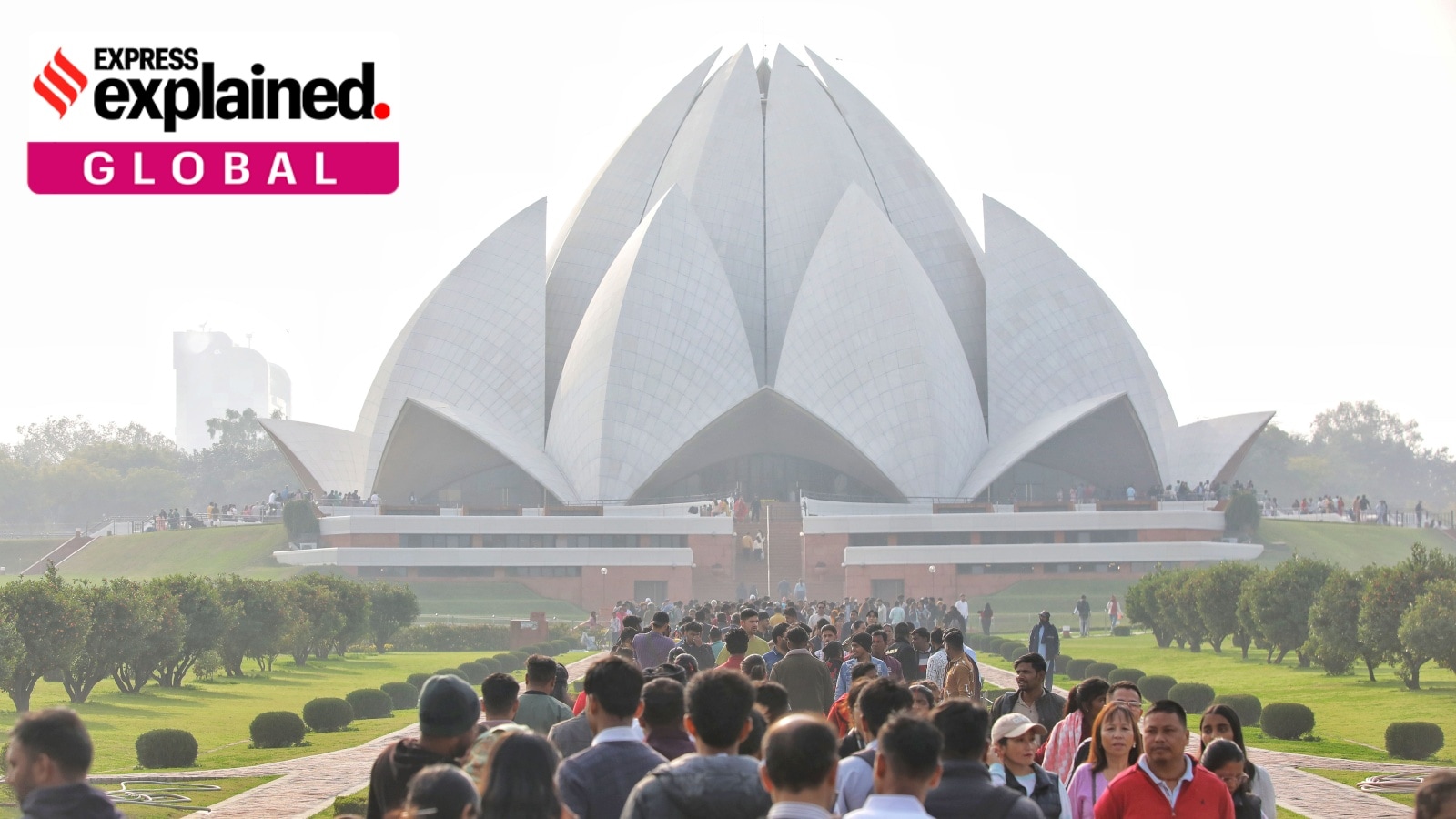
Today, thousands of Indian Baha’is trace the threads of their spiritual heritage back to Iran. India hosts the world’s largest Baha’i population, concentrated in rural areas, while the iconic Lotus Temple in New Delhi was built in New Delhi in 1986 as a mark of their presence.
The Baha’i community itself reports over two million members in India, representing nearly a third of their global population. However, the 2011 Census recorded only 4,572 of them, reflecting a large discrepancy between community-enrolled members and those who identify as such in national surveys.
Baha’is in India before 1979
Story continues below this ad
The official website of the Baha’i community in India says: “The teachings of Bahá’u’lláh were first brought to India in 1872 by Jamal Effendi, a Persian nobleman, who travelled throughout the subcontinent. His visits took him from Rampur and Lucknow in the North, to Calcutta and Rangoon in the East to Baroda and Mumbai in the West and finally to Chennai and Colombo in the South.”
He introduced Bahá’u’lláh’s teachings of unity and fellowship to all he met, from nawabs, princes, and colonial administrators to the common folk. By the turn of the century, there were small Baha’i communities in Mumbai, Delhi, Pune, and Hyderabad. In the early 20th century, they grew in size and strength, and the teachings of Bahá’u’lláh gradually started to come to the attention of the leaders and thinkers of the time.
Mahatma Gandhi, after his interactions with a number of Baha’is, proclaimed: “The Bahá’í Faith is a solace to humankind.” Rabindranath Tagore, who met many eminent Baha’is, referred to Bahá’u’lláh as “the latest Prophet to come out of Asia”, whose “message is of great importance for the progress of civilization”.
Persecution during the present war
The latest bulletin of the International Baha’i Community’s United Nations office based in Geneva documents over half a dozen cases of arrests and imprisonments of the community members in the month of April itself.
Story continues below this ad
It cites several cases, including that of Faranak Zabihi, a resident of Qaemshahr, who was arrested by security agents on April 7, and taken to Tir Kola Prison in Sari. Following her arrest, officers searched her home and confiscated a number of personal belongings and electronic devices belonging to her and her son. After interrogation in Tir Kola Prison, Zabihi was released a day later. However, to date, no information has been made available regarding the nature of any charges against her.
Nilakshi Rajkhowa, director of the Delhi-based Office of Public Affairs for the National Spiritual Assembly of the Baha’is of India, told The Indian Express that the war — and the civilian protests that preceded it for several months in Iran — gave Iranian authorities more excuses to round up Baha’is on the pretext of national security and crackdown. “Even before that, it has been going on for the last 47 years,” she added.
In a report released April 2024, global watchdog Human Rights Watch had said that Iranian authorities’ decades-long systematic repression of Baha’is amounts to the crime against humanity of persecution. The 49-page report, “‘The Boot on My Neck’: Iranian Authorities’ Crime of Persecution Against Baha’is in Iran”, documented systematic violation of the fundamental rights of members of the Baha’i community in Iran through discriminatory laws and policies that target them.
“Iranian authorities deprive Baha’is of their fundamental rights in every aspect of their lives, not due to their actions, but simply for belonging to a faith group,” said Michael Page, deputy Middle East director at Human Rights Watch while releasing the report. “It is critically important to increase international pressure on Iran to end this crime against humanity.”
Dealing with the current wave of persecution
Story continues below this ad
Data recorded by the community’s UN Office regarding persecution between 2023 and 2025 shows that by mid-2024, nearly three-quarters of all Baha’is summoned to court or prison were women. Baha’i musicians have been barred from performing, students have been asked to sign declarations renouncing their faith as a condition for university admission, while cemeteries have been seized, bulldozed, and placed under intelligence surveillance, the office claimed.
At the 61st session of the Human Rights Council held in March this year, they recorded their protest officially during the address.
“The Baha’i community has deep roots in the Indian subcontinent. India can play a special role here by making our voices heard,” Rajkhowa said.