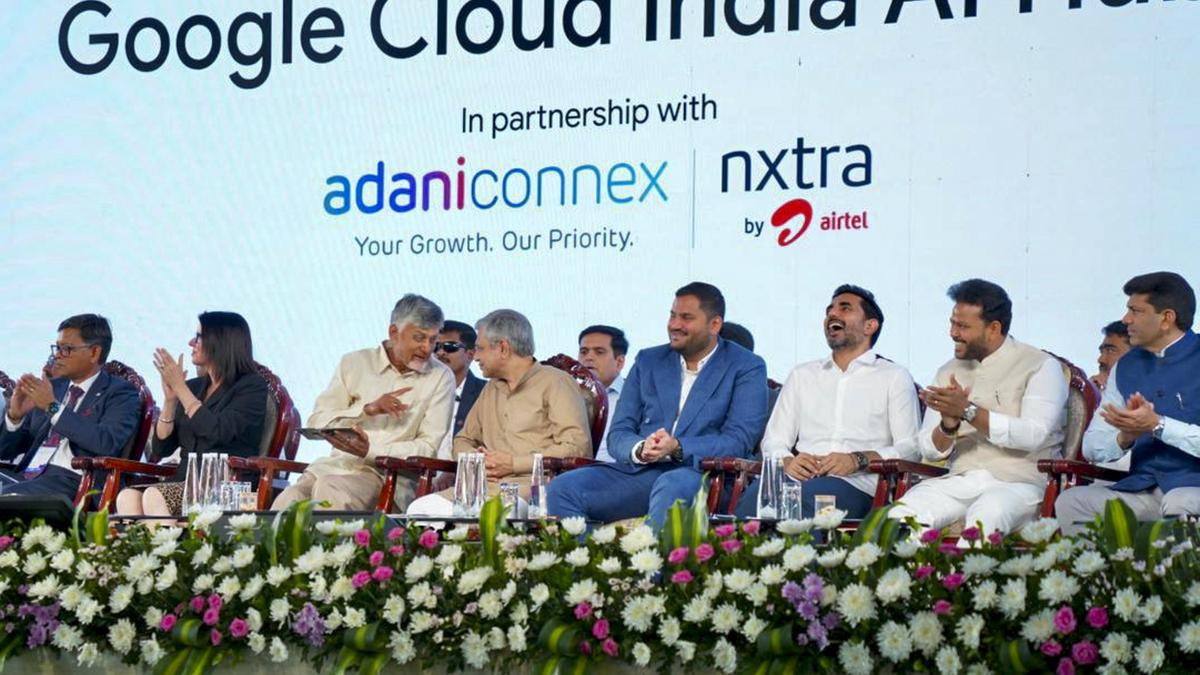
Union Minister of Electronics and Information Technology Ashwini Vaishnaw, Union Minister of Civil Aviation Ram Mohan Naidu Kinjarapu, Andhra Pradesh Chief Minister N. Chandrababu Naidu and others during the foundation-stone laying ceremony of the Google Cloud India AI Hub in Visakhapatnam on April 28, 2026. Handout photo via PTI
The Google Cloud India AI Hub, for which the technology giant and Andhra Pradesh recently broke ground in Visakhapatnam, is a sign that India is finally moving from providing information technology services and coding to owning infrastructure. While the facility is part of a larger digital infrastructure push in Visakhapatnam, expected to involve investments running to ₹1.25 lakh crore, there are also numerous second-order gains in the offing. The facility could strengthen downstream demand for high-end computing hardware, augmenting India’s efforts to build semiconductor capacity under Production Linked Incentive (PLI) schemes, even if manufacturing viability will still depend on broader ecosystem factors.
The project has been integrated into the America-India Connect initiative, as part of which multiple international subsea cables will land in Visakhapatnam, creating India’s second major gateway on the eastern seaboard. As a result, Indian data will have a direct connection from the east coast to South Africa and thereon to the U.S. without first being backhauled to Cochin, that too on Google’s high-capacity cables. Likewise, in the east, data from Visakhapatnam can reach the U.S. via Singapore and Australia, no longer restricted to the Chennai-Singapore connection and thereafter to the U.S. on third-party cables. As a result, India’s dependence on geopolitical stability in the Red Sea — through which cables from Mumbai pass before reaching Europe — will reduce. Similarly, within India, the Hub’s location could move high-value technological activity away from expensive metropolitan cities, potentially redistributing growth.
Infrastructure problem
The Hub is an integrated complex with computational infrastructure and high-capacity data connectivity, and large power requirements. Its expected power demand of 1 GW makes it a so-called hyperscale hub, with the ability to run powerful artificial intelligence (AI) models.
But that is also a gateway to consider the not-inconsiderable challenges the project poses. For example, the Hub could attract firms handling sensitive data, especially in sectors where legal or regulatory preferences favour keeping data in India. However, while Google will thus lower costs for Indian firms, it will increase dependence on a single foreign provider’s proprietary stack. As a result, India could become a site for “sovereign AI” — as Google Cloud CEO Thomas Kurian said — only in name.
Second, even though AI GPU workloads are among the world’s most power-guzzling uses of computing infrastructure, the Hub suggests AI is now an infrastructure problem: power, land, and water are the bottlenecks. The power demand may strain the local grid and result in knock-on effects for local residents and industries. While Google has pledged 100% use of renewable energy, the Hub will still feature a fleet of backup diesel generators, which will affect local air quality and microclimate.
If Google aspires to maintain its global average power usage effectiveness of 1.1 in Visakhapatnam’s humid weather, it may need evaporative cooling, which is water-intensive. The district is periodically vulnerable to water stress, especially in summer. It depends heavily on inter-basin water transfers to meet its needs. In fact, it has the lowest groundwater levels for domestic, agricultural or industrial use in the State, as per the Water Resources and Information Management System. Facilities worldwide similar to the Hub are known to consume over 2 million litres per day per 100 MW. At 1 GW, the indicated demand is an eye-watering 20 million litres per day.
Rights groups have alleged that the State government assigned the project to a category that allowed it to sidestep a full environmental impact assessment and public hearings — measures that have forced Google, et al. in other countries to redesign data centres to be more sustainable. India still struggles to harmonise State-level incentives. Andhra Pradesh offers aggressive tax holidays and power subsidies yet they have not come with environmental benchmarks or ‘green’ capacity targets. A Central single-window could standardise public hearings and resource accounting. If India does not codify these safeguards, its climb up the digital stack will come at the cost of its environmental and democratic foundations.
Published – June 02, 2026 12:51 am IST