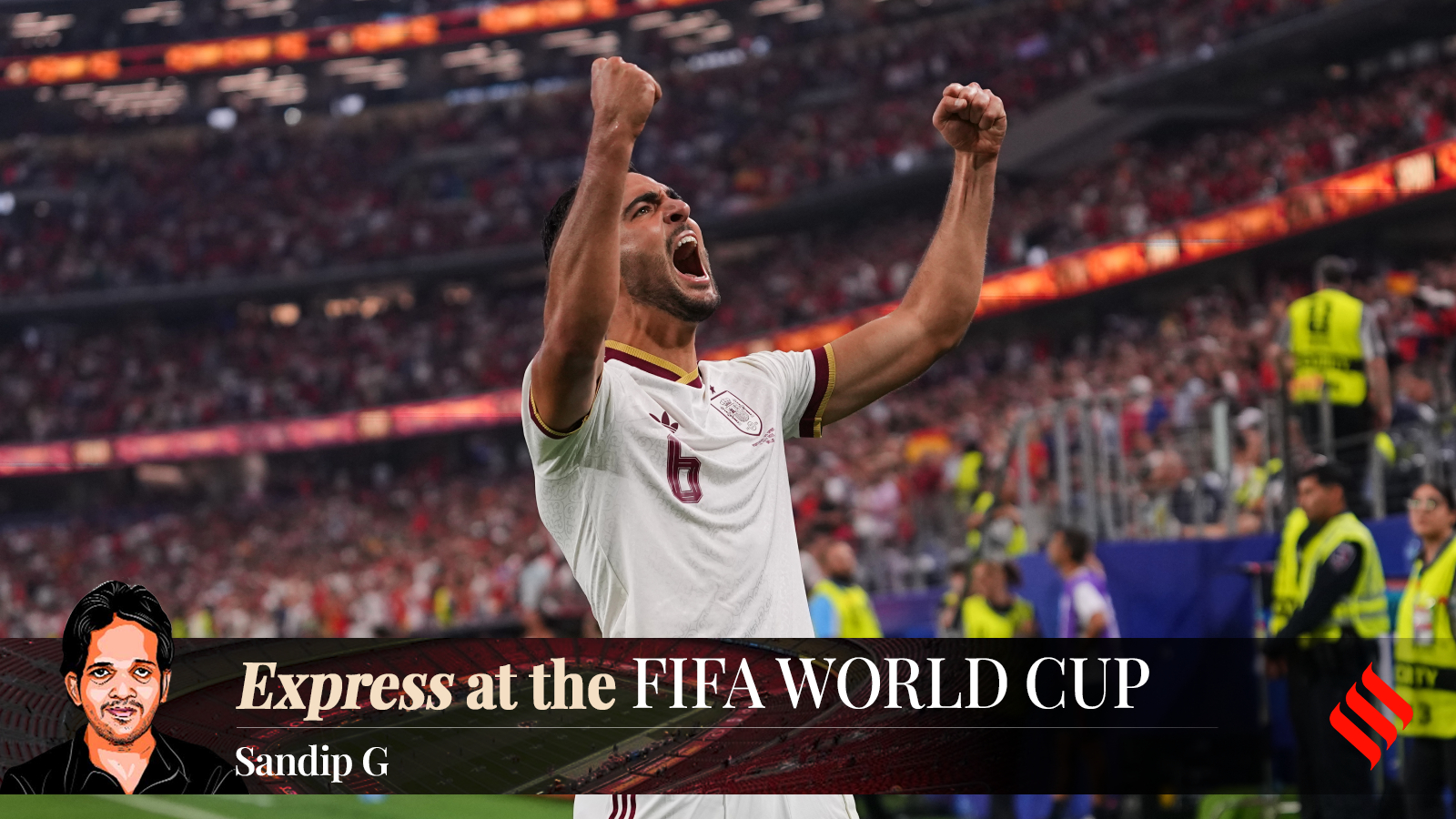
From the shadows pounced Mikel Merino. He was not in the place he was meant to be, yet here he was. Wigging through half a space the tired Portuguese defenders had left unmarked, latching onto a needle-through-an-eye pass of Ferran Torres and coaxing the ball past an unsuspecting Diogo Costa. Merino is seldom the hero before a game, little reams of newsprint is wasted on his utilitarian affinities to influence a game, but not for the first time, he made the difference for his team, the difference between an exhaustive extra time and potential tiebreaker, the difference between Cristiano Ronaldo living another day and bidding farewell to a tournament that seldom has been his.
When Fabian Ruiz took a hurried free kick, roughly 20 yards from Portugal’s goalmouth, Merino was lumbering, as though something was pulling him back. Ruiz passed behind to Rodri in midfield, he was just a few yards ahead of Rodri. But by the time the midfielder slipped the ball to Torres, Merino had made his typical run from behind, in stealth. And when Torres slid a gorgeously weighted ball, Merino was in the place where the ball was meant to be. He collected the ball and nervelessly plucked the goal to end a game that struggled to fulfil its preordained quality, that slumped to an afternoon siesta in Dallas.

For 90 minutes, the forwards and wingers designated to score goals, men far more celebrated than Merino, had failed to locate that perfect space. Costa did dash to flap away a thunderbolt from Alex Baena, but most other saves did not test his reflexes or elasticity. Perhaps, Costa or his defenders did not expect Merino’s anonymous run from the midfield. No one does, except when he rattles the goal. Merino has made a career out of invisible intrusions for his club and country. Arsenal supporters would recount several such goals that have made him a cult hero; Spain owed to him for the goal in the Euros semi-final against Germany. His uncanny knack of scoring important goals had his Arsenal teammate Gabriel Martinell call him “R9”.
In its precision and nervelessness, the goal was quite like the numerous ones Ronaldo Nazario has stroked in his career. Soon after he scored the goal, he went to the corner flag and circled it thrice, a nod to his father Miguel Merino, a midfielder with a string of modest La Liga sides in the late and 90s. Yet, it was a moment that never happened. When he suffered a bone stress fracture and a rare hairline fracture in his right foot in January, he thought his World Cup dreams were over. “When they told me about my injury, I thought I would not be at the World Cup, but here I am,” he said after the game.
For three months, he couldn’t walk. He prayed and cried. Then the doctor conveyed he was recovering faster than he had expected. He resumed his training with Arsenal, even though he remained on the bench for the Champions League final. He checked out with Spain’s manager Carlos de la Fuente whether he is in the World Cup scheme. He told him he will wait.
The manager knew that few could multitask as imperceptibly as Merino could. He could man any role in the midfielder, as an attacking midfielder
a box-crasher, or a few times as the pivot; on the frontline, Arteta has deployed him a false nine, an auxiliary striker and as centre forward. At Dortmund, he was commissioned as a left-sided centre back; in age-group tournaments for Spain, he was often the centre-back.
Story continues below this ad
Arteta discovered that he has the requisites to be a centre forward, he is aerially strong, he is clever in giving his defenders the slip, and he seldom wasteful, attributes that shone in his 15-goal season for Arsenal in 2024-25. “When he returned, I saw his desperation to get himself back into shape for the final (Champions League) and the World Cup,” Arteta said. “He’s another one that is going to push every boundary, sacrificing every little joy,” he added.
In his race to get fit, he missed time with his newborn son, who is only two months old. “The injury, not seeing my little one grow: I used that as strength to get the best out of me. This is the product of the hard work my family always inculcated in me. I did my part. For it to happen at the last minute again, I am so happy,” he said after the game.
The 29-year-old is not the archetypal Spanish midfield stylist, has a limited passing range, has nothing flashy. But he could perform difficult roles,When he was introduced in the 85th minute, the manager had a clear plan. “Mikel can play that role, between midfield and attack. And we thought of what might happen if it went to extra time,” he said.
It did not roll into extra time, because Spain had Merino, the king of shadows.