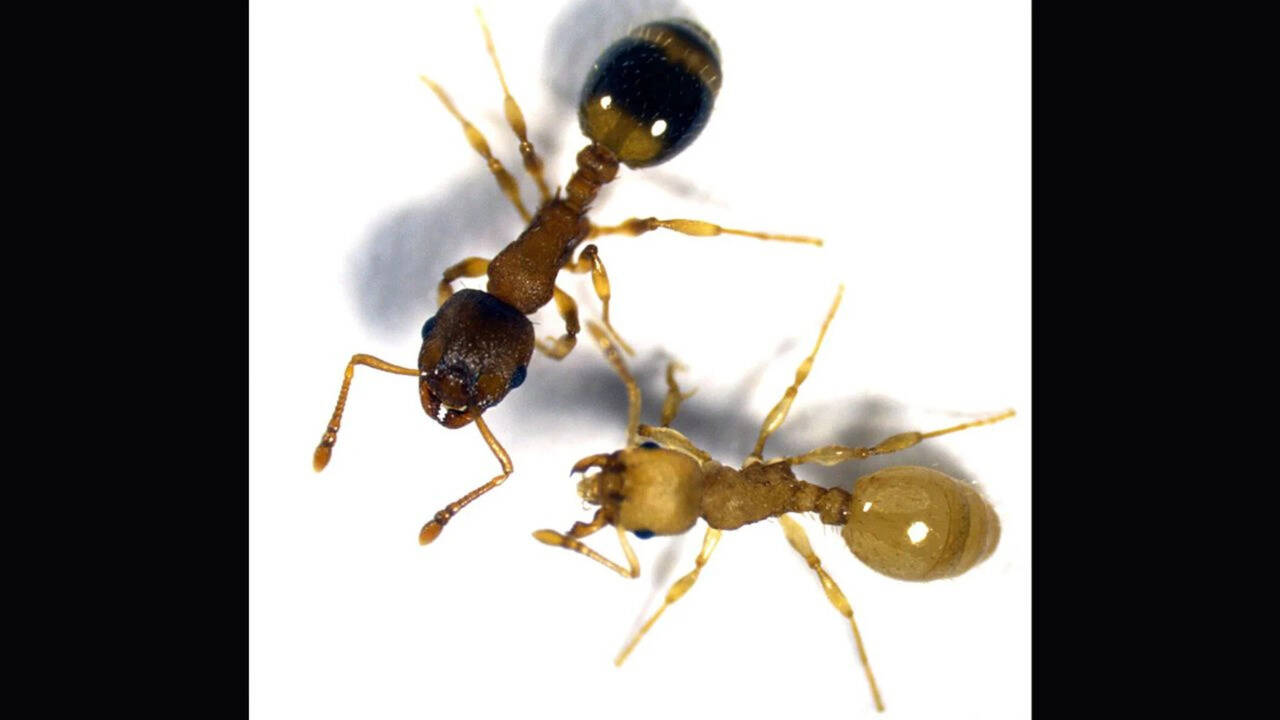
Deep inside the damp leaf litter of the Lenneberg Forest near Mainz, Germany, tiny worker ants of the species Temnothorax nylanderi are living surprisingly long lives. While a normal worker ant usually leads a short, busy life of just one to two years, workers carrying a parasitic tapeworm called Anomotaenia brevis can live several times longer. Instead of dying young, their chances of staying alive start to match those of their queen, a royal ant that can live for up to twenty years.Now, a detailed study published in the journal BMC Genomics shows how this unusual long life actually works. Scientists at Johannes Gutenberg University Mainz (JGU) found that the tapeworm does not simply make the ant sick or weak. Instead, it carefully changes how the ant’s genes work, tweaking normal body processes so that the worker’s physical body starts to act much like that of a long-lived queen ant.
Tapping into royal biology
To understand how the parasite extends life, an international research team led by Professor Susanne Foitzik from the Institute of Organismic and Molecular Evolution (iomE) at JGU brought forest ant colonies into the laboratory. They split the ants into three test groups: healthy queens, healthy uninfected workers, and workers carrying the tapeworm parasite.The scientists carefully removed two key parts from the ants: the brain and the fat body. In insects, the fat body is an important tissue in the belly that stores energy, manages digestion, handles stress, and protects the immune system, working much like a human liver. Using advanced RNA sequencing, the researchers measured which genes were active in these tissues. They also looked at genetic data from the tapeworm itself to track its activity and check if it was using sneaky chemical tricks.The results showed a clear difference in how the parasite affects its host. Rather than causing general harm, the infection changed the ant’s active genes in a very specific way.“Our genetic analyses show that the infection does not simply make the ants sick, but alters their physiology in a highly targeted way,” said Susanne Foitzik. “At the molecular level, infected workers showed a profile that was partially queen-like.”This shift was strongest inside the fat body. The active genes in infected workers matched up closely with those seen in long-lived queens, especially the biological systems in charge of digestion, immune protection, stress resistance, and aging.“The findings in the fat body suggest that the tapeworm taps into existing signaling and metabolic pathways of the ant and shifts them,” said Foitzik.
Quiet brains and slow behaviour
While the parasite changes the ant’s body to slow down aging, it takes a completely different path inside the brain. In healthy nests, worker ants build, gather food, care for young ants, and protect the colony. Infected workers, however, become very quiet, doing far less work and sitting still inside the nest for long periods.When researchers checked the brain tissue, they found that infected workers did not look like queens at all. Instead, many neuropeptides, which are signaling chemicals that control social actions, feeding, and energy levels, were turned right down, along with the cell parts that receive them.“The effect of the infection is therefore tissue-specific,” explained Giulia Blasi, first author of the study and a doctoral researcher at iomE. “In the fat body, we see a shift toward a queen-like metabolic profile. In the brain, by contrast, many signaling pathways linked to behavior and activity are dampened.”
An indirect takeover strategy
At first, the scientists wondered if the tapeworm was making its own copycat chemicals to directly trick the ant’s brain and body. Many parasites produce fake chemicals that look like their host’s own signals, tricking the host’s body into doing what the parasite wants.However, genetic testing on the tapeworm showed that its chemicals were not similar enough to those of the ant to act as direct copycats.“The data rather suggest that the parasite influences the ant indirectly by intervening in the host’s own regulatory networks, which control metabolism, the immune system, aging, and behavior, among other processes,” said Blasi.This clever method fits the tapeworm’s life plan. For Anomotaenia brevis, the worker ant is just a temporary home. The parasite cannot lay eggs inside the ant; its full life cycle can only finish inside the tummy of a woodpecker, its main host.Keeping the host ant alive longer while making it slow and lazy serves a real purpose. An ant that lives for years inside a nest without burning itself out gives the tapeworm a safe, steady home. At the same time, a slow, resting ant makes easy food when a woodpecker breaks open the nest looking for a snack.
A clear view into how aging works
The research, funded by the German Research Foundation, was carried out by JGU researchers Susanne Foitzik, Giulia Blasi, and Katharina Schwolow, alongside Hugo Darras from Zhejiang University in Hangzhou, China.The findings give scientists a helpful natural setup to study how aging is controlled at the genetic level. Because worker ants and queen ants are born from the exact same genetic instructions, their hugely different lifespans depend entirely on which genes get turned on or off.“Queens and workers of social insects share the same genetic basis, but differ greatly in lifestyle and lifespan,” said Susanne Foitzik. “The fact that infected workers show a partially queen-like molecular profile in the fat body suggests that the parasite taps into existing biological programs of the ant.”The study was conducted by Giulia Blasi, Katharina Schwolow, Hugo Darras, and Susanne Foitzik from Johannes Gutenberg University Mainz. Their research, titled Cestode infection is linked to transcriptional shifts in neuropeptide signalling and caste-specific ageing pathways in a social insect, investigates how parasite infections affect gene activity and ageing pathways in social insects.