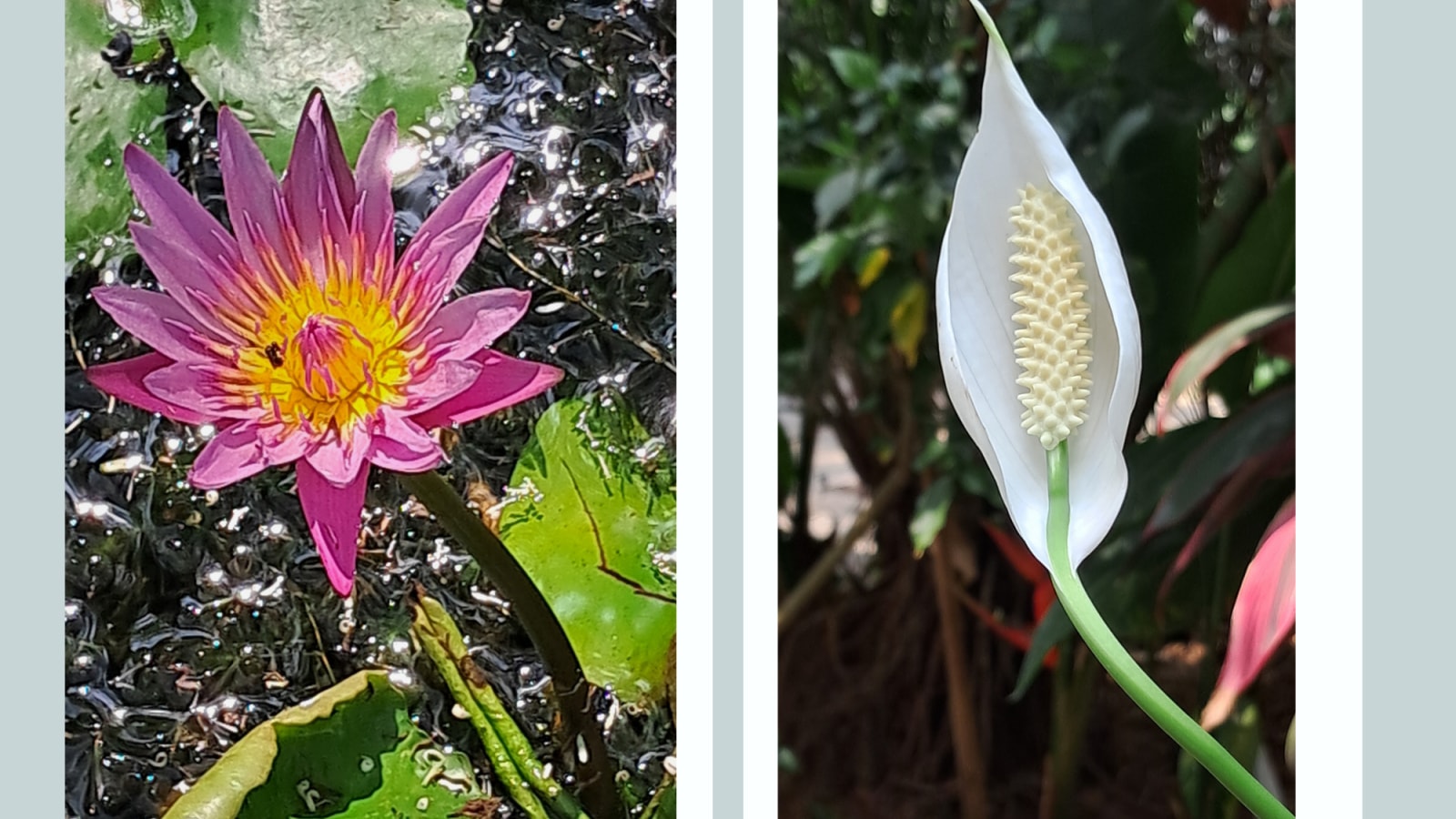
I first noticed it while sitting by the pool – hidden low amidst the broad-leafed heliconia. A long waxy white kayak shaped ‘petal’ perched on a shiny green stalk protectively guarding a hundred starfish shaped very pale-yellow florets. Its leaves were broad and green. It turned out to be a Peace lily – something surely, we need a lot more of these days.
To my surprise I discovered that like most of the other lilies I knew of, it wasn’t a ‘true’ lily. That title only belonged to what we call the Easter lily – that familiar trumpet shaped showy flower, pure white, yellow, orange or scarlet, with dark splotches and brushstrokes on the insides of its petals that blooms around March and April, its heavy pollen laden stamens sticking out showily. But interestingly, it and all of the pseudo lilies that I knew of, and that one encountered in gardens, parks and ponds hailed from the wild – their native lands being in the Americas, and Asia – and most have carved special niches in our lives.

Most are toxic, whether mildly or highly – to us and especially to cats. They reproduce via bulbs, tubers or rhizomes buried deep in the soil which store enough nutrients during winter and dry seasons, to kick start them again as new plants when the good times (usually spring and early summer, or the rains) return. There are 119 species of ‘true’ lilies spread across the globe, covering both the Old and New worlds, including, of course, India. Their natural habitat ranges from woodlands, mountains and grasslands.
The Easter Lily per se hails from Taiwan and Japan and has been vigorously cultivated. It is also called the Bermuda lily. Highly regarded by Christians, it is believed that some of these beautiful blooms sprung up where drops of Jesus’ tears fell on the night before his crucifixion. They have long been associated with peace, ardor, happiness, warmth and love, and are the flowers (white ones) most used in funerals where they symbolically imply that the soul of the deceased has been restored to a state of innocence.
Lilies are preyed upon by various beetles, the caterpillars of some butterflies and moths, deer, mice and squirrels and have been used as a food source by indigenous people and of course in Chinese ‘medicine’. Predation by deer has caused their population to drop dangerously in some areas.
There are 59 species of Peace lilies, (aka Spath lilies) growing in the tropical regions of the Americas and South-East Asia. They grow (and look lovely) on forest floors in damp, humid tropical jungles along rivers and streams. They are shade loving, popular as houseplants, known for their air purification qualities and came into the limelight during Victorian times symbolizing peace, purity and new beginnings. They were apparently Queen Elizabeth II’s favorite flower. They are exactly what our rabid world leaders and road-ragers need today. Observe one closely for a few minutes and you will feel becalmed, almost enveloped by that tall white pseudo-petal that protects and half-embraces the true florets inside – like the way you would nurture a newborn flame in cupped palms.
One of the most pleasant surprises in the garden during the monsoons is the magical, synchronous appearance of Rain lilies (called ‘blitzes’) – usually in pink but sometimes white – in colorful ‘bunches’ at the edges of the flower beds. In a different lawn, at the same location every year, yellow ones bloom straight out of the grass. They may wither and vanish in a day or two, but happily – especially after a rain- or thunderstorm – are replaced by fresh sprays. They are also known as fairy lilies, zephyr lilies, magic lilies and white wildflowers. Some are pleasantly fragrant and others attract nocturnal pollinators. It is amazing to think that their tubers or rhizomes have remained buried deep in the mud all year-long, just waiting for the humidity and rain to start, before bursting out, rather in the manner of mushrooms and toadstools.
Story continues below this ad
They hail from the tropical and sub-tropical areas of America and have been introduced to Asia, Africa and Australia. They are toxic (and have alkaloids) and have been evaluated for medical properties and been used in traditional medicine in China and Peru for coughs, colds, diabetes and cancer.
Nearly every pond and water-body (natural or man-made) has its selection of attractive water lilies, in mauve, white, yellow or purple floating on top of a bed of flat green leaves. These aquatic herbs like temperate and tropical climates, and have spread to the extent that they are regarded as ‘invasive’ in some areas. They are rooted in the soft soil beneath and the glamorous ones especially, are usually beetle pollinated. Bees, wasps and flies also pitch in, as does the wind, and some are
self-pollinating when their male and female reproductive parts get active at the same time. There are some 70 species of these serene yet flamboyant lilies floating around in ponds and water-bodies around the world, their broad leaves providing resting places for frogs and their stalks — underwater, being checked by dragonflies as suitable locations for egg-laying. They may be perennial or annual.
Water lilies are the national flower of Bangladesh, Iran and Sri Lanka and were considered as symbols of water purity by the Mayans, who also consumed them, to enjoy their ‘out of mind’ imparting properties. They were significant in ancient classical Tamil literature too, in poetry, symbolizing the grief of separation.
Story continues below this ad
There are three more ‘lilies’ on my list which I’ll cover next week: the Spider lily, Arum lily and the most deadly of them all, Lily of the Valley.