4 min readPuneUpdated: May 16, 2026 01:14 PM IST
Written by Shubham Kurale and Pavan Khengre

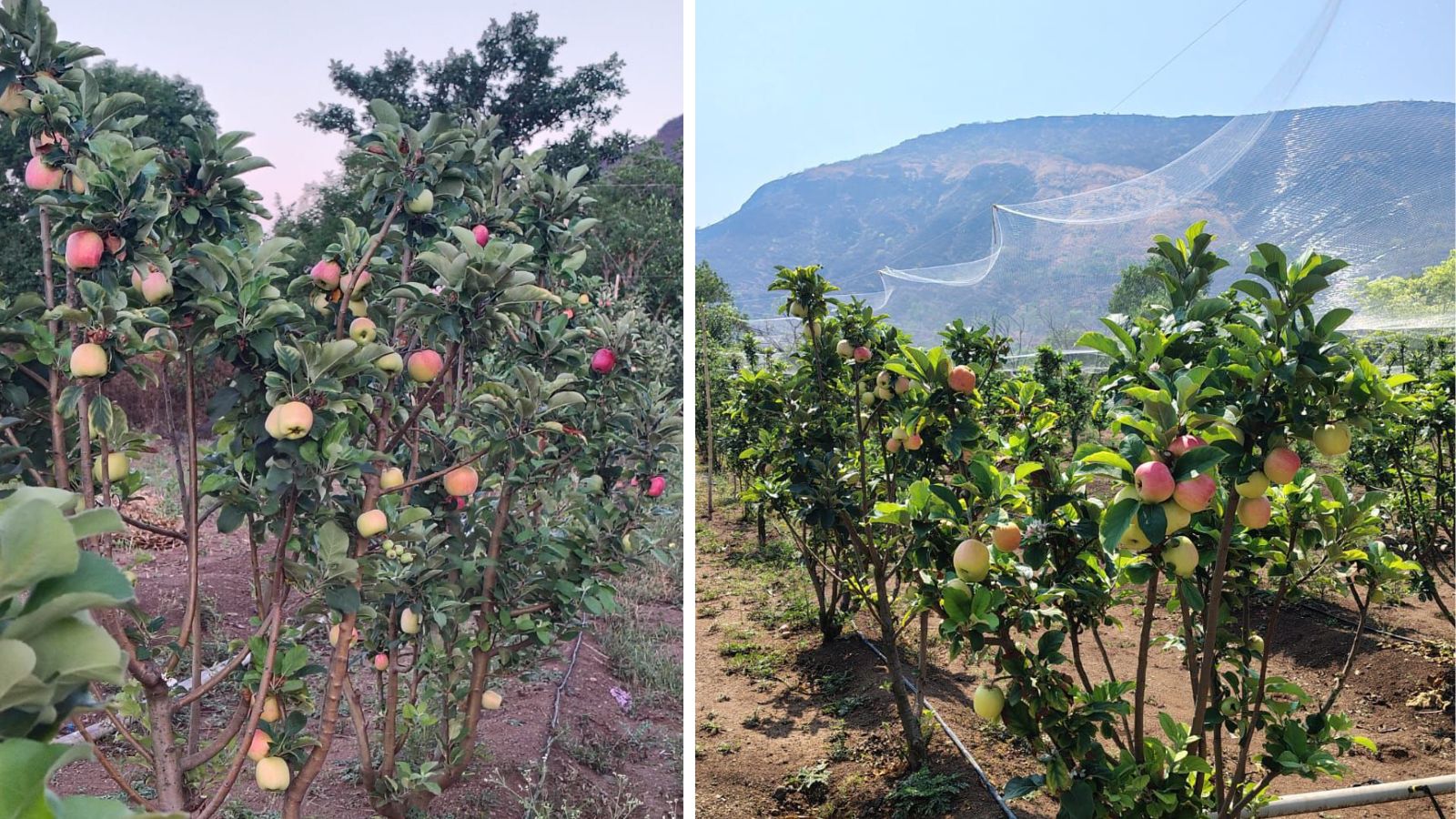
Mention apples, and most people immediately picture the snow-draped valleys of Kashmir or the cool heights of Himachal Pradesh. That’s where apples belong, or so everyone thought. But tucked away at the foothills of Pasarni Ghat in Maharashtra’s Satara district, a self-taught farmer has rewritten that assumption. Bapu alias Raju Bhilare, a JCB operator by profession, has successfully cultivated an apple orchard, and his two-acre farm in Wai taluka is now the point of discussion.
The story began not in a classroom or an agricultural lab, but on a work trip to Kashmir.
“Being a Poclain (JCB) operator, I got an opportunity to visit Kashmir,” says Bhilare. “That’s when I thought – Panchgani and Mahabaleshwar also have relatively cool weather. People even call them ‘mini Kashmir’. But farmers there mostly grow strawberries. So I thought, why not at least attempt to grow apples? If it worked, it could open up an entirely new avenue for farmers here.” And it worked!
Jammu to Satara
In May 2024, Bhilare planted 600 saplings of the Anna and Dorsett Golden apple variety sourced from Bilaspur village in Udhampur district of Jammu & Kashmir, across two acres of land at a spacing of 10×7 feet. “The total initial investment was around Rs 4 lakh. And the plants were of 1.5 years of age when planted with a variety chosen that is versatile and can withstand high temperatures. I prepared the soil with cow dung to keep the farming organic, installed bird-protection nets over the trees, and set up a watering schedule of at least four times a week for two hours,” he said.
“The initial phase was tough and cautious of extreme weather events,” he admits. “But I prepared the field well and stayed committed to the process.”
“The effort paid off. The orchard now yields two harvests a year, one in April-May and another in November-December. The first harvest fetched an average of 10 to 15 kg per tree at around Rs 200 per kg. The total output gained has been around Rs 12 lakh, and the actual realised profit, cutting all labour and other costs, is Rs 6 lakhs,” Bhilare said.
Officials visit
Story continues below this ad
Word of Bhilare’s orchard spread quickly. Pune Divisional Commissioner Dr Chandrakant Pulkundwar, Satara District Collector Santosh Patil, and officials from the Department of Agriculture recently visited the farm to see the harvest first-hand.
“This is probably the first successful cultivation of apples of good quality in this region, and it was a courageous move,” said Dr Pulkundwar during his visit.
“All 600 trees across the two-acre stretch have produced mature, juicy apples – comparable in quality to those grown in Jammu & Kashmir or even American varieties. Bhilare has already completed the first plucking, and this should serve as an inspiration for farmers across the state.”
Pulkundwar added that, “Pune’s agriculture college would connect with its counterpart in Jammu & Kashmir to exchange best practices and share information that could benefit farmers looking to replicate Bhilare’s model.”
Story continues below this ad
Satara District Collector Santosh Patil was equally effusive. “The apples have the colour and quality of those grown in Jammu and Kashmir. Farmers always believed that Maharashtra’s climate wasn’t suitable for apple cultivation – but Wai’s pilot has proved them wrong. Maharashtra is now among a rare group of states that have successfully grown multiple varieties of fruit,” he said.
Patil also extended an invitation to tourists visiting the nearby hill stations: “I urge visitors to Panchgani and Mahabaleshwar to make a detour to this farm and enjoy fresh, crunchy, juicy apples on the way.”
Supplying the next wave
Bhilare’s success has not just earned him recognition – it has created a new business. He has set up a plant nursery to supply saplings to other local farmers who want to follow in his footsteps.
“After the project got successful, demand grew substantially – plant orders have crossed one lakh,” he says. “I source the rootstock from Jammu & Kashmir and graft it with scionwood from my own cultivation, which carries the best traits of both.”