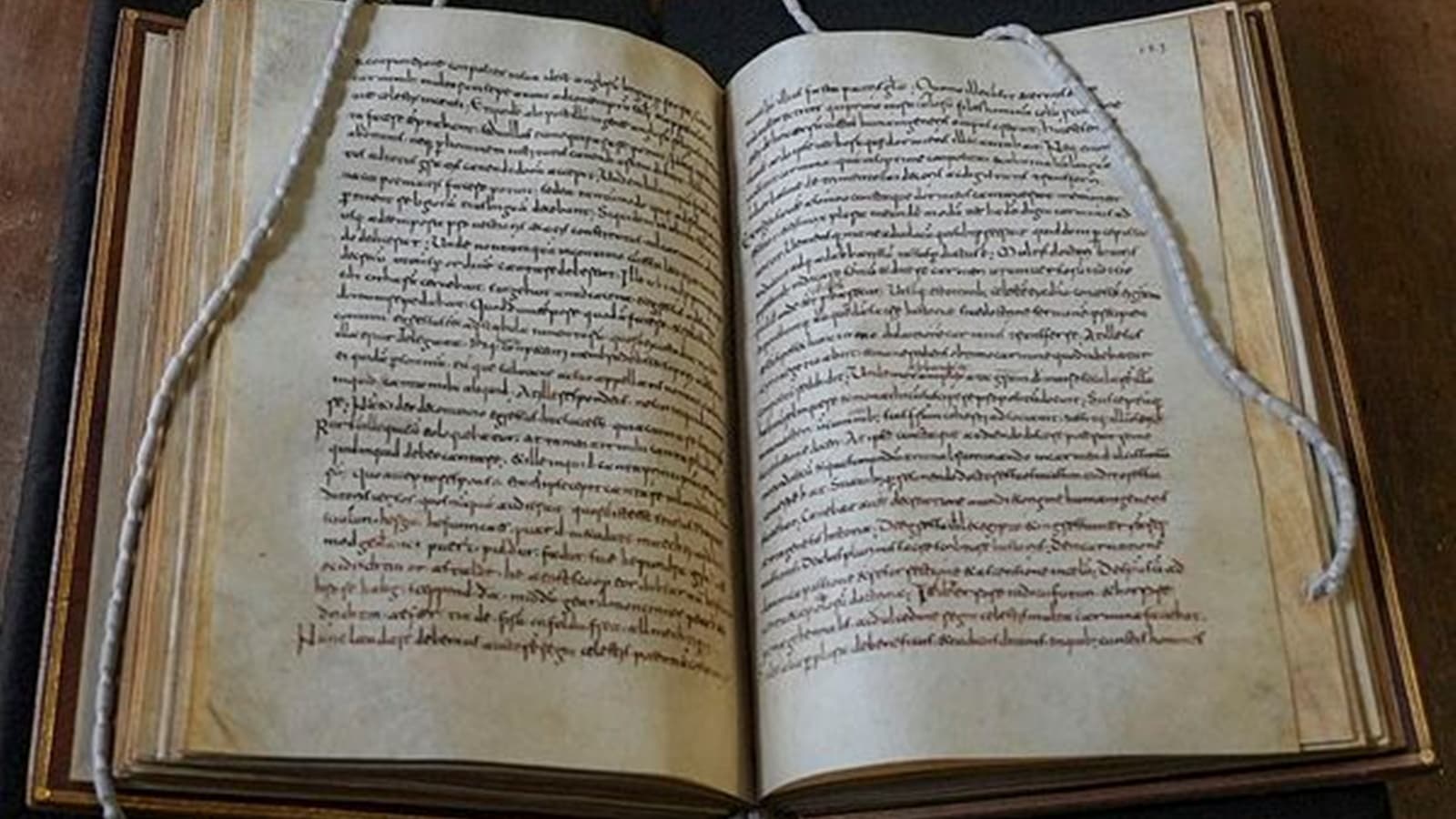
A previously unexamined manuscript at Rome’s National Central Library was found to contain a copy of Cædmon’s Hymn, the oldest poem ever written in Old English, predating the previously known earliest version by at least 300 years.
The findings by scholars Elisabetta Magnanti and Mark Faulkner of Trinity College Dublin were published in April 20226 in the journal Early Medieval England and its Neighbours.
The Hymn is a nine-line poem composed in the seventh century and is the oldest piece of literature in the English language. Our main source for its origin is Bede — the eighth-century monk and scholar also known as the Venerable Bede, whose Ecclesiastical History of the English People, completed around 731, is one of the foundational texts of English history and among the most widely copied books of the entire Middle Ages. According to Bede, the poem was written by Cædmon, an illiterate cowherd at Whitby Abbey in Yorkshire.
The story goes that Cædmon left a feast one night, ashamed that he could not sing when the harp was passed around. In his sleep, a figure appeared and told him to sing about creation, and he did, producing the Hymn. Whether the story is true or not, the poem survived, and nothing older in English has ever been found.
Bede included the story of Cædmon in his History, along with a Latin paraphrase of the Hymn. In some copies, a scribe later added the original Old English text alongside the Latin.
If the poem was already known, why is this discovery significant?
This is down to three reasons:
📌 First, age. Two older copies of the Hymn in Old English are known to exist, both from the 8th century, known as the Moore Bede and the Leningrad Bede. So the Rome manuscript is not the oldest copy. What makes it remarkable is that it is not the same version of the poem as those two earlier copies. Over centuries of copying and recopying, the Hymn’s text diverged into slightly different forms because of different word choices and different spellings. The Rome manuscript belongs to one of those variant traditions, known as the eordu recension, and within that tradition it is by far the oldest. The next oldest manuscript of this particular version of the poem dated to the 12th century. This find pushes that back by more than 300 years, meaning an entire branch of the poem’s history was almost invisible to us until now.
Story continues below this ad
📌 Second, placement. In every other surviving manuscript that contains the Hymn in Old English, including the two older ones, the text appears as an addition, written in the margins or tacked on as an appendix, clearly treated as supplementary to Bede’s Latin. In the Rome manuscript, the Old English poem sits directly inside the main Latin text, as if the scribe considered it an integral part of Bede’s work. No other surviving copy does this, and it suggests the English poem was being treated with a significance not previously documented.
📌 Third, geography. The manuscript was not copied in England. It was made at the Benedictine Abbey of Nonantola, near modern-day Modena in northern Italy. That an Italian scriptorium was copying and preserving Old English poetry in the early 800s reveals how widely the English language and its literature were travelling in the early medieval period.
How did the manuscript end up in Rome, and how was it lost?
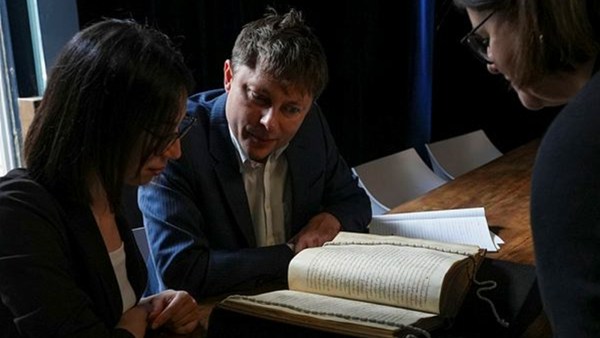 (From left) Elisabetta Magnanti and Mark Faulkner from Dublin’s Trinity College and Valentina Longo of Rome’s National Central Library look at a manuscript containing a rare, long-lost copy of Caedmon’s Hymn, the first poem ever to be written down in Old English, at Rome’s National Library. (AP Photo/Andrea Rosa)
The manuscript spent roughly seven centuries at Nonantola, appearing in the abbey’s catalogues as early as 1166, before being transferred to a Cistercian monastery in Rome in the mid-1600s. During the Napoleonic Wars it was moved to the Vatican for safekeeping, then returned to the Cistercians, only to be stolen sometime before 1821 and sold into private hands.
It resurfaced in 1827 in the collection of English antiquarian Sir Thomas Phillipps, who noted the presence of Old English text but did not pursue its significance. After his death the manuscript passed to Swiss collector Martin Bodmer, then to Austrian-born New York bookseller H P Kraus. The Italian government bought it from Kraus in 1972 and deposited it at Rome’s National Central Library, where it was catalogued, and then, for all practical purposes, forgotten.
Story continues below this ad
When scholars tried to track it down in 1975, the library’s own director at the time denied it existed at all.
How was it rediscovered?
Magnanti had spent more than four years systematically cataloguing all surviving copies of Bede’s Ecclesiastical History when she noticed the Rome manuscript listed in the library’s catalogue. Suspecting its complicated provenance history had kept it off other scholars’ radar, she contacted the library directly. Three months later she received complete digital images, and found the Old English poem sitting in the middle of the Latin text. “We were extremely surprised. We were speechless. We couldn’t believe our eyes when we first saw that,” she told the Associated Press.
The library has since digitised its entire collection of Nonantola manuscripts and made them freely available online. Andrea Cappa, the library’s head of manuscripts and rare books, described the discovery as a demonstration of what open digitisation and international scholarly collaboration can achieve. “The discovery made by the experts of Trinity College is just one starting point,” he said, “a single manuscript that might pave the way for countless other discoveries, in countless other fields.”