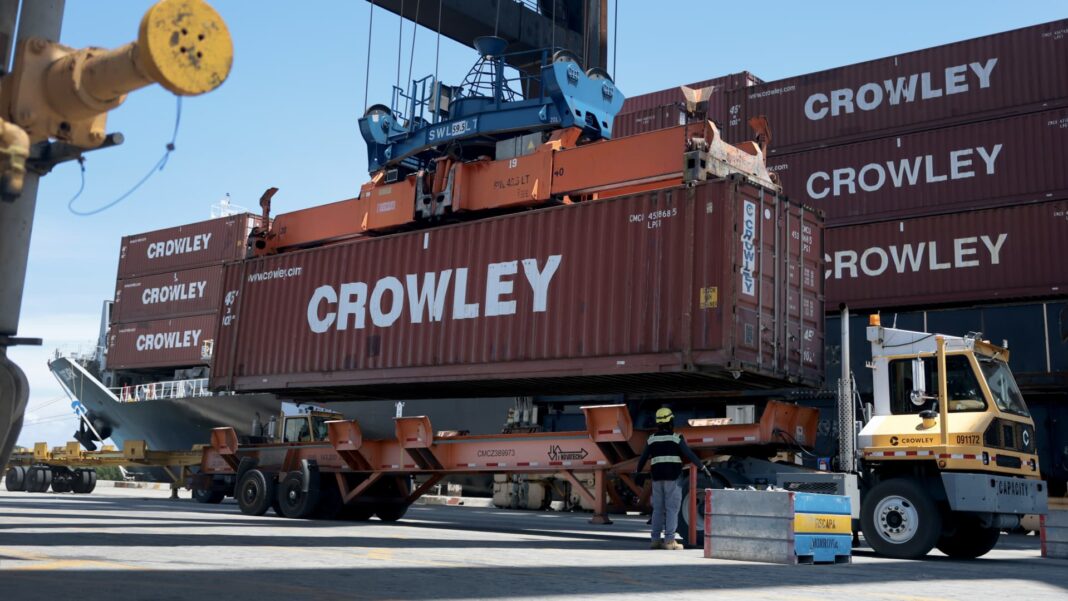
Dock workers offload shipping containers from a ship at Port Everglades on April 20, 2026 in Fort Lauderdale, Florida.
Joe Raedle | Getty Images
The cost of goods brought into the U.S. posted an unexpected increase in June as the price of goods from China rose by their largest monthly level in more than 18 years, the Bureau of Labor Statistics reported Friday.
Import prices were up 0.3% for the month, as a drop in energy was more than offset by increases elsewhere. On an annual basis, prices jumped 7.1%, the biggest move higher since August 2022. Economists surveyed by Dow Jones had been looking for a decline of 0.8% in June.
The report indicated that the artificial intelligence buildout could be hitting prices, as costs rose for computers, peripherals and semiconductors.
Beyond those areas, the BLS said industrial and service machinery drove costs higher, offsetting a 0.4% decrease in fuels and lubricants. The group posted a 12.6% jump in May.
China also played a role, with import prices rising 0.9%, the biggest monthly move since January 2008, a possible reflection of tariff impacts. The 12-month increase was 1.3%, the largest yearly gain since the period from November 2021 to November 2022. Export prices to China actually fell 0.2% in June, but were up 7.4% annually, the biggest monthly increase dating back to August 2022.
The report broadly showed that while a decline in oil costs helped lower prices in June, inflation is showing signs of broadening beyond energy as businesses face a variety of rising costs. Export prices broadly decreased 0.6%, the first monthly drop since May 2025. However, export prices rose 10.2% annually.
Earlier this week, the BLS reported that both consumer and wholesale prices declined, largely on the back of sliding energy costs as tensions between the U.S. and Iran briefly softened.
Federal Reserve officials have been grappling with the inflation question since prices spiked following the U.S. and Israel attacks on Iran that began in late February.
In congressional hearings earlier this week, Fed Chairman Kevin Warsh said he didn’t view the softer June inflation reports as an indication that the central bank’s work is finished in returning inflation back to the 2% goal. Indeed, the reports showed consumer prices up 3.5% from a year ago and wholesale costs rising 5.5%, despite both measures declining in June.
On Thursday, Dallas Fed President Lorie Logan said she thinks benchmark interest rates should be “modestly higher” to address the inflation problem. Similarly, Cleveland Fed President Beth Hammack on Friday also suggested that policy needs to be tighter.
“For the first time in my tenure, I’m hearing from businesses who say they think we need to take action to curb inflation, and from consumers who can’t make ends meet about a growing sense of despair,” Hammack said in a LinkedIn post.