UPSC Essentials brings to you its initiative for the practice of Mains answer writing. It covers essential topics of static and dynamic parts of the UPSC Civil Services syllabus covered under various GS papers. This answer-writing practice is designed to help you as a value addition to your UPSC CSE Mains. Attempt today’s answer writing on questions related to topics of GS-2 to check your progress.
🚨 Click Here to read the UPSC Essentials magazine for May 2026. Share your views and suggestions in the comment box or at manas.srivastava@indianexpress.com🚨
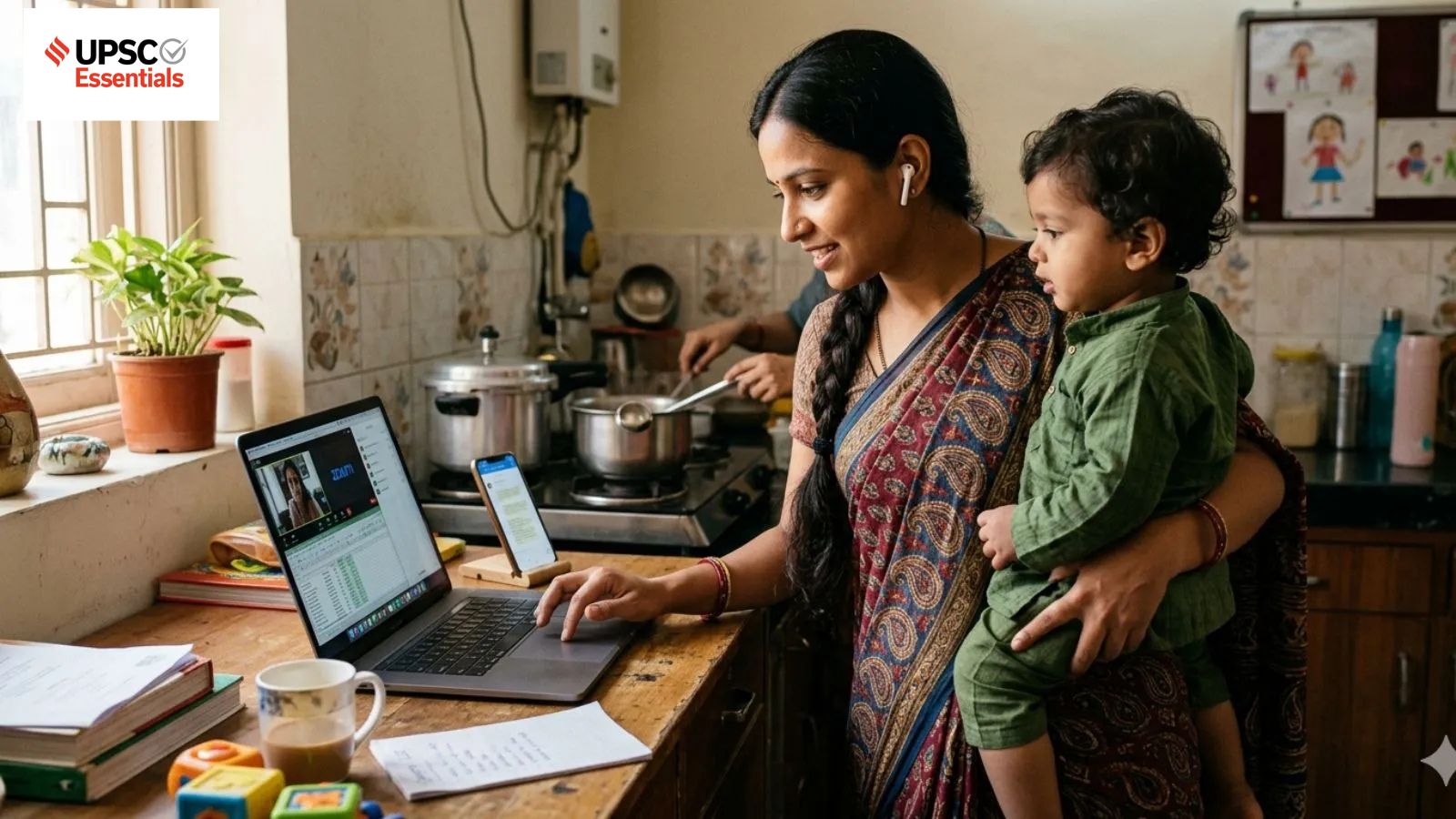
Unpaid domestic and care work remains one of the most invisible contributors to the economy. Discuss the significance of the recent Supreme Court judgment on homemakers in advancing gender justice and social equity.
QUESTION 2
India’s participation in forums such as the G7 reflects its growing role in shaping global governance. Discuss.
QUESTION 1: Unpaid domestic and care work remains one of the most invisible contributors to the economy. Discuss the significance of the recent Supreme Court judgment on homemakers in advancing gender justice and social equity.
Relevance: The issue relates to gender justice, women’s empowerment, and judicial interpretation of equality, important themes in GS-2. The Supreme Court’s recognition of unpaid care work highlights the role of the judiciary in advancing substantive equality and social justice.
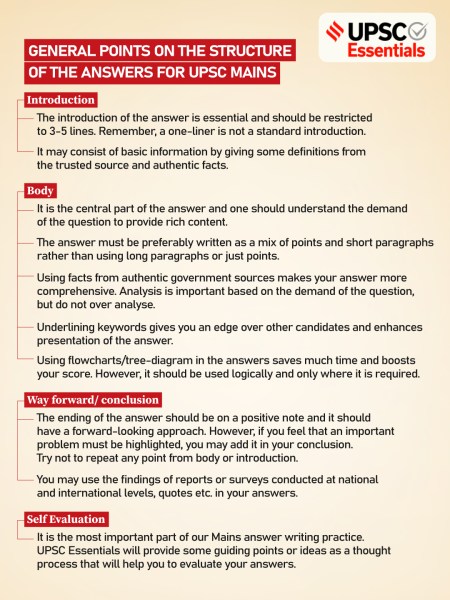
Note: This is not a model UPSC answer. It only provides you with a thought process which you may incorporate into the answers.
Introduction:
Story continues below this ad
— In a historic judgement, the Supreme Court identified homemakers as “nation builders” and added a separate compensation head, “loss of domestic care”, while assigning a baseline value of ₹30,000 per month for unpaid domestic work in vehicle accident compensation cases. The decision aims to remedy the long-standing undervaluation of unpaid domestic employment.
— A bench comprising Justices Sanjay Karol and N Kotiswar Singh held that homemakers are not merely caregivers but “economic entities” whose contribution to the household had been consistently undervalued by courts. It said that “the ‘homemakers’, to put it directly, actually are the ‘nation builders’ and they ought to be recognised as such”.
Body:
You may incorporate some of the following points in your answer:
Significance for Gender Justice
— The Court recognised that homemakers are more than just carers; they are also economic entities whose contributions have been continuously devalued.
Story continues below this ad
— The decision acknowledged a shift in society sensibility, in which a married woman managing a family is seen as a “homemaker” rather than being viewed as having a limited domestic role.
— According to the Time Use Survey, women spend more than seven hours per day on unpaid domestic work and are responsible for 2.6 times more unpaid caring than males.
— The Court highlighted that women’s unpaid caregiving work accounts for an estimated 15-17% of India’s GDP, despite the fact that it is unpaid and unrecognised.
Significance for Social Equity
— The Court established a new category of compensation called “loss of domestic care” to account for the economic and caregiving contributions that were not appropriately reflected in notional income estimates.
Story continues below this ad
— The court ruled that the death of a homemaker affects not only the spouse and children, but also the parents and in-laws who rely on her care, assistance, and friendship.
— The Court emphasised homemakers’ roles in meal preparation, childcare, senior care, domestic supplies, and emotional support, all of which allow other family members to participate constructively in society.
— The Court emphasised that homemakers have an important role in nurturing children, passing down values, forming social relationships, and developing human capital, all of which are necessary for national success.
Conclusion:
— The court identified three dimensions of loss when a homemaker dies:
(i) the management of the household itself;
Story continues below this ad
(ii) the loss of “first teacher” for the children, as in the daily transmission of skills, language, and values that no paid arrangement replicates; and
(iii) the loss to the earning spouse of the domestic infrastructure that enabled his focus on work.
— These, the court said, make the homemaker’s contribution “neither entirely economic nor entirely non-economic”.
(Source: Homemakers are nation builders: How Supreme Court recognised economic value of unpaid domestic labour, ‘Homemakers are nation builders’: Supreme Court sets Rs 30,000 monthly income)
Points to Ponder
Story continues below this ad
In what ways can such recognition contribute to social equity and women’s empowerment?
What challenges remain in translating judicial recognition into policy and societal change?
Related Previous Year Questions
Discuss the contribution of civil society groups for women’s effective and meaningful participation and representation in state legislatures in India. (2023)
“Though women in post-Independent India have excelled in various fields, the social attitude towards women and feminist movement has been patriarchal.” Apart from women education and women empowerment schemes, what interventions can help change this milieu? (2021)
Story continues below this ad
QUESTION 2: India’s participation in forums such as the G7 reflects its growing role in shaping global governance. Discuss.
Relevance: The topic is directly linked to India’s foreign policy and its engagement with global institutions and multilateral forums. The issue is important for analysing India’s evolving role as a leading power in shaping international norms, rules, and institutions.
Note: This is not a model UPSC answer. It only provides you with a thought process which you may incorporate into the answers.
Introduction:
— The G7 may not dominate the global economy as much as it did in the 1970s, but it still has an impact on international standards, financial flows, and policy frameworks. In this context, India’s invitation to the G7 Summit indicates its growing prominence in discussions about economic security, technology, energy, climate finance, and development.
Story continues below this ad
— While leaders will discuss hotspots like West Asia and Ukraine, France has deliberately placed economic imbalances and the risks of fragmentation in the global economy at the centre of the agenda, which will focus on economic security, artificial intelligence, the energy transition, climate finance and development. As one of the largest economies, a growing energy market and technology hub, India is affected by and increasingly central to these debates. It will bring to the table concerns shared by many emerging and developing economies.
Body:
You may incorporate some of the following points in your answer:
India’s Growing Economic and Strategic Influence
— India is one of the world’s major economies and a key economic driver. Its growing market and economic weight place it at the center of concerns about global economic governance.
— India shares the G7’s worries about the security of lithium, cobalt, nickel, and rare earth minerals. Its market size and processing capabilities make it a key node in new critical mineral partnerships and initiatives to avoid excessive supply-chain dependence.
— Artificial intelligence has arisen as a key concern for governance, standards, safety, and technological leadership. India’s experience with Digital Public Infrastructure (DPI) provides it a credible voice in shaping global discussions around technology governance.
— India is a big energy user as well as a leader in large-scale renewable energy deployment.
— India takes to global forums concerns that are shared by many growing and developing economies. Few governments can comfortably engage with both advanced economies and developing countries while maintaining influence over both.
Conclusion:
— India deserves a larger role in global governance since it promotes combining climate ambition with developmental priorities and the notion of differentiated responsibilities. India has expressed worry over coercive trade practices and policies, such as the EU’s Carbon Border Adjustment Mechanism, which may disproportionately harm developing countries.
— India should approach forums like the G7 not just as a participant, but as a country that is shaping global frameworks, because “today’s discussions become tomorrow’s rules.”
(Source: At G7 summit, India should help shape global frameworks)
Points to Ponder
What role does India play in representing the interests of the Global South?
How can India leverage forums such as G20, G7, BRICS, and the UN to shape international norms and institutions?
Related Previous Year Questions
“Energy security constitutes the dominant kingpin of India’s foreign policy, and is linked with India’s overarching influence in Middle Eastern countries.” How would you integrate energy security with India’s foreign policy trajectories in the coming years? (2025)
Critically analyse India’s evolving diplomatic, economic, and strategic relations with the Central Asian Republics (CARs), highlighting their increasing significance in regional and global geopolitics. (2024)
Previous Mains Answer Practice
UPSC Essentials: Mains answer practice — GS 3 (Week 158)
UPSC Essentials: Mains answer practice — GS 3 (Week 159)
UPSC Essentials: Mains answer practice — GS 2 (Week 158)
UPSC Essentials: Mains answer practice — GS 2 (Week 157)
UPSC Essentials: Mains answer practice — GS 1 (Week 158)
UPSC Essentials: Mains answer practice — GS 1 (Week 157)
Subscribe to our UPSC newsletter and stay updated with the news cues from the past week.
Stay updated with the latest UPSC articles by joining our Telegram channel – IndianExpress UPSC Hub, and follow us on Instagram and X.