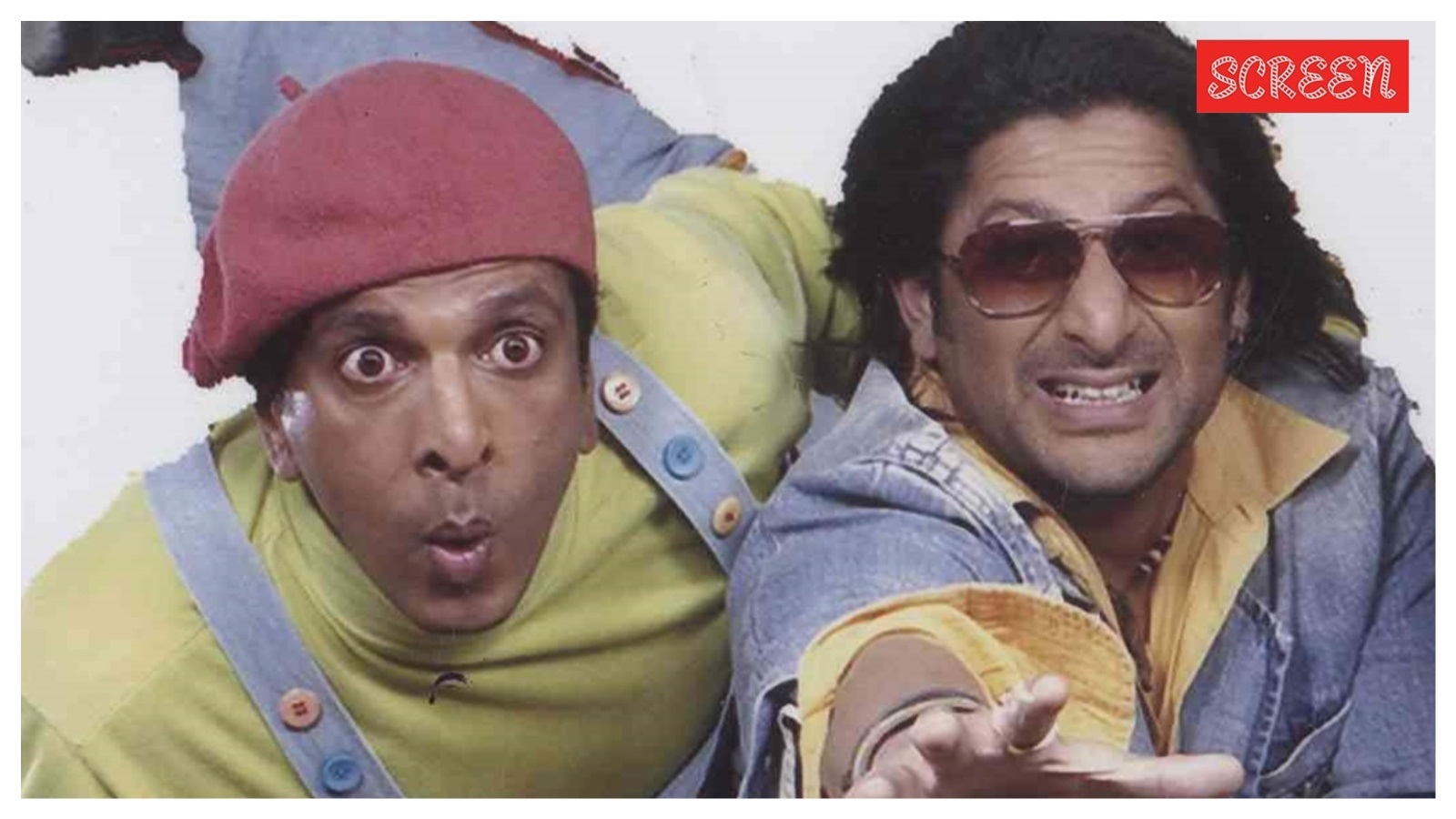
Actor Jaaved Jaaferi returns as the man-child and baby of the pack, Manav, in Indra Kumar’s buddy comedy Dhamaal 4, slated to release in cinemas this Friday on July 10. The actor first stepped into those shoes — and the turtleneck T-shirt, denim suspenders, and the newsboy cap — almost two decades ago in Dhamaal (2007). In this exclusive interview with SCREEN, the actor looks back at his career, from villainy to comedy, and how he still manages to look the same as Manav 19 years later.
There’s nothing that’s changed in Manav. The whole point is that it shouldn’t. It’s the character that makes the film. Yes, there’s a journey, but Dhamaal is all about its characters. Throughout the franchise, the two characters that have remained constant across the four films are Arshad Warsi and me, Adi-Manav. Everybody else has changed. Ajay Devgn came in the third part, Total Dhamaal (2019). Riteish Deshmukh shifted character from a detective to a Bihari conman. Ashish Chaudhary left after the second one, Double Dhamaal (2011).
How do Arshad and you strike that chemistry as brothers Adi-Manav?
He’s a fabulous actor. I’ve known him for way before he became an actor, for easily 40 years. Before I started my career, I know he used to dance. He’s six years younger to me, but he was about 18 when he started dancing. We already had a comfort level with each other. There was mutual love, respect, and friendship before Dhamaal came together. He’s evolved over the years. Initially, it was more dancing, fun, and lighthearted comedy.
Do you remember the first day of the first Dhamaal, around 20 years ago?
I remember very clearly the first day of shoot was the one with pizza and the landlady. Riteish was also not that big of a star then. He’d started and done some films by then. Aasish had also done more television than films. Sanju (Sanjay Dutt) was obviously a big star. So, coming together as four friends in this crazy, zany comedy was totally organic and fun. I loved making the first film the best.
Story continues below this ad
This year itself, you’ve had two films as varied as Dhamaal 4 and Rahil Anil Bharve’s psychological thriller Mayasabha. Do you think you’re in the best phase of your career now, given the range?
I feel the best is yet to come. But the past two years have been the most productive of my life so far. I’ve had four feature films — In Galiyon Mein, De De Pyaar De 2, Mayasabha, and Dhamaal 4, and four web series — The Magic of Shiri on JioHotstar, Mohrey, Taaza Khabar, and Do You Wanna Partner, which have all been from a varied range. But there’s so much more I want to do which I haven’t done yet. I look forward to that.
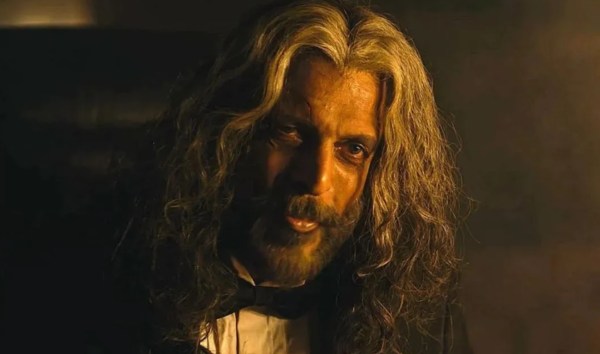 Jaaved Jaaferi in Mayasabha.
You’ve always had this range, and have also been an impeccable dancer. Do you think about why you never became an A-list star in the 1990s?
I think it depends on how you’re packaged. There’s also PR involved because the industry has its own web. There are times when there’s a negative thing about you out there, so you need a reality check or a positive thing about you being put out. I failed to do that, in some ways. I was also not a part of any group. Also, if you have a big hit, nobody argues with you. Nothing speaks like success. Like it happened with Salman Khan. He came in with Biwi Ho Toh Aisi (1988), and people wrote him off. Then Maine Pyar Kiya (1989) happened, and then everybody was running after him. It’s the same Salman Khan! It’s not like he was doing something different than what he was doing in Biwi Ho Toh Aisi. But it’s just the success. And then of course, you grow with that. From that perspective, I never got that big hit.
Story continues below this ad
But your debut film itself, Subhash Ghai’s Meri Jung (1985), was a huge hit. Your song “Bol Baby Bol” also blew up. What changed after that?
I was launched as a villain! Subhash Ghai sahab was the most successful director then. NN Sippy sahab was one of the top producers then. So, everyone thought if they’ve taken me as a villain, that’s what I should be taken as going forward. That judgement was already passed. To argue with that, somebody had to make a fun musical film like probably they did with Prabhu Deva in the South. But they didn’t, and I didn’t pitch myself either. But I don’t think too much about it, honestly.
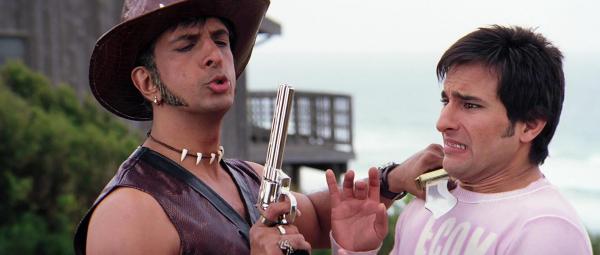 Jaaved Jaaferi and Saif Ali Khan in Salaam Namaste.
Do you think the switch to comic roles happened with Salaam Namaste in 2005?
Technically, it was with Jajantaram Mamantaram (2003), where I was the lead. It was a fun character. He was actually a street-smart hero character. Like we have the tapori guy as the hero in Hindi films. It was great, and the movie did pretty well actually. I don’t know, man. Then there was Salaam Namaste in 2005 and Dhamaal in 2007. Again, it’s about what succeeds. So, then I began getting approached for funny characters and became a part of the supporting cast. There was no solo thing riding because you need a solo hit to become a lead actor. Otherwise a lot of lead actors are still stuck in ensemble casts. People won’t make a solo film with them, but would take them in an ensemble of three to four actors. But that’s how the parameters of the industry work. By the grace of god, I’ve just managed to stay afloat for 40+ years. So, there’s gratitude, but I feel I can do much more.
Story continues below this ad
One of the funniest things you did was the Hindi narration of Takeshi’s Castle, the popular Japanese game show. How did you manage to take an entirely different culture and make it so desi, and that too extremely funny?
It’s not something that was very lucrative from a financial perspective. It was for Pogo, a television channel for children. But it was enjoyable. See, I do things where I think I can hone my talent a bit more. It can be an advertisement for Maggi Hot & Sweet Sauce, it can be the song “Mumbhai” (1998), or Takeshi’s Castle. I’d already become the highest paid VJ from 1994 till 1999 on Channel V. What Takeshi’s Castle was paying me was much less than what I was already getting. But my children were young then, so I thought let’s just do it for the children. I also wanted to move away from the Channel V zone — the “Yo, bro!” and the Gen-X lingo. I thought let’s go more pan-India. So, I got this writer Baba Khan with me. He was a friend of my father. He was senior to me, but also became my friend. He was well-versed with Urdu and the muhavaras across Bihari and Haryanvi. So, I merged my Channel V zone with his. We used to just sit on the studio, improvise, and crack something funny which lands. There was nobody from the channel. It was just me, Baba bhai, and recordist Pradeep Shukla in this small studio in Lokhandwala. It was a very organic process. That just worked and blew up. It was aimed at children, but there was a whole elder audience which was enjoying it also.
Since you mentioned your father Jagdeep, what have you learnt from him about doing comedy?
I’d say my father was among the top three comedians of all time, right up there with Mehmood uncle and Johnny Walker sahab. Obviously, you’d observe him, and he had a lot of nuance. Growing up, there was no video or internet. Later on, when we started watching his films, we realized that as a child actor, he was way ahead of his time. He was crying at the age of 12 without glycerin. At that age, you can’t! The comic timing, nuances., and reference points are definitely there somewhere in my system, at the back of your head, and in your data bank.
Story continues below this ad
Also Read: Karan Johar’s Dharma Productions locks Rs 250 cr deal to distribute Ramayana in India
Finally, since you mentioned that Manav is not meant to change or age in the Dhamaal franchise, how do you manage to still look the same 19 years after you first played that character?
Of course, we’ve aged! I’m probably lucky. Obviously, you can change your look today with makeup, prosthetic, and post-effects. But in my case, we haven’t changed anything at all. So, whatever you see is real, including the few wrinkles that have come around the eyes. But the character is you as an actor. You put on that mask, and the way you walk and talk remains constant. You can’t change the physical ageing. I’m lucky that my weight has also not changed much. If you look at the first Dhamaal and now, I fit into the same clothes!