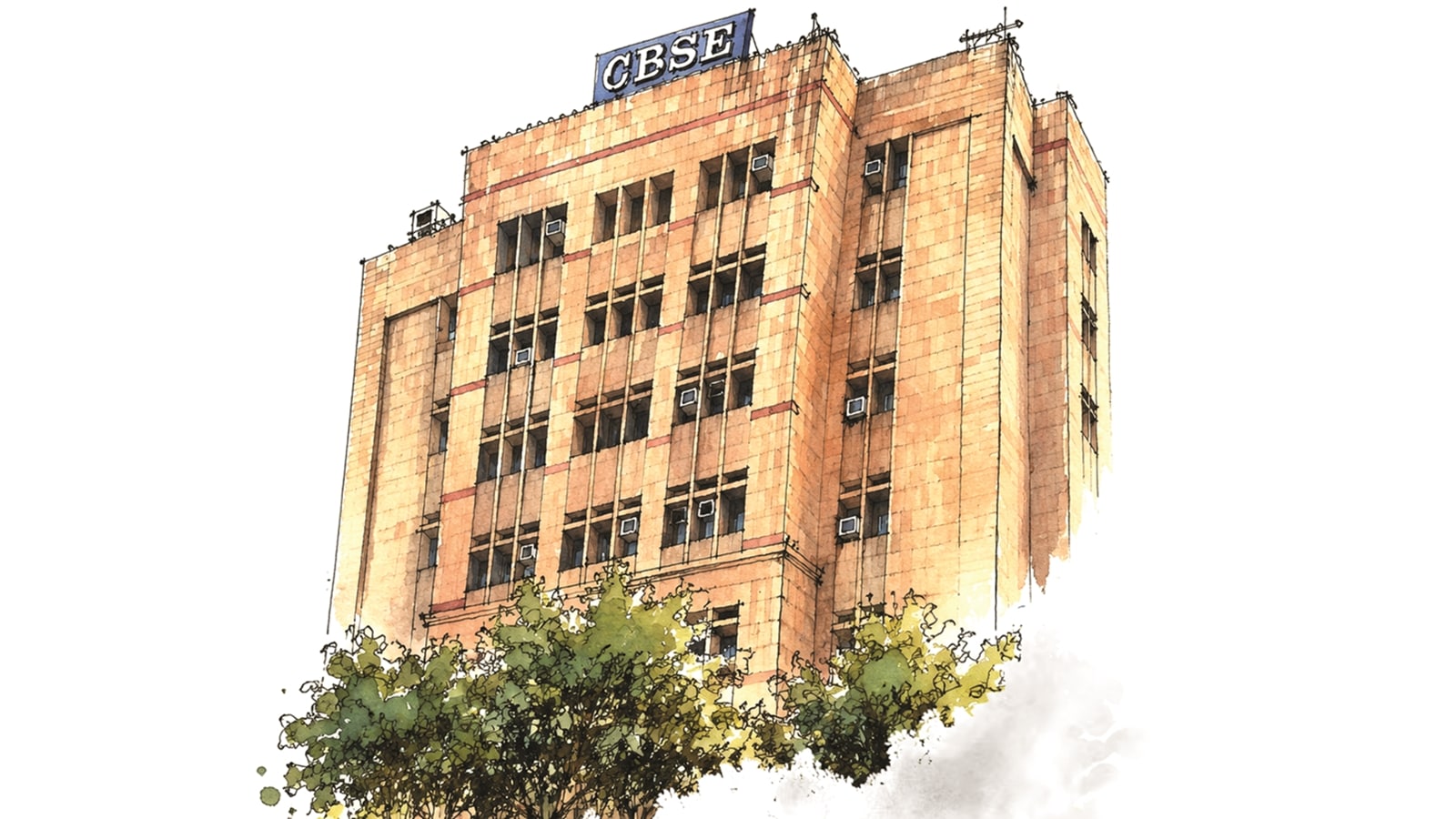
It was not every day that 17-year-old Sachi, a student from Delhi, woke up before 5 am, trying repeatedly to open a website, while the rest of the city slept. But earlier this month, she was attempting to open the Central Board of Secondary Education (CBSE) re-evaluation portal — the website had been crashing for days as students across the country tried to obtain scanned copies of their answer books after the declaration of the Class 12 board examination results on May 13.
For days, as she tried, the site would open briefly or freeze. Sachi thought the best bet to access it would be to wake up before dawn when, as she hoped, fewer students would be online. “It finally worked,” she recalled, accessing her scanning answer books.

For thousands of students like Sachi, CBSE’s On-Screen Marking (OSM), a digital evaluation system introduced for Class 12 board examination for the first time this year, has raised major concerns about possible errors in their result. Many have even questioned if the scanned answer books they accessed even belonged to them.
For, 17-year-old Kushal Jain getting a scanned copy of the Chemistry answer book turned into an ordeal. He got a score of 97 in Physics and Mathematics, each, but only 79 in Chemistry. “I had expected a score above 95. When the results were declared, I assumed there had been a mistake.” But the re-evaluation portal, he said, repeatedly malfunctioned and dates for re-evaluation were extended by CBSE.
On May 29, CBSE ultimately announced that the Post-Result Activities portal — for verification and re-evaluation — would only become operational from June 1, saying the delay was necessary to ensure a “transparent and glitch-free process” and maintain the “highest standards and protocols of evaluation.”
But students are worried as deadlines are nearing for admissions to the college of their choice. “The registration for Joint Admission Counselling (JAC), Delhi, which conducts admissions to the B Tech and B Arch programmes, closes on June 9. My counselling starts on June 2. CBSE keeps extending the dates and students are stuck in limbo,” said Kushal.
“If my marks increase,” he added, “my overall percentage crosses 95.” But the revised score may arrive after critical decisions regarding the college admissions have already been made.
Story continues below this ad
For students pursuing engineering, like 17-year-old Moksh Yadav, a handful of marks can alter eligibility, counselling prospects and admission outcomes. Many engineering institutions require candidates to secure at least 75% marks in Class 12, in addition to qualifying through entrance examinations such as Joint Entrance Examination (JEE).
However, it was no less than a rude shock for Moksh when he had opened the scanned copy of his Class 12 English answer book — his score was 33 out of 80. “The handwriting was unfamiliar, entire sections were blank and the answer book had only 12 pages,” he said. He distinctly remembered using a supplementary sheet during the examination. “The first page looked like mine,” he said. “After that, the entire answer book, it seemed, belonged to someone else.”
While he hoped to score around 78-80%, the English score brought his overall percentage down. “I wasn’t expecting perfection. I just expected fairness,” he said.
Moksh hopes to pursue Bachelor of Management Studies at Delhi University and has appeared for the Common University Entrance Test (CUET). “I did not get the marks for which I studied and wrote the examination… this could alter my chances to even qualify JEE,” he rued.
Story continues below this ad
After CBSE responded to his re-evaluation complaint by stating that no discrepancy had been found, Moksh turned to social media. Eventually, a legal notice was sent to CBSE. “If the matter remains unresolved, my family is considering approaching the Supreme Court.”
Rollout rushed, say evaluators
Even as the CBSE had promised “minimum human errors” with the launch of the new evaluation system, several principals, evaluators and senior teachers who spoke to The Indian Express claimed that the rollout was rushed, inadequately tested and difficult to navigate for many teachers.
Minutes of a meeting held last June of the CBSE Governing Body — the Board’s highest decision-making body — show that members had recommended the implementation of the OSM system across all subjects only after pilot projects had been conducted in selected subjects and regional offices. According to teachers, this never materialised.
Instead, teachers and evaluators claimed, the dry run was held across five schools involving around 100 teachers in January this year. This, even as the CBSE claimed, that they had been preparing for nearly a year.
Story continues below this ad
Formal onboarding and practice sessions began around mid-February, evaluators said. “A six-month trial run should have taken place,” said a headmistress of a private school in South Delhi.
The system frequently struggled under its own weight, said some teachers. “Evaluators were forced to make sense of blurred and poorly scanned answer sheets. At times, the system even logged evaluators out, and when they logged back in, the sheet appeared as already checked,” alleged a teacher, who participated in the evaluation process.
According to school principals, teachers were repeatedly called in to clear backlogs as pending answer books piled up on the portal, particularly in subjects such as Physics.
The transition to a new system was especially daunting for many elderly teachers, the headmistress said, adding, “Some even admitted they did not know how to use a mouse properly.”
Story continues below this ad
Teachers said the challenges extended far beyond basic computer literacy. Initially, CBSE required evaluators to assess 20 answer books a day. Later, this daily limit was increased to 25.
Many evaluators found those targets difficult to meet. “I was not able to correct more than 10 sheets,” one evaluator said. “Many teachers faced the same situation.”
Another teacher described the physical strain of the process. “Teachers were irritated, fatigued and under pressure. They had to sit in front of screens for long hours. For elderly teachers, this can take a physical toll on their bodies.”
Several evaluators claimed that some scripts were blurred, poorly scanned or difficult to decipher because of overwritten text and faint handwriting.
Story continues below this ad
Since the answer book appeared as a continuous digital booklet, evaluators often felt they had little choice but to continue assessing it even when the quality was poor. “Once you start the booklet, you have to finish it,” one teacher said, adding, “The pressure to meet the minimum requirements often forced evaluators to compromise and correct the paper fully anyway.”
A principal of a private school recalled teachers repeatedly struggling to access the platform itself. “The evaluators themselves struggled with credentials and OTPs, often unable to even access the system properly,” the principal said.
What CBSE says
As the CBSE continues to be under fire, a fresh statement was put out on Sunday. “We have been closely monitoring the vulnerabilities in the OnMark portal of our service provider that are being flagged in the public domain. An expert team of cybersecurity professionals has been deployed over the last few days from across various arms of the government as well as the IITs to fortify these systems, including taking them over to a more secure set up. The identified vulnerabilities have been contained, and other exploitable weaknesses are being ruled out.”
Earlier, officials had told The Indian Express that the Board received 2.94 lakh applications seeking copies of 8.56 lakh answer books this year — more than double last year’s 1.31 lakh applications for 2.82 lakh answer books. Officials and educators attributed part of the surge to a decline in top scores, with the number of students scoring above 90% falling by around 16% compared to 2025.
Story continues below this ad
The CBSE is also considering imposing a financial penalty on Hyderabad-based vendor Coempt Edutech Pvt Ltd handling the OSM system, The Indian Express reported on May 29. Sources said the CBSE has identified 5,000 blurred answer book scans so far and 23 cases where students received scanned copies belonging to another candidate’s answer sheet.
However, officials have defended the digital evaluation process, saying it involves three separate layers of quality checks before answer books reach evaluators. Scripts were reviewed during scanning, reviewed again during uploading and evaluators themselves could reject illegible scans.
In the case of mismatched answer sheets, CBSE pointed to the anonymisation stage, suggesting that errors may have occurred while handling the “flying slips” used to conceal student identities before evaluation.
Battles over evaluation
OSM challenged: Allahabad HC, May 2026
CBSE’s On-Screen Marking system for Class 12 has been challenged before the Lucknow Bench of the Allahabad High Court. The PIL has been filed by Lucknow-based advocate Mohit Ashok against the Union of India, CBSE, the Controller of Examinations, and the State of Uttar Pradesh. The petitioner has alleged that the rushed implementation of the digital evaluation mechanism has caused “systemic institutional failure” in the assessment of lakhs of students across the country.
Re-evaluation Scrapped — Delhi HC (2017)
Story continues below this ad
CBSE had abolished the re-evaluation system for board exam answer sheets. When the matter came before a bench of Justices Sanjeev Sachdeva and A K Chawla, the court was shown answer sheets where completely correct responses had been awarded zero marks. Troubled by this, the bench questioned CBSE on why it had done away with re-evaluation altogether, noting that even if such errors affected just one student, that student’s entire career was at stake.
COVID Evaluation Controversy — Supreme Court (2021)
After Class 12 board exams were cancelled due to COVID-19, CBSE adopted a 30:30:40 formula to calculate students’ marks based on their performance in Classes 10, 11, and 12 respectively. A group of pass-out students petitioned the Supreme Court alleging that their marks had not actually been computed using this formula, and that their true performance had not been reflected. They further alleged that while CBSE had announced a dispute resolution mechanism for aggrieved students, it existed only on paper and was never meaningfully implemented, causing serious harm to the affected students.
Class 10 Internal Assessment — Delhi HC (2021)
With board exams cancelled due to COVID-19, CBSE announced that Class 10 students would be assessed entirely on the basis of internal marks awarded by their own schools. An NGO challenged this policy before the Delhi High Court through a PIL, arguing that it was unconstitutional and created serious risks of manipulation, exploitation, and extortion of students and parents by school authorities. The court issued notice to the Central government and the Delhi government, seeking their response to the petition.
Step-by-step
WRITING
- Students appeared for exams at designated CBSE examination centres.
- Answer books were sent to CBSE’s regional offices, where they went through a “secrecy” process to conceal identifying details to make sure that evaluation was anonymous.
SCANNING
- Each answer booklet was digitally scanned at the regional office.
- Officials were supposed to check whether the scanned pages were clear, complete, and properly uploaded.
- After a second verification, the digitised answer sheets were uploaded to CBSE’s OSM evaluation system.
MARKING
- Teachers appointed as examiners were given login credentials through CBSE’s portal. CBSE uploaded detailed marking schemes for all 116 subjects; also supplied physical copies to evaluators.
- Evaluators read the scanned answer sheets online. They awarded marks for each answer directly into the digital system, using the marking scheme.
- The software automatically added the marks – the intention being to reduce calculation errors.
SUBMISSION
- Some evaluated answer sheets were supposed to be randomly reviewed by senior evaluators, including Additional Head Examiners and Head Examiners.
- After evaluation and checking, the digitally marked answer books were submitted into the system.
12-year road to OSM
Early experiment: 2013-14
CBSE first experimented with On-Screen Marking (OSM) in 2013-14 for select subjects and regional offices, working with technology vendors including TCS. While some centres reported satisfactory outcomes, operational and infrastructural challenges prevented the system from being expanded nationwide at the time.
Proposed pilot: 2024-25
CBSE proposed that OSM be implemented from the 2024-25 exams in “small-volume subjects” (those with fewer examinees). Targeted for the pilot were a few subjects in the main examination for both Classes 10 and 12, and the science or mathematics supplementary exams. Class 12 Applied Mathematics was specifically flagged for OSM review.
Controversial implementation
The system has been used by examination boards like Cambridge (UK), IB, and Pearson for years. CBSE decided to introduce OSM for the evaluation of all Class 12 answer books beginning with the 2026 exams, covering all 116 subjects at full scale. The rollout has run into serious issues, with allegations of marking discrepancies, blurred scans, and technical glitches in the portal.