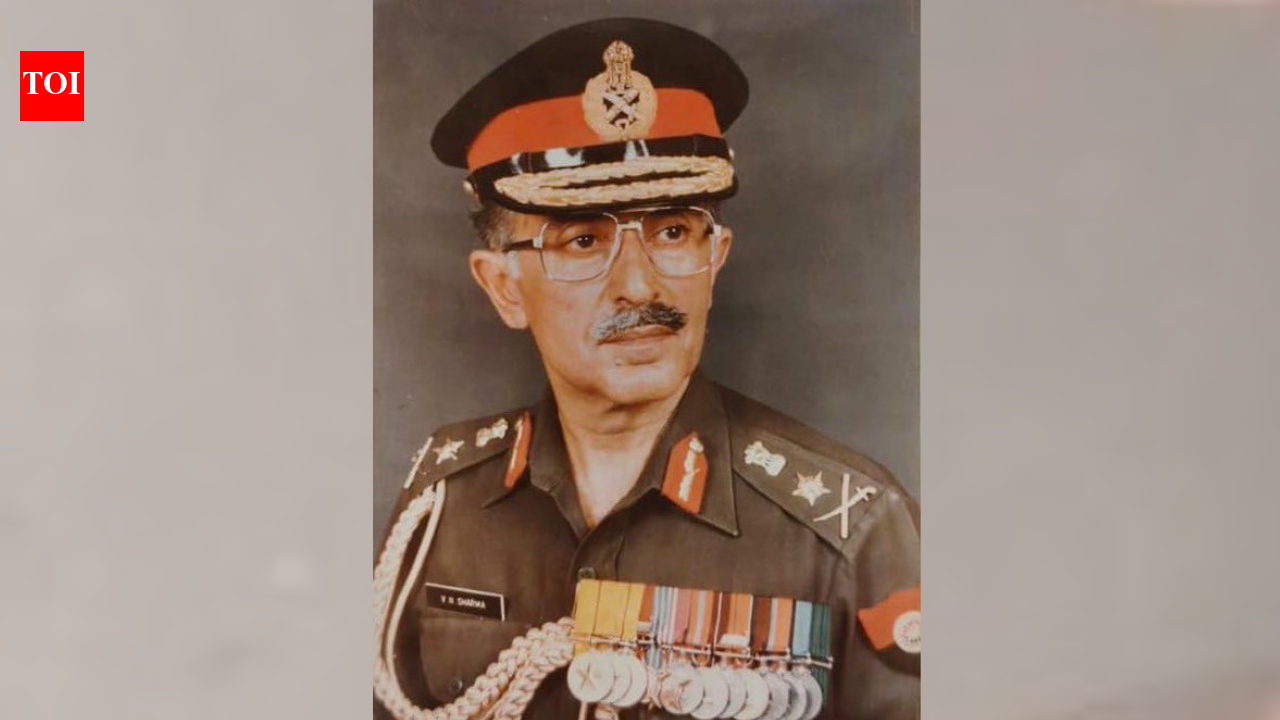
Former Army Chief General Vishwa Nath Sharma, who played a pivotal role during the 1987 military stand-off with China, passed away of natural causes in New Delhi in the early hours of Friday at the age of 96. Commissioned into the 16th Light Cavalry in 1950, General Sharma became the first officer commissioned after Independence to rise to the position of Army Chief. He served as the 14th Chief of Army Staff from May 1, 1988, to June 30, 1990.His career was marked by distinguished service across multiple theatres. As a Major, he fought in the 1965 war in the Lahore sector. He later commanded the 66 Armoured Regiment and served as an instructor at the Defence Services Staff College in Wellington. During the 1971 war, he served as Colonel General Staff (Operations) of an Armoured Division. His subsequent commands included a mountain brigade in insurgency-hit areas, an armoured brigade in Rajasthan, and a mountain division in the eastern sector. He was awarded the Ati Vishisht Seva Medal and later the Param Vishisht Seva Medal.General Sharma’s tenure as Eastern Army Commander coincided with the tense Sumdorong Chu stand-off in Arunachal Pradesh. The crisis began in June 1986 when Indian forces discovered Chinese attempts to alter the undemarcated Line of Actual Control near the village of Sumdorong Chu in Tawang district. The situation escalated into a major military mobilisation in 1987 under then Army Chief General K. Sundarji, who launched Operation Chequerboard.The operation involved the deployment of 10 divisions and several Indian Air Force squadrons across the northeastern Himalayas. General Sharma’s leadership during this period was instrumental in managing one of the most serious confrontations between India and China since the 1962 war and the 1967 clashes.General Sharma was Army Chief during a particularly challenging period for both the country and the armed forces. During his tenure, the Army was engaged in combat against the Liberation Tigers of Tamil Eelam (LTTE) in Sri Lanka while simultaneously battling insurgencies across the Northeast and Punjab. The insurgency in Kashmir had also just begun, while the guns continued to boom in the Siachen Glacier sector.General Sharma’s family legacy was also deeply rooted in military valour. His elder brother, Major Som Nath Sharma, was the first recipient of the Param Vir Chakra for his heroism during the Battle of Budgam in 1947.General Sharma’s passing marks the end of an era for a soldier-scholar who combined operational brilliance with instructional acumen. He led the Army at a critical juncture in the nation’s history. The insurgency in Punjab was brought under control a few years after he demitted office, while the Army maintained stability in the Northeast.At the same time, the force was undergoing modernisation, with new equipment and operational concepts being introduced, even as General Sharma and the Army continued to meet multiple security challenges in the best interests of the nation.