
4 min readMumbaiJul 20, 2026 07:40 AM IST
Earnings for most Indian IT companies so far have shown resilience on several fronts, even as the demand outlook remains clouded by factors such as geopolitical uncertainty, client budget cuts and rising AI spends.
While each IT major has its own set of clients spread across various verticals, all these players have singled out one segment that has underperformed across the board — the healthcare and lifesciences vertical in the Americas.

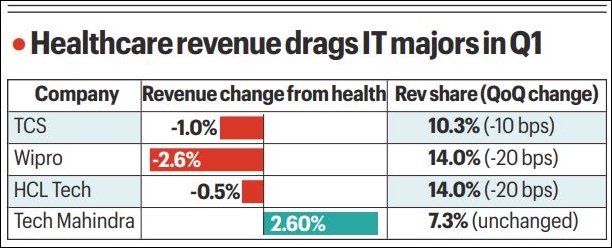
For example, revenue from Wipro’s Health vertical, which accounts for 14% of its overall revenue, fell 2.6% sequentially in Q1. In its post-earnings conference call on Thursday, Chief Executive Officer (CEO) Srini Palia said budgets of US-based healthcare providers and insurers have remained flat due to pressures in the US healthcare ecosystem, with these companies also looking to increasingly spend towards AI.
“Their budgets have been flattish for us, and in some places we have seen negative growth. Also, most of the budgets right now are being reallocated to some kind of discretionary spending, but towards AI,” Palia said.
Other IT majors have also seen revenue from the segment decline sequentially in Q1 — by 1% for TCS and 0.5% for HCL Technologies. Tech Mahindra was the only exception, with the segment registering positive growth of 2.6%.
Why healthcare underperformed
A large chunk of the healthcare and lifesciences verticals of Indian IT majors comprises US-based healthcare providers, insurers, life sciences companies and medical device manufacturers. The US healthcare system has faced an affordability crisis since the Covid-19 pandemic, prompting the government to tighten scrutiny and introduce measures that have pressured companies in the sector over the past few years.
Some of the measures include capping prices of critical drugs and aggressively squeezing medicare-related costs, which is positive for citizens but have sharply hit the margins of companies in the sector.
Story continues below this ad
“The government crackdown has reduced the discretionary spending power of US health companies and payers. What has made it worse for Indian IT companies is that these US clients have now focused their limited spending ability towards AI and automation to reduce costs in that way as margins remain squeezed,” an analyst tracking the IT sector at a domestic brokerage said.
Traditionally, healthcare companies in the US approached Indian IT firms for jobs such as server maintenance, back office operations, and compliance. However, they are now spending heavily on AI, in which the Indian majors face much more competition from global AI companies.
‘Spending shifts towards AI’
“It is very difficult to say from here what the issue is. It might be a sector-specific issue, or maybe a client-specific one. But discretionary spending, where you experiment on new stuff, is definitely declining in favour of AI spending,” said Sunny Agrawal, head of research at SBICAPS Securities.
These factors have led to the healthcare and life sciences vertical being on a declining trend over the past year across many Indian IT majors. For instance, Wipro has seen their revenue from the segment falling sequentially in three of the last four quarters. HCL Tech saw its revenue from the segment fall 1.8% in FY26.
Story continues below this ad
However, some of these companies expect performance from the segment to improve in the upcoming quarters. TCS Managing Director and CEO K Kirthivasan said he expects the vertical to pick up in the Q2 earnings. Wipro’s Palia said while companies in the American healthcare sector focus on AI, he expects new opportunities such as AI implementation and compliance to also arrive.