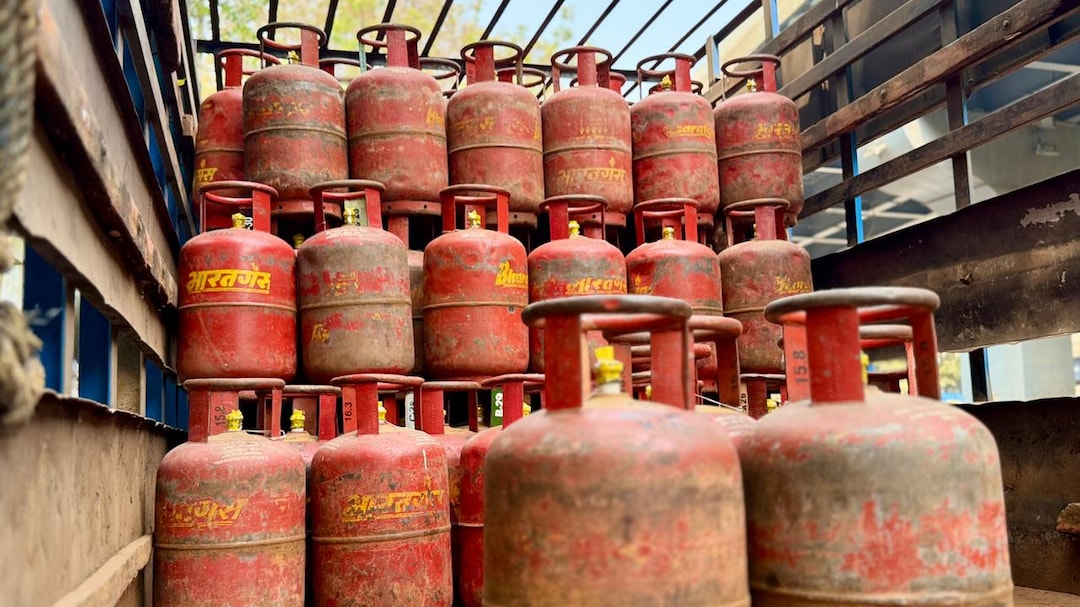
India needs to significantly expand its liquefied petroleum gas (LPG) storage infrastructure and is currently evaluating multiple models to strengthen reserves amid growing concerns over global supply disruptions, according to Bharat Petroleum Corporation Limited (BPCL) Chairman and Managing Director Sanjay Khanna.
“India definitely needs more LPG storage. At this juncture, multiple options are being explored to increase capacity. We are in talks with various stakeholders and will have a plan in place within six months,” Khanna said.
The remarks come at a time when the ongoing West Asia conflict has heightened concerns around India’s heavy dependence on imported energy supplies and exposed vulnerabilities in the country’s storage infrastructure.
ALSO READ: Petrol, Diesel Prices To Rise? OMCs Eye Modest Fuel Price Hike As Losses Mount, Says Report
A recent report by S&P Global said India requires a comprehensive energy storage policy spanning crude oil, LPG, natural gas, battery storage and power systems instead of a “piecemeal” approach to storage planning.
According to S&P Global, India currently maintains LPG storage equivalent to nearly 22 days of demand, compared with around 74 days for crude oil and about 60 days for aviation turbine fuel (ATF). The country has no strategic reserve for natural gas, while battery storage capacity remains below 2 gigawatts.
India’s import dependence remains particularly high in the energy sector, with nearly 90% of crude oil, 50% of natural gas and 60% of LPG demand met through imports. A substantial share of these imports comes from West Asia due to geographic proximity and established supply chains.
ALSO READ: India Maintains 60-Day Stock, No Plan To Ration Fuel Usage, Oil Secretary Clarifies
According to ANI, Gauri Jauhar, Executive Director, Strategic Climate & Clean Energy Initiatives at S&P Global Energy, said last week that India needs a unified storage framework that integrates both conventional fuels and emerging clean energy systems.
“There has to be a much more comprehensive view of storage. It cannot just be about crude or LPG separately. It has to cut across electrons and molecules,” Jauhar said.
She added that the current geopolitical environment should act as a catalyst for faster energy transition and long-term planning.
“Crisis is a catalyst because it gives an opportunity to reset and compress timelines around what is urgent and important,” she said.
Essential Business Intelligence,
Continuous LIVE TV,
Sharp Market Insights,
Practical Personal Finance Advice and
Latest Stories — On NDTV Profit.