Short on time before UPSC Prelims and struggling with tricky concepts? The exam increasingly tests your conceptual clarity and ability to apply core ideas, especially in the most dynamic subjects: Science, Economy, and Environment (SEE).
UPSC Essentials’ new initiative, UPSC Prelims ‘SEE’ Snapshot, brings you, every Wednesday, a quick, exam-focused revision of key concepts. In each article, we pick three important current themes from Science, Economy, and Environment and decode them strictly through the Prelims lens—focusing on concepts and clarity.
SCIENCE
Sustainable Aviation Fuel
Core Concept:
— SAF, also known as aviation biofuel, is a biofuel that is produced from sustainable feedstocks and has chemistry similar to conventional aviation turbine fuel or jet fuel, which is derived from crude oil.
— It is a ‘drop in’ fuel, meaning it can be blended with ATF without requiring any change in the existing machinery of aircraft.
— SAF can be derived from a range of materials, including:
Story continues below this ad
• Oils and fats such as Used Cooking Oil (UCO), oil-rich seeds from plants, algae oils, animal fats,
• Municipal Solid Waste (MSW)
• Agricultural and forestry residues such as wood waste, sugarcane bagasse, corn stover, husks and straw, sugars and starches.
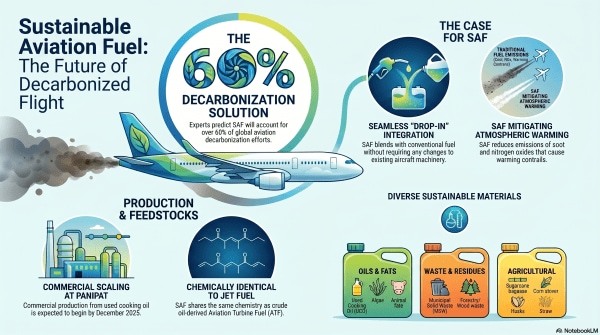 (Image generated using Google NotebookLM)
— There are various methods to produce SAF, with each using different combinations of raw materials.
Sustainable Aviation Fuel (SAF) Explained
DEFINITION
A cleaner alternative to conventional jet fuel
Sustainable Aviation Fuel (SAF), also called aviation biofuel, is produced from sustainable feedstocks with chemistry similar to conventional Aviation Turbine Fuel (ATF). It is a ‘drop-in’ fuel — blendable with ATF without any modifications to existing aircraft, engines, or fuelling infrastructure.
◆
Oils & Fats
Used Cooking Oil (UCO), algae oils, oil-rich seeds, animal fats.
◆
Municipal Solid Waste
Urban waste converted into aviation-grade biofuel feedstock.
◆
Agricultural Residues
Wood waste, sugarcane bagasse, corn stover, husks, straw, sugars and starches.
80%
Potential reduction in GHG emissions vs conventional jet fuel
60%+
Share of global aviation decarbonisation expected from SAF alone
★
No fleet modifications needed
Compatible with existing planes, engines, and fuelling infrastructure worldwide.
★
Energy security
Reduces import dependence and shields aviation from global crude oil price volatility.
★
Employment generation
SAF adoption creates jobs across the sustainability and biofuel sector.
CHALLENGE
Widespread adoption faces three key hurdles
Despite its promise, SAF faces significant barriers that limit large-scale deployment — especially in a cost-sensitive aviation market.
✕
High production cost
SAF costs more than double conventional jet fuel, making large-scale adoption difficult without passing the burden to consumers.
✕
Infrastructure investment
New infrastructure for production, storage, blending, and transportation adds significantly to initial adoption costs.
✕
Feedstock availability
Seasonal and varied feedstocks mean no guarantee of year-round supply at the scale needed.
CERTIFICATION & COMPLIANCE
ISCC CORSIA — the global SAF compliance framework
ISCC CORSIA certifies compliance with CORSIA (Carbon Offsetting and Reduction Scheme for International Aviation) — a prerequisite for commercial SAF production. IOC became India’s first company to receive this certification at its Panipat refinery.
→
2027: Mandatory CORSIA phase begins
Airlines globally must offset CO₂ growth beyond 2020 levels. SAF-blended fuel is a key compliance route.
→
India’s blending targets (NBCC)
1% SAF blending in 2027 and 2% in 2028 for international flights. Domestic mandates to follow.
→
IOC Panipat milestone
India’s largest refiner expects commercial SAF production from Used Cooking Oil by December 2025.
Sources: Indian Express · IOC · NBCC · ICAO CORSIA
📍UPSC Twist Points– SAF vs Hydrogen Fuel Cells
Story continues below this ad
— As India accelerates its transition to sustainable transportation, major players across sectors are embracing green hydrogen mobility.
— Hydrogen Fuel Cells (HFCs) generate high-quality electric power that is clean, quiet, and consistently reliable by converting the chemical energy stored in Hydrogen into electrical energy.
— The primary components of an HFC are the Membrane Electrode Assembly (MEA) and the bipolar plates.
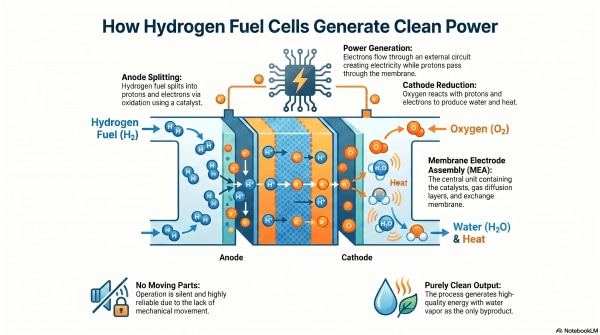 (Image generated using Google NotebookLM))
Story continues below this ad
ECONOMY
Levels of Economic Integration
Core Concept:
— Economic integration refers to the process of harmonising economic policies and activities among different member countries. It is aimed to foster closer economic cooperation and greater collaboration.
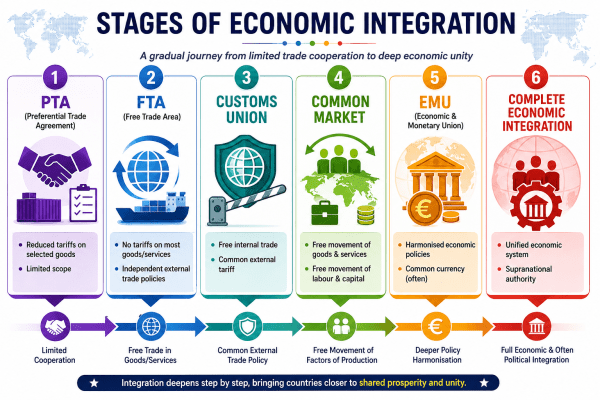
— Economic integration typically occurs in stages. The most commonly recognised levels of economic integration are:
(i) Preferential Trade Agreement (PTA): At this initial stage, countries agree to reduce tariffs and trade barriers on selected goods and services, when trading with each other.
Story continues below this ad
(ii) Free Trade Area (FTA): In a free trade area, participating countries eliminate or substantially reduce tariffs and trade barriers on a broad range of goods and services traded amongst them. However, each country maintains its own external trade policies and can negotiate independent agreements with non-member countries.
(iii) Customs Union: A customs union involves the elimination of internal tariffs and trade barriers among member countries and the adoption of a standard external trade policy. Member countries coordinate their trade policies and present a unified front to non-members.
 (Image generated using AI)
(iv) Common Market: A common market takes integration a step further by not only removing barriers to the movement of goods and services but also allowing for the free movement of factors of production, such as labour and capital, across borders.
(v) Economic and Monetary Union (EMU): In EMU, there is deep integration involving harmonisation of various economic policies, and often a common currency and unified monetary policy.
Story continues below this ad
(vi) Complete Economic Integration: At the highest level of economic integration, countries fully harmonise their economic policies, institutions, and regulations. This stage often involves significant political integration and the creation of supranational bodies with authority extending over member states as well.
📍UPSC Twist Points– Customs Union vs Common Market
— Customs Union: Elimination of internal tariffs with a common external tariff, but no free movement of labour and capital.
— Common Market: Includes a customs union and additionally ensures free movement of goods, services, labour, and capital.
ENVIRONMENT
Breached Planetary Boundaries
Core Concept:
Story continues below this ad
— Planet boundaries are a framework that identifies guardrails for humanity’s impacts on the Earth system. Put simply, it sets limits on how much humans can be allowed to impact not only the climate but also other global processes that are essential for maintaining conditions on the planet to support modern civilisations.
— Developed in 2009, the framework includes nine planet boundaries that scientists believe capture all of the processes critical for maintaining the Earth’s system state.
— These boundaries and their control variables are:
1. Biosphere integrity: The health of ecosystems and rate of extinction of species.
2. Climate change: Atmospheric CO2 concentration and the change in radiative forcing — a measure of the balance of energy from sunlight that hits Earth, in comparison with thermal energy the planet loses.
Story continues below this ad
3. Novel entities: Levels of plastic, concrete, synthetic chemicals, gene-modified organisms, etc., that would not be found on Earth if we humans were not here.
4. Stratospheric ozone depletion: The anthropogenic release of manufactured chemicals that destroy ozone molecules.
5. Freshwater change: It includes an examination of the human-induced impact on blue water (found in lakes, rivers, and reservoirs) and green water (available in the soil for plants and soil microorganisms)
6. Atmospheric aerosol loading: Tracking various particles from anthropogenic emissions that affect cloud formation as well as global and regional atmospheric circulation.
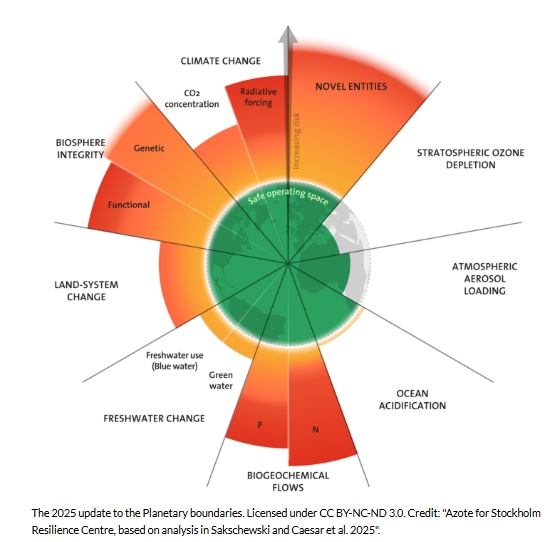
7. Ocean acidification: Reduction in the pH of the ocean over an extended period of time.
8. Land system change: Changes in land use, especially the conversion of tropical forests to farmland.
9. Biogeochemical flow: Alteration in the natural flows and the forms of nitrogen and phosphorus cycles, which are essential elements for plant growth.
— The seven breached planetary boundaries are: Climate Change, Biosphere Integrity, Land System Change, Freshwater Use, Biogeochemical Flows, Novel Entities, and Ocean Acidification (new in 2025). All of these seven boundaries show worsening trends. Only Ozone Depletion and Aerosol Loading remain in the safe zone.
📍UPSC Twist Points– Ocean Acidification vs Climate Change
— Ocean Acidification: The dissolving Carbon Dioxide in seawater forms carbonic acid, decreasing the ocean’s pH. This process is collectively known as ocean acidification.
— Climate Change: According to the Intergovernmental Panel for Climate Change (IPCC), “Climate change refers to a change in the state of the climate that can be identified (e.g., by using statistical tests) by changes in the mean and/or the variability of its properties and that persists for an extended period, typically decades or longer.”
— Notably, ocean acidification and climate change are two separate planetary boundaries.
Prelims Practice MCQ
Let’s see how much can you recall
Consider the following statements:
1. Sustainable Aviation Fuel can be used in existing aircraft engines without requiring major modifications, as it is a drop-in fuel.
2. In a Customs Union, member countries allow free movement of labour and capital among themselves.
3. Ocean acidification is part of climate change boundary
Which of the statements given above is/are correct?
(a) 1 and 2 only
(b) 1 only
(c) 2 only
(d) 1, 2 and 3
ALSO CHECK
UPSC Prelims S.E.E. Snapshot: Dimethyl Ether, CPI overhaul, Tar Balls
UPSC Prelims ‘SEE’ Snapshot : Induction cooktop, Forex reserve, and Earth’s energy imbalance
UPSC Prelims ‘SEE’ Snapshot: Talking cars, GDP rebasing and Nor’westers — quick look
Gear up for UPSC Prelims 2026—Practice smarter, revise faster, and succeed with our Special Quiz Magazine. Click Here
🚨 Click Here to read the UPSC Essentials magazine for April 2026. Share your views and suggestions in the comment box or at manas.srivastava@indianexpress.com🚨
Subscribe to our UPSC newsletter. Stay updated with the latest UPSC articles by joining our Telegram channel – Indian Express UPSC Hub, and follow us on Instagram and X.