


What’s the ongoing story: Prime Minister Narendra Modi on Sunday appealed for collective participation of the people to help the country face global disruptions and challenges, urging measures to reduce the consumption of petroleum products and conserve foreign exchange reserves.
• What exactly Prime Minister Narendra Modi appealed?
• Why did Prime Minister Narendra Modi appeal for the people’s collective participation?
• Why Prime Minister Narendra Modi asked people to refrain from the practice of buying gold during festivals for a year?
• How petroleum products are adding to this strain?
• What is an austerity measure?
Key Takeaways:
• Addressing a public meeting in Hyderabad, the PM asked citizens to use public transport as much as possible, increase the use of electric vehicles (EVs), revive Covid-era measures such as work-from-home arrangements and virtual meetings, avoid non-essential foreign travel and gold purchases for a year, and prioritise local goods, among other measures.
• Referring to measures adopted during the Covid-19 pandemic period, Modi said, “We have developed work from home, virtual meetings, video conferencing and many other methods during corona. We got habituated to it. The need of the hour is to resume those methods.”
Story continues below this ad
• He stressed the need to conserve foreign exchange, and said, “The growing culture of weddings abroad, travelling abroad, and vacationing abroad is becoming prevalent among the middle class. We must decide that during this time of crisis, we should postpone travelling abroad for at least a year…” He urged people to refrain from the practice of buying gold during festivals for a year.
Do You Know
• India is not a gold producer and imports almost all of its gold. Last year, India spent about $72 billion – approximately $6 billion per month – on gold alone. This situation is complicated by gold’s dual role as a consumer import and a reserve asset.
The Reserve Bank of India has been aggressively accumulating gold, adding 168 tonnes from London over the past year to a total of 880 tonnes as of March 2026. Gold currently comprises 16% of India’s total forex reserves, an increase from 10% last year.
• However, household gold purchases have a different economic effect. Unlike the RBI’s reserve-management operations, consumer demand for imported gold directly increases dollar outflows from the economy. Large-scale gold imports can therefore add pressure on India’s current account deficit and increase demand for dollars, which may weaken the rupee over time.
• As dollars flow out, the Indian rupee weakens, making gold even more expensive. This creates a vicious cycle in which the Indian consumer pays more rupees for gold because previous gold purchases have added to pressure on the rupee.
Other Important Articles Covering the same topic:
Story continues below this ad
📍Why PM Modi has asked Indians to reduce spending on gold, petrol, edible oils
Previous year UPSC Prelims Question Covering similar theme:
1) Which one of the following groups of items is included in India’s foreign-exchange reserves? (UPSC CSE, 2013)
(a) Foreign-currency assets, Special Drawing Rights (SDRs) and loans from foreign countries
(b) Foreign-currency assets, gold holdings of the RBI and SDRs
(c) Foreign-currency assets, loans from the World Bank and SDRs
(d) Foreign-currency assets, gold holdings of the RBI and loans from the World Bank
Govt targets homegrown AI systems for defence sector
Preliminary Examination: Current events of national and international importance
Mains Examination: General Studies III: Science and Technology- developments and Awareness in the fields of IT, Space, Computers, robotics, nano-technology, biotechnology and issues relating to intellectual property rights.
What’s the ongoing story: As the Indian defence establishment evaluates the ongoing conflict in West Asia, a compelling need is being felt for the military to have access to domestically-made artificial intelligence (AI) systems, amid a concerted push to decouple from foreign-made technology in strategic sectors, The Indian Express has learnt.
Key Points to Ponder:
Story continues below this ad
• Why the defence ministry is currently in conversations with Indian companies like SarvamAI and BharatGen?
• What exactly Palantir Technologies (PLTR) do?
• Why India is considering Indian version of Palantir?
• How AI effectively can be a game changer for defense?
• What is “intelligentised warfare”?
• What is Intelligence fusion?
• Why India is pushing for indigenous AI systems in the defence sector?
• How Artificial Intelligence is transforming modern warfare from platform-centric warfare to data-centric warfare?
Story continues below this ad
• What are the opportunities and risks associated with integrating AI into military decision-making?
Key Takeaways:
• The defence ministry is currently in conversations with Indian companies like SarvamAI and BharatGen — that have built domestic AI models — on how the technology can be integrated with India’s existing defence capabilities, three senior government officials said.
• “The idea is to have an Indian version of Palantir as soon as possible,” an official said. To invest in a foundational model of our own has a growing strategic imperative, even if we’re behind the curve, another official involved in the broader deliberations said.
• The conflicts in Iran and Ukraine, where the defence forces are said to have used AI effectively to take operational decisions, have shown New Delhi that the technology can be a game changer, not just as a defensive resource, but as an offensive option as well. In the US, systems developed by the likes of Palantir were used in strikes carried out on Iran. The technology has also been used to carry out cyber-attacks on digital infrastructure.
Story continues below this ad
• China, for instance, is rapidly integrating artificial intelligence into military operations as part of the push by the People’s Liberation Army (PLA) towards what’s being described as “intelligentised warfare”.
• Chinese military planners are using AI for battlefield decision-making, autonomous drone swarms, surveillance, target recognition and command systems that can process combat data in seconds. Recent studies of PLA procurement documents show strong focus on AI-enabled command-and-control and reconnaissance systems, aimed at speeding up operations and countering US military advantages. China has also showcased AI-powered robotic “wolf pack” combat systems and autonomous drone platforms.
• The key question though is whether India should rely on existing AI solutions for warfare, with the government and the country’s military establishment believing that domestic options might be the better alternative for strategic sectors such as defence.
Do You Know
• Intelligence fusion in the military refers to the process of aggregating, analysing and integrating data from multiple sources — such as signals, imagery and human intelligence — to create a unified, actionable and real-time picture of threats. This concept is evolving into Intelligence Fusion Systems, which utilise AI and machine learning to rapidly process data, reducing the time from data collection to decision-making.
Story continues below this ad
• One of the reasons behind that is also the money involved in building AI models. General purpose large language models such as those built by companies like OpenAI and Anthropic take substantial investments, with computing alone costing close to $200 million, and data training and annotation costs can take that figure up to $500 million-$600 million.
• Smaller models which are tuned for specific purposes may be cheaper to build comparatively. Indian firms may also struggle in matching compute access that some of their Western counterparts have, although the government has tried to address that handicap by providing them GPUs at discounted usage rates under the IndiaAI Mission.
• What has also irked New Delhi are comments made by senior US administration officials earlier this year, where they insisted that the US expects that its allies, including India, should build their AI solutions on top of the so-called America AI stack.
Other Important Articles Covering the same topic:
📍From training to battlefield: How AI is redefining India’s military capabilities
Story continues below this ad
Previous year UPSC Prelims Question Covering similar theme:
2) With the present state of development, Artificial Intelligence can effectively do which of the following? (UPSC CSE, 2020)
1. Bring down electricity consumption in industrial units
2. Create meaningful short stories and songs
3. Disease diagnosis
4. Text-to-Speech Conversion
5. Wireless transmission of electrical energy
Select the correct answer using the code given below:
(a) 1, 2, 3 and 5 only
(b) 1, 3 and 4 only
(c) 2, 4 and 5 only
(d) 1, 2, 3, 4 and 5
The Second Page
DRDO tests combustor of new hypersonic cruise missile
Preliminary Examination: Current events of national and international importance.
Main Examination: General Studies III: Achievements of Indians in science & technology; indigenization of technology and developing new technology.
What’s the ongoing story: Marking a further breakthrough in hypersonic missile technology for India, the Defence Research and Development Organisation (DRDO) achieved a 1,200-second runtime of its actively cooled scramjet full-scale combustor on Saturday. The test was conducted at the Scramjet Connect Pipe Test (SCPT) facility in Hyderabad, building on the successful 700-plus second test carried out in January.
Key Points to Ponder:
• Know the terms—Infra Sonic, Subsonic, Super Sonic, hypersonic and Ultra Sonic.
• What are Cruise Missiles?
• What speed is a Mach?
• What is Ramjet?
• What is the difference between a ramjet and scramjet?
• Missile Technology Control Regime and India-Know in detail
• What is the history of missile technology in India?
• What kind of missiles does India have?
• Which of India’s missile systems are most important?
• What about hypersonic technology?
• What makes India good in missile technology?
• Where do China and Pakistan stand compared to India?
Key Takeaways:
• The hypersonic cruise missile is capable of exceeding five times the speed of sound, or over 6,100 km per hour, for extended periods. The speed is achieved through a cutting-edge air-breathing engine, which utilises supersonic combustion to sustain long-duration flight.
• The test was conducted at the SCPT facility at the Defence Research and Development Laboratory (DRDL), Hyderabad-based premier facility of the DRDO, which is responsible for the design and development of state-of-the-art Missile Systems and technologies.
• Scramjet combustor incorporates an innovative flame stabilisation technique that holds a continuous flame inside the combustor with an air speed of more than 1.5 km per second. DRDO scientists studied many novel and promising ignition and flame-holding techniques over multiple ground tests before arriving at the scramjet engine configuration.
• With regard to the specialised fuel for the system, the MoD said an indigenous endothermic scramjet fuel jointly developed for the first time by the DRDL and industry partners is central to the breakthrough. The fuel offers dual benefits of significant cooling improvement and ease of ignition.
• Another key achievement amid the development of hypersonic technologies is the development of Thermal Barrier Coating (TBC), designed to withstand extreme temperatures encountered during hypersonic flight. A new advanced ceramic TBC having high thermal resistance and capable of operating beyond the melting point of steel has been jointly developed by DRDL and Department of Science and Technology (DST) facilities.
• Hypersonic weapons have the potential to beat existing air defence systems available with major military powers across the world and deliver rapid and high-impact strikes. Several nations, including the US, Russia, India, and China, are actively pursuing hypersonic technology and have demonstrated various levels of development.
Do You Know
• A ramjet is a type of engine that uses the vehicle’s high speed to compress incoming air, mix it with fuel, and generate thrust without moving parts like turbines. In artillery systems, ramjets allow shells to travel much farther after being fired, extending range without changing the gun itself. This gives armed forces greater reach and flexibility while keeping costs and complexity low.
• A cruise missile is an unmanned self-propelled guided missile that sustains flight through aerodynamic lift for most of its flight path. Cruise missiles are designed to deliver a large payload over long distances with high precision. Modern cruise missiles are capable of traveling at high subsonic, supersonic, or hypersonic speeds, are self-navigating, and are able to fly on a non-ballistic, extremely low-altitude trajectory
• Subsonic refers to speeds slower than the speed of sound (approx. 343 m/s or 1,235 km/h in air at sea level). It is commonly used in aviation, ballistics, and audio to describe movement or frequencies that do not create a shockwave, such as subsonic aircraft, reduced-noise ammunition, or deep bass.
• Supersonic speed is the speed of an object that exceeds the speed of sound (Mach 1).
• Hypersonic speed refers to speeds much faster than the speed of sound, usually more than approximately Mach 5.
Other Important Articles Covering the same topic:
📍Explained: What are hypersonic missiles, and why is Russia using them in Ukraine?
Previous year UPSC Prelims Question Covering similar theme:
3) Consider the following statements: (UPSC CSE, 2023)
1. Ballistic missiles are jet-propelled at subsonic speeds throughout their flights, while cruise missiles are rocket powered only in the initial phase of flight.
2. Agni-V is a medium-range supersonic cruise missile, while BrahMos is a solid-fuelled intercontinental ballistic missile.
Which of the statements given above is/are correct?
(a) 1 only
(b) 2 only
(c) Both 1 and 2
(d) Neither 1 nor 2
Nation
‘Identical words, common signatures’: Gram Sabha resolutions question
Preliminary Examination: Current events of national and international importance
Mains Examination: General Studies III: Conservation, environmental pollution and degradation, environmental impact assessment and Infrastructure and Energy, Ports, Roads, Airports, Railways etc.
What’s the ongoing story: Three Gram Sabha resolutions cited by the Andaman and Nicobar islands administration as proof of tribal consent to divert 166.10 sq km of forests for Great Nicobar project had consent of settlers rather than Nicobarese and Shompen tribes, and signatures of at least 60 persons were found on at least two of the three resolutions.
Key Points to Ponder:
• Map Work- Andaman and Nicobar Islands in general and Great Nicobar Island in particular, Barren Island, Ross Island, Eastern most and southern most point
• What tribe are in the Great Nicobar?
• What you know about Shompen and the Nicobarese?
• The ‘draft master plan for Great Nicobar Island Development Area, 2047-what you know about the same?
• What are the issues related to the Great Nicobar Island Development Area Project?
• Analyse the trade-offs between development and conservation in the Great Nicobar Island Project.
• How the Great Nicobar Project can enhance India’s maritime security?
• How the Great Nicobar Project can impact on the Shompen and Nicobarese tribes?
• What is the conservation status of leatherback sea turtle, long-tailed macaque, coconut crab and Nicobar megapode?
• What do you understand by the term ‘Environmental Impact Assessment’ (EIA)?
• Environmental Impact Assessment (EIA) and Environment Protection Act, 1986-How they are related with each other?
• Why Environmental Impact Assessment (EIA) is Important?
• How many islands are there in Andaman and Nicobar?
• Know the names of Eastern most and southern most point in the Andaman and Nicobar island?
• Name the water body that separates Andaman Islands from the Nicobar Islands
• What is special about Barren Island?
• What is special about Ross Island?
Key Takeaways:
• These submissions were made before the Calcutta High Court’s Port Blair bench by the petitioner, former union government secretary Meena Gupta, who has filed a PIL alleging illegalities in the islands administration’s order claiming compliance of Forest Rights Act (FRA), 2006 for the mega project.
• In an order that was made public on Friday, the Calcutta High Court division bench headed by Chief Justice Sujoy Paul overruled the Centre’s objections on the maintainability of this and two other petitions, and agreed to hear them.
Do You Know
• Great Nicobar Island covers 910 sq km and is home to India’s southernmost location, Indira Point. The government’s main goal on the island is to create an economic and defence hub. This goal rests on four pillars: An integrated township that will include defence facilities, a transhipment port, a civil and military airport, and a 450-MVA gas and solar power-based plant. Initially driven by NITI Aayog, the project’s implementing agency is now the Andaman and Nicobar Island Integrated Development Corp Ltd (ANIIDCO).
• Of the cumulative area earmarked for the project, around 149 sq km will be used for the integrated township, 8.45 sq km for the new airport, 7.66 sq km for the port and .39 sq km for the power plant.
• The integrated township will include residential, commercial, tourist, logistics and defence facilities. The transshipment port will be located on the southern tip of Great Nicobar at Galathea Bay, an ecologically important area that is home to the nesting sites of Leatherback turtles, and where the Galathea River drains into the sea.
• The dual-use international airport is proposed to the east of the port. It will be the second one on the island after the Navy’s airstrip at INS Baaz Naval Air Station. The airport will require the acquisition of 4.2 sq km of land and affect 379 families, largely those who have settled on the island from the mainland. Land reclamation has also been proposed for the port and the airport. An estimated 2.98 sq km of land will be reclaimed for the port and 1.94 sq km for the airport. It is also estimated that 33.35 million cubic metres of material will be required for this purpose. Cement, rocks, sand, steel will have to be shipped to the construction sites, according to the 2021 pre-feasibility report that was prepared by AECOM India Pvt Ltd for NITI Aayog.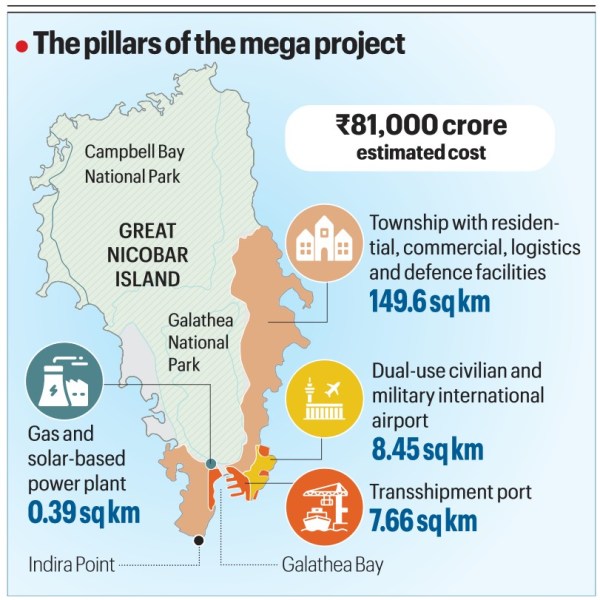
• The Centre’s push for the project appears to be driven by three key factors: geopolitics, maritime trade and geographic advantage.
—The Great Nicobar island is India’s closest territory to the Malacca Strait, a narrow maritime choke point linking the Indian Ocean and the Pacific Ocean. This trade route sees 94,000 ships pass through it annually, according to the World Economic Forum. It accounts for an estimated 30% of all traded goods globally and a third of the world’s maritime oil trade.
—Transshipment ports are equipped to transfer cargo containers from larger to smaller vessels before they head to their eventual destination. India has only one operational transshipment port at Vizhinjam in Kerala, on the west coast.
—The port at Galathea Bay will thus contest for a share of the maritime trade pie with Sri Lanka’s Colombo and Hambantota ports, Malaysia’s Port Klang, and the Port of Singapore.
The government has projected that the Nicobar port can handle approximately 14.2 TEU (twenty-foot equivalent unit) of cargo — this means it can handle 14 million 20-foot containers every year.
• A tri-services Andaman and Nicobar Command has been operational at Port Blair since 2001. The INS Baaz Naval Air Station is also located at Campbell Bay, north of the proposed township. The project plans show that defence-related infrastructure will be part of the first of three construction phases.
Other Important Articles Covering the same topic:
📍As NGT clears Great Nicobar project, a look at its strategic importance and ecological fallout
Previous year UPSC Prelims Question Covering similar theme:
4) Consider the following statements: (UPSC CSE, 2018)
1. The Barren Island volcano is an active volcano located in the Indian territory.
2. Barren Island lies about 140 km east of Great Nicobar.
3. The last time the Barren Island volcano erupted was in 1991 and it has remained inactive since then.
Which of the statements given above is/are correct?
(a) 1 only
(b) 2 and 3
(c) 3 only
(d) 1 and 3
5) Which one of the following pairs of islands is separated from each other by the ‘Ten Degree Channel’? (UPSC CSE, 2014)
(a) Andaman and Nicobar
(b) Nicobar and Sumatra
(c) Maldives and Lakshadweep
(d) Sumatra and Java
Previous year UPSC main Question Covering similar theme:
📍Environmental impact assessment studies are increasingly undertaken before the project is cleared by the government. Discuss the environmental impacts of coal- fired thermal plants located at Pitheads.(2023)
The Ideas Page
eVs in India have moved on subsidies. Delhi policy shows clearer path
Preliminary Examination: Economic and Social Development
Mains Examination: General Studies II: Government policies and interventions for development in various sectors and issues arising out of their design and implementation.
What’s the ongoing story: Amitabh Kant Writes– India’s transition to clean mobility has reached a decisive moment. Within the span of a week, two critical policy developments unfolded.
Key Points to Ponder:
• EV Policy in India-what you know?
• Delhi EV Policy 2.0-know about the same
• What is Corporate Average Fuel Efficiency (CAFE) norms in India?
• Why two-wheelers and three-wheelers are central to India’s EV transition?
• “India’s EV transition is gradually shifting from subsidy-driven adoption to regulation-driven transformation”-what is your opinion?
• What are the limitations of subsidies as the primary instrument for promoting electric mobility in India?
Key Takeaways:
Amitabh Kant Writes-
• The Government of Delhi released its draft EV Policy 2.0 for public consultation, and the Bureau of Energy Efficiency (BEE) circulated a revised draft of the CAFE-3 norms to industry stakeholders. Each of these is significant. The next few months will determine whether India can move from incremental progress to large-scale transformation.
• Delhi has once again set the pace. Historically, the capital has often incubated urban transport innovation. Its early adoption of metro rail created a template for the country. Its transition to modern bus systems reshaped public transport expectations. In electric mobility, Delhi’s first EV policy in 2020 became a benchmark for other states. The new draft builds on that legacy, but more importantly, it marks a shift in approach.
• The most important element of the policy is the proposed phase-out of internal combustion engine vehicles in key segments. The plan to stop new registrations of ICE three-wheelers from January 2027 and two-wheelers from April 2027 is an ambitious and strategic intervention as the segment constitutes almost three-fourths of motor vehicle sales in Delhi. It moves beyond incentives and establishes a clear regulatory direction. This distinction is critical.
Do You Know
Amitabh Kant Writes-
• India’s EV journey so far has relied heavily on subsidies. While these have played an important role in market creation, they have not delivered scale on their own. What drives sustained adoption is certainty. When the industry knows that a transition is inevitable, it invests accordingly in manufacturing, supply chains, and innovation. Consumers, in turn, respond to falling costs and improved availability. Global experience reinforces this. Jurisdictions that have achieved rapid EV adoption have done so by combining incentives with clear phase-out timelines. India has been cautious in embracing this approach. Delhi’s draft policy signals a departure from that caution. It is a step in the right direction, and one that other states would do well to study closely.
Other Important Articles Covering the same topic:
📍Knowledge Nugget | India’s Push for Electric Vehicles: Types of EVs and policy measures
Previous year UPSC Prelims Question Covering similar theme:
6) Consider the following types of vehicles: (UPSC CSE, 2025)
I. Full battery electric vehicles
II. Hydrogen fuel cell vehicles
III. Fuel cell-electric hybrid vehicles
How many of the above are considered as alternative powertrain vehicles?
(a) Only one
(b) Only two
(c) All the three
(d) None
7) In the context of electric vehicle batteries, consider the following elements: (UPSC CSE, 2025)
I. Cobalt
II. Graphite
III. Lithium
IV. Nickel
How many of the above usually make up battery cathodes?
(a) Only one
(b) Only two
(c) Only three
(d) All the four
Previous year UPSC Mains Question Covering similar theme:
📍How is efficient and affordable urban mass transport key to the rapid economic development in India? (2019)
Explained
Who counts India’s road accident deaths, why data see discrepancies
Preliminary Examination: Economic and Social Development-Sustainable Development, Poverty, Inclusion, Demographics, Social Sector Initiatives, etc.
Mains Examination:
• General Studies II: Issues relating to development and management of Social Sector/Services relating to Health, Education, Human Resources.
• General Studies III: Infrastructure: Energy, Ports, Roads, Airports, Railways etc.
What’s the ongoing story: While India continues to be the top nation in terms of total fatalities from road accidents, these deaths often end up being just plain statistics that can be disputed.
Key Points to Ponder:
• Road Accidents in India-Know Broad Profile of Road Accidents
• What are the data sources for accident data?
• What could explain the disparity in data?
• Why Road Safety is must in India?
• What position does India have in terms of Road safety?
• Road accidents are multi-causal phenomenon and are the result of an interplay of various factors-What are those factors?
• What are the Initiatives Related to Road Safety?
• What actions are being taken by the Supreme Court of India in the matter of Road Safety?
• What are the Initiatives Related to Road Safety at national as well at international level?
• What is ‘Brasilia Declaration on Road Safety’?
• What is the Significance of Road Safety in India?
Key Takeaways:
• The data on road accidents and fatalities are released every year by two central agencies- the Ministry of Road Transport and Highways (MoRTH) and the National Crime Records Bureau (NCRB). But there has been a persisting mismatch in these figures for many years, varying to the tune of thousands of deaths.
• The MoRTH report for 2024 says that a total of 1.77 lakh people died in road accidents across the country. Whereas the NCRB’s “Accidental deaths & suicide in India” report, released online on Wednesday (May 6), says that 1.75 lakh people died during the period. “Crime in India”, another report by the NCRB, which records deaths due to negligence relating to road accidents, shows that 1.81 lakh people lost their lives in road crashes in 2024.
• The mismatch is not unusual. An analysis of the last five years of data shows that, barring 2023, the number of road fatalities varied across reports. This trend has continued even when the road transport ministry rolled out its ambitious Electronic Detailed Accident Report (e-DAR)/Integrated Road Accident Database (iRAD) system in 2021-22, with the intent of collecting real-time data entered by the police.
• While the difference may not appear large, the gap rises to nearly 4,000 deaths over the period under analysis. Since it involves human lives, each disparity should be treated seriously and with concern, say analysts tracking the numbers.
Do You Know
• In an accident, the policeman, who is typically the first responder, is regarded as the best source of primary data. One may also rely on data from hospitals and state transport departments.
• The Transport Research Wing (TRW), a division of MoRTH, collects accident data from the state police departments in formats provided by the United Nations Economic and Social Commission for Asia and the Pacific (UNESCAP) under the Asia-Pacific Road Accident Data (APRAD) base project. It collects 21 types of data from the police, including accident identification, details of the road, the vehicle and its driver. This data is used in four of its important publications, including Road Accidents in India.
• The NCRB, on the other hand, collects the data from State Crime Record Bureaus (SCRBs). The SCRBs collect data from District Crime Record Bureaus (DCRBs), which in turn get the data from the police stations. The source of both departments’ data is the same.
In case of death by negligence due to an accident, the police FIR would register the crime under section 304-A of the Indian Penal Code (IPC), now under section 106 of Bharatiya Nyay Sanhita (BNS).
According to the WHO’s global status report, even internationally, around 50% of reporting countries relied on police data, 7% on the health departments and another 11% from transport departments.
• According to the World Road Statistics by the International Road Federation, India continues to be the top country in total people
killed due to road accidents, followed by China and the United States. Iran has the highest rate of persons killed per lakh population. Several countries, such as Pakistan, Nigeria, Ethiopia and China, have lower rates of persons killed per one lakh population than India.
Other Important Articles Covering the same topic:
📍Knowledge Nugget: Road Accidents in India — Causes, reports and UPSC relevance
How new DRDO system helps air missiles fly longer, strike better
Preliminary Examination: Current events of national and international importance.
Mains Examination: General Studies III: Achievements of Indians in science & technology; indigenization of technology and developing new technology.
What’s the ongoing story: The Defence Research and Development Organisation (DRDO) and the Indian Air Force (IAF) on Thursday (May 7) successfully carried out the first flight trial of a system that can transform an unguided missile into a guided one.
Key Points to Ponder:
• What is Tactical Advanced Range Augmentation (TARA) system?
• How does the system work?
• What is the Strategic and logistic significance?
• How attachable propulsion systems can enhance the operational capability of air-to-air missiles?
• Know the role of indigenous innovation in strengthening India’s missile ecosystem.
• What are the challenges India faces in developing advanced indigenous missile technologies?
Key Takeaways:
• The homegrown Tactical Advanced Range Augmentation (TARA) system is essentially a kit that can be attached to a conventional missile. This kit helps the missile glide over long distances, and accurately strike a target. Here’s a look at why this system is strategically important.
• The TARA glide weapon system is primarily a modular kit that can be attached to a conventional unguided warhead. DRDO scientists say the system can be fired from multiple fighter jets in the IAF’s service.
• The TARA system was tested from an IAF fighter off the coast of Odisha. TARA has been designed and developed by the Hyderabad-based DRDO facility Research Centre Imarat (RCI) in collaboration with other DRDO laboratories and industry partners.
• The successful flight trial is a critical milestone in the weapon’s development. This will pave the way for a series of developmental, validation and user trials before induction into the service. All these trials will evaluate the system’s guidance accuracy, range, reliability, performance from different platforms, and effectiveness under varied operational conditions.
Do You Know
• The TARA glide weapon system is primarily a modular kit that can be attached to a conventional unguided warhead. DRDO scientists say the system can be fired from multiple fighter jets in the IAF’s service. Once released from an aircraft at a certain altitude and speed, foldable wings and aerodynamic surfaces come into play, allowing the weapon to glide over long distances instead of falling directly onto the target. An on-board navigation and guidance system corrects the missile’s flight path to improve its accuracy.
• Strategically, TARA is significant because it enhances the IAF’s stand-off strike capability. This means an aircraft can hit targets from a distance that puts it out of the reach of air defence systems. In a battlespace, the capability to accurately strike a target from a distance can increase the chances of a fighter jet’s survival and lend it greater flexibility.
• Unguided bombs, which are referred to as gravity bombs or dumb bombs, can thus be upgraded to smart bombs, or precision-guided munitions, with relatively low effort. This can reduce the need to develop entirely new missile systems. This approach can substantially reduce costs while allowing rapid scaling of precision strike inventory.
• The use of indigenous low-cost systems and its production by Indian industry partners will also reduce import dependence. It is learnt that three TARA versions, with different weight variants, are being produced. These are to be used with warheads of different weights ranging from 250 to 500 kg.
Other Important Articles Covering the same topic:
📍Southern Command conducts successful long-range precision launch of BrahMos missile
|
PRELIMS ANSWER KEY |
|
1.(b) 2.(d) 3.(d) 4.(a) 5.(a) 6.(c) 7.(c) |
For any queries and feedback, contact priya.shukla@indianexpress.com
Subscribe to our UPSC newsletter. Stay updated with the latest UPSC articles by joining our Telegram channel – IndianExpress UPSC Hub, and follow us on Instagram and X.


